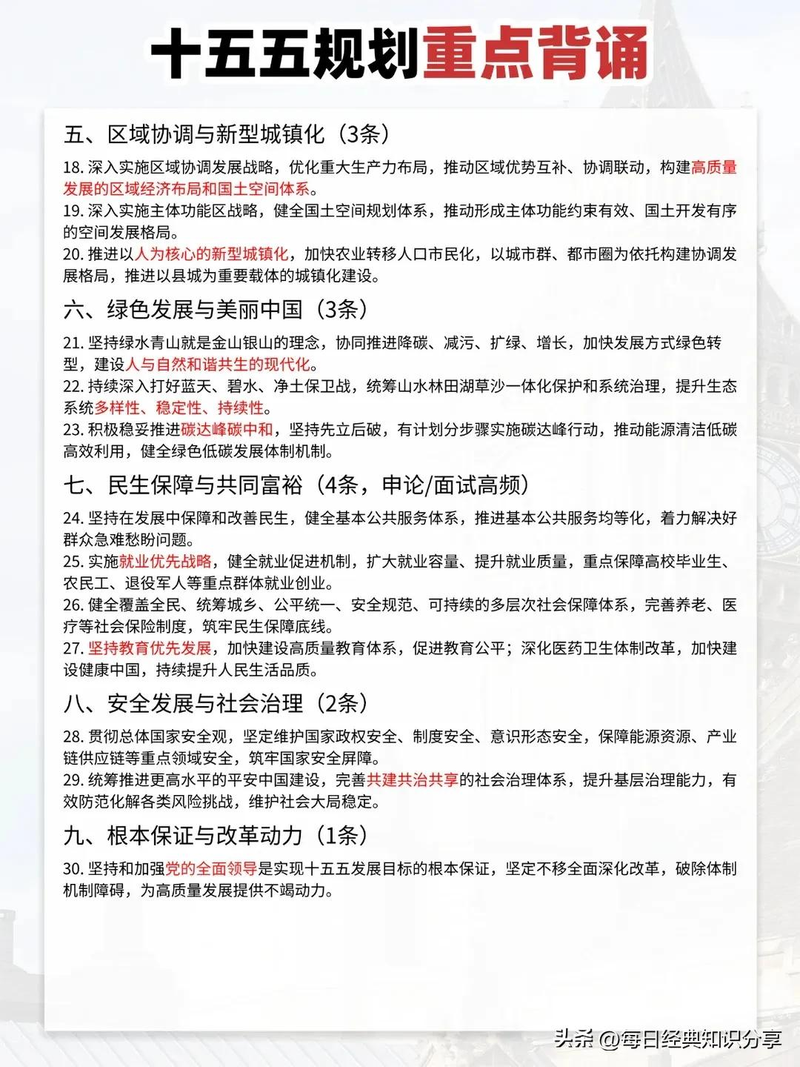
The “fifty-fifth five” period (2026-2030) was a crucial five-year period for the full construction of a modern socialist state and a central source of political rhetoric in the various examinations. This 30 core points, all of which are drawn from the original official planning proposal, are empty, non-exaggerated, focused on high frequency (hf) points, practical information, easy-to-understand logic, which can be used both for written questions and for opposable writing to help you catch up quickly on the main development line for the next five years。
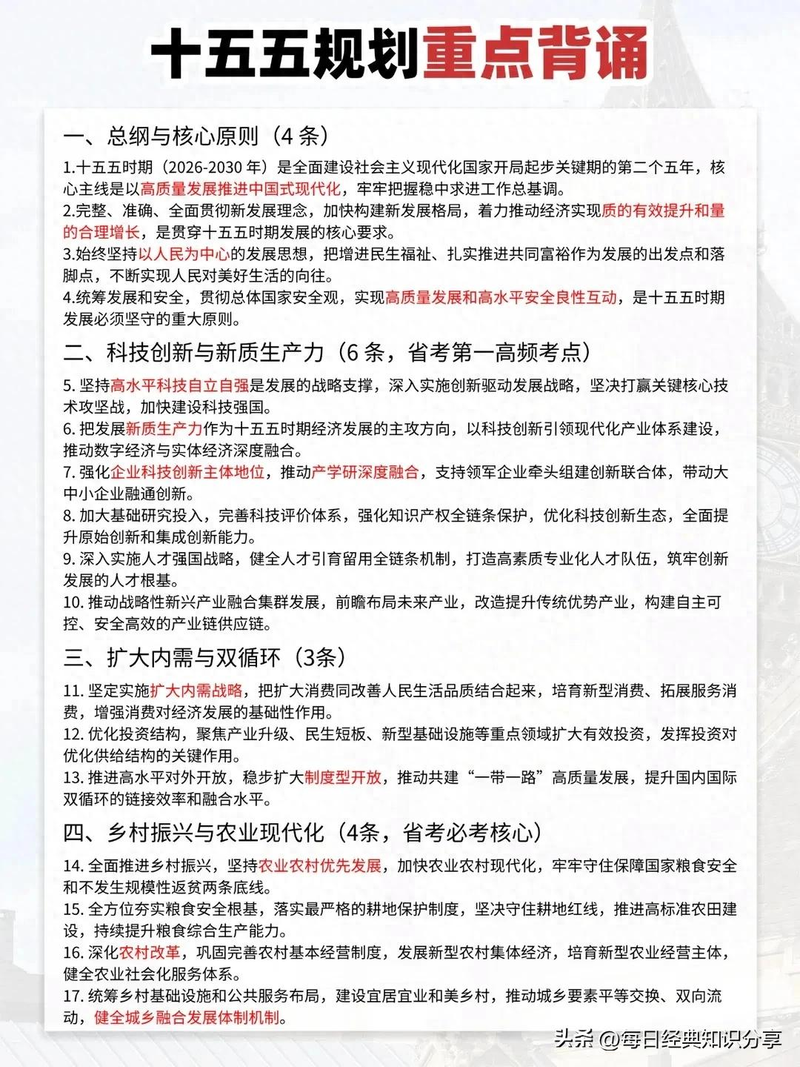
1. General positioning: fifteen-five is the key five years since the beginning and the foundations of modernization in 2035。
2. Masterline: integrated development and security, with high-quality development as the theme。
3. Overall objectives: quality development, science and technology self-reliance, reform breakthroughs, human quality, beautiful china, national security。
4. First priority: to build modern industrial systems and strengthen the real economy。
5. Maintain a reasonable share of manufacturing and promote intellectualization, greening and integration。
6. Implementation of industrial infrastructure rehabilitation projects to improve the resilience of the industrial chain supply chain。
7. Fostering advanced manufacturing clusters and promoting the upgrading of traditional industries。
8. Growing strategic and new industries, moving ahead with future industries。
9. Core dynamics: accelerating high-level science and technology self-reliance and leading the development of new quality productivity。
10. Improving new national institutions and breaking through key core technologies。
11. Focused coverage: integrated circuits, industrial carriers, high-end instruments, basic software, advanced materials, etc。
Integration of education, science and technology, and the integration of talent。
13. Strengthening national strategic science and technology and optimizing the national laboratory system。
Strategic basis: expand domestic demand and build strong domestic markets。
15. Building a single national market to break down local protection and administrative barriers。
16. Promote consumption upgrading and synergistic growth between consumption in kind and service consumption。
17. Expand effective investment to focus on livelihoods and new infrastructure。
18. Deepening economic institutional reforms and maintaining effective market integration with government。
19. Promoting a high level of openness to the outside world and steadily expanding systemic openness。
20. Fully promote the overall revitalization of villages and guarantee food and vital agricultural security。
21. Optimizing the regional economic landscape and promoting regional coordination and rural-urban integration。
22. Promote new people-centred urbanization。
23. Strongly promote common prosperity and greater human security。
24. Implement employment priority strategies to support employment entrepreneurship among priority groups。
25. Improve income distribution patterns and increase income for low-income groups。
26. Sound public service systems such as education, social security, medical care, old age, nursing, etc。
27. Promote a green, low-carbon transformation that combines carbon reduction, pollution reduction, greening and growth。
28. The blue sky, the water and the clean land war were fought in depth。
29. Integrated development and security, maintaining economic, financial, data and industrial chain security。
30. Consolidation of the national strategic system and capacity for integration and strengthening of defence。
These 30 items cover the economic, technological, industrial, livelihood, ecological and safety sectors, and are logical and focused, and are high-frequency case files for examinations of civil servants, enterprises, state enterprises, etc. Unlike sporadic memories, these elements are interrelated and understand logic more efficiently than hard to remember, responding to objective questions and serving as a central argument for argument and interview。
Having the core points is only the first step, which are the easiest to make a brief answer or address? What are the terms that can be confused and often dug? These details of points hidden in the text are the key to opening the gap。