


In 2026, central i was officially published as the first three-farm platform document of the 15th opening session, focusing on the 14th consecutive theme of “three-farm” and directly targeting the core of the national examination, the provincial examination, the enterprise, and three one-strength propositions this year. From the issue of common sense to the general summary, the articles, to the comprehensive analysis of the interviews, the organization of the programme, the high-frequency hits of the subject and the penetration of the document are equal to a 30+ score in advance。
The paper is not read in full, is not taken in piecemeal form, and is broken down by three panels, based on a schematic of the points of assessment, a high-scoring template, and a response framework for interviews。
I. Common sense: 20 core points and direct seconds prior to examination select
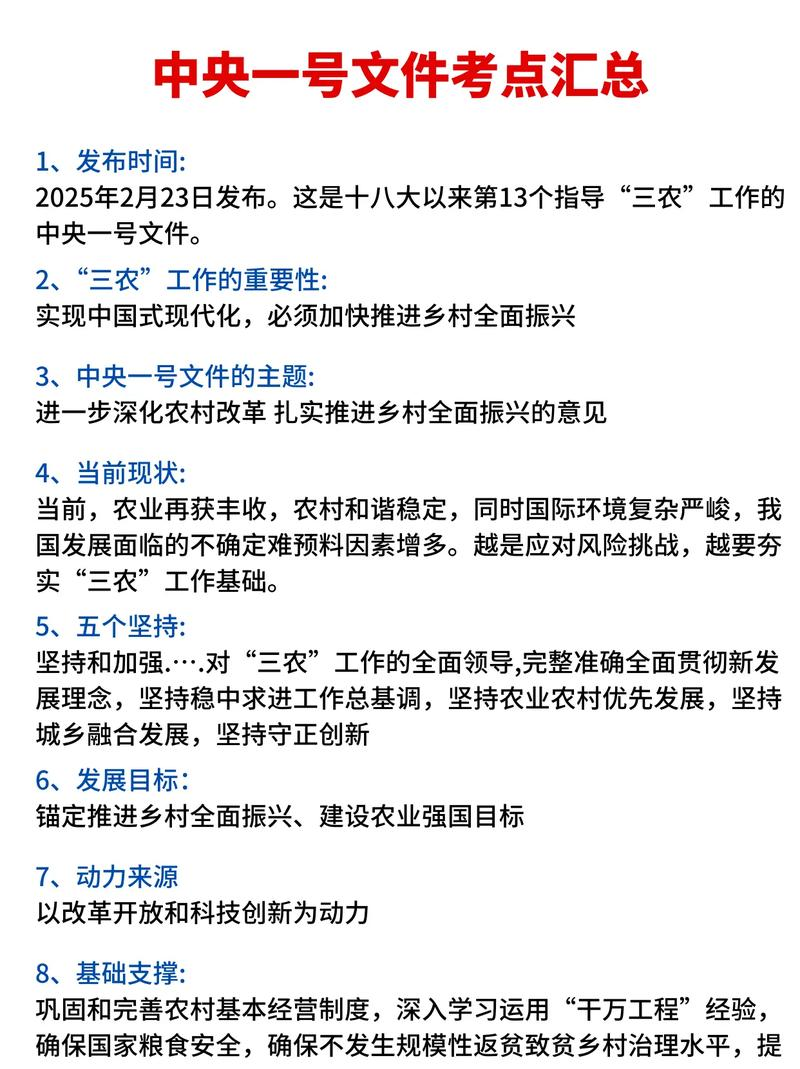
In common sense, central i appears in a single, multi-selective form, focusing on core positioning, key data, proprietary terms, policy red lines, without having to go back, bearing in mind the 20 points:
1. Document theme: stabilizing rural agricultural modernization and solid promotion of overall rural revitalization
Core positioning: the 14th central document guiding the work of the three farmers since the eighteenth century
3. General hand: promoting comprehensive rural revitalization
Lead experience: learning to apply the “millions of works” experience
Fundamental drivers: innovation for change
6. Food security core: a new round of action to upgrade food production capacity
Red line for cropland: strict red line for cropland protection, firm containment of “de-farming” and effective prevention of “de-foodization”
8. Anti-poverty mechanisms: sound monitoring of the dynamics of anti-poverty prevention and precision support mechanisms
9. Farmers ' income generation: broadening wage, business, property, transfer income channels
10. And the villages of america: the development of niche and meio-rural development, with a view to eliminating the thousands of villages
11. Building agricultural housing: promoting modern, liveable agricultural housing and sustainable rural housing rehabilitation
12. Agrarian reform: the orderly promotion of land for collective rural construction and the prohibition of commercial housing development
13. Home base management: enhanced approval management and rigorous inspection of the purchase of farm houses and home bases in violation of the law
Rural governance: promoting the `party-building + grid' model and implementing the new era's maple bridge experience
15. Accountability: implementation of the five-level secretary's responsibility for rural revitalization production
16. Agricultural science and technology: strengthening the revival of farming industries and advancing the critical core technologies in agriculture
17. District industries: development of the wealthiest industries in the counties and development of the union of agricultural and rural benefits
18. Digital villages: promoting rural digital infrastructure and developing rural electricians and intelligent agriculture

19. Village culture: furthering the implementation of the construction of a civil society village to promote the peaceful rule of law
20. Performance orientation: optimizing rural revitalization strategies, highlighting effectiveness and reducing burden at the grass-roots level
Scrutiny techniques: the memory of the six clusters of “positioning-bottom-receiving-building-reform-governance” with 3-4 keywords per group, a quick rewinding of the first 10 minutes, and an increase of 90 per cent in common sense accuracy。
Ii. Communication: 4 sets of universal templates, summary/response/writing directly applied
Central i is the descriptor's library, the logical framework library, the high-specific sentences library. The four-problem types apply the template directly, leave the oralization and encapsulation of questions, and easily break the upper limit of the two。
1. Summarizing the title: replace the normative term and increase the accuracy of the summary
The material is spoken in terms of the standard language of the document, and the viewer identifies the policy profile:
- there is a single source of low-income income for farmers and a weak coalition of farmers all
- poorly adapted rural environment and inadequate long-lasting care mechanisms
- low level of industries with no characteristics and high level of homogenous competition
- inadequate enforcement at the grass-roots level and inadequate implementation at the local level
- high risk of return to poverty monitoring and poor early warning and effectiveness of regularized assistance
High-scoring formula: core issues + document normative terms, for example: “the problem of non-foodification of cultivated land is prominent in some areas, food production is less efficient and food security is more stressful”。
2. Presentation of the response issue: a six-dimensional framework, with no loss of logical integrity
Directly following the logic of the document's response, without having to collage itself to cover the full dimension points:
A bottom-line industry that boosts growth and improves environmental security
Each response is written as “objective + initiative + mechanism”, for example:
** broadening farmers ' access to revenue and revitalizing people's livelihoods. **developing the wealthiest industries in the counties, promoting the processing of agricultural products and the upgrading of the integration of rural tourism; improving the bonding of interests in order farming, joint-stock cooperation, etc.; enhancing skills training for farmers, broadening access to employment, and allowing farmers to share in the value added benefits of the industry。
3. Follow-up on the implementation of the international convention on the elimination of all forms of racial discrimination
High frequency (hf) languages: job reports, initiatives, research reports, short evaluations, general beginnings directly:
- at the beginning: in order to follow up on central i of 2026 and implement a comprehensive rural revitalization deployment, work xx is as follows:
- end of sentence: implementation with a hard-on spirit to speed up the construction of fit-for-living and beautiful villages and to provide solid support for the modernization of rural farming。

4. Topics of the article: the universal framework, no problem, no depth
Almighty title:
- stabilizing rural agricultural modernization. Chapter
- led by the "millions of works" experience to build a liveable and beautiful village
- the mandarin ballasts activate the country's new kinetic energy
Standard 5 framework:
Starting: documentation + general arguments: separatism 1: maintaining the food security bottom line: construction of a residence-friendly and a rural-american division 3: end of deep reform revitalizing internal dynamics: upgrading to agricultural power, china modernisation
It's a gold sentence:
1. Agricultural work, national outline。
2. In order for the nation to recover, the village must be revitalized。
To secure the base plate of the three farmers and to build solid and stable ballast。
4. To promote rural development in a manner consistent with local conditions, gradual and long-standing efforts。
5. Making agriculture a dynamic industry, making farmers attractive occupations and making rural areas a beautiful home for well-being。
Iii. Interview responses: five high frequency (hf) features, frame + speech directly back
In interviews, central i documents focus on integrated analysis, planning organization, emergency response, scenario simulation, interpersonal communication in five broad issues, combining grassroots workspace scenarios with a framework + voice, and high-level, off-site response。
1. Comprehensive analysis (necessary)
Response framework: short-term policy implications and implementation initiatives
Reference: central i of 2026 anchors the general objective of agricultural rural modernization and sets out a road map for rural renewal. The spirit of the document needs to be kept to the bottom line of food security, the expansion of county-based industries, and the construction and development of villages in the united states in order to transform innovation to solve development challenges and promote new breakthroughs in the overall revitalization of villages。
2. Organization of the plan
High frequency propositions: organization of food security advocacy, research on rural construction in the united states, skills training for farmers
Response framework: pre-preparation medium-term implementation of long-term end-effect alignment of document requirements
Core points: policy literacy is reflected in the inclusion of key words such as “normally refined assistance” “locally appropriate” “unanimous farming”。
3. Emergency response issues
High-frequency propositions: non-food rehabilitation of cropland, resistance of farmers to new farm improvements, risk disposal of poverty
Response framework: remedial emotional surveys verify long-term control of legal disposition
Core points: maintaining the policy red line, balancing the interests of the population, and implementing the requirements of “soft law enforcement, precision support”。
4. Scenario simulation
Hf proposition: to persuade farmers to participate in high-standard farm construction, to promote new varieties and to participate in the remediation of the habitat environment
Query: policy benefits combined with real benefits and guaranteed commitments, with the deployment of the document “safeguarding food earnings and improving the human settlements environment”。
5. Interpersonal communication
High frequency proposition: implementation of policy by grass-roots cadres in conflict with popular demands, cross-sectoral synergy to advance village projects
Response framework: thinkover communication coordination and synergetic implementation of long-term linkages
Core point: to reflect the concept of governance as a “five-level secretary to revitalize” and “shared governance”。
Four, 30 days of efficient refresher programme, 15 minutes a day. Min
- days 1-7: recitation of common sense points, four points per day with five time simulations topic
- days 8-15: a theoretical template exercise, rewriting of the answer with the latest three years of rural revitalization, strengthening the use of normative terms
- day 16-22: interview framework recited, one high frequency (hf) feature per day, integration key word
- 23-30 days: subject-wide model, document entry test, gap check
V. The three principles of place survey, enhancing inspection
1. Non-full recitation: recitation of keywords, normative expressions, core data only, rejection of verbatim memory
2. Non-segregation of material: material information extracted from the presentation of questions and then upgraded in document format, no hard stacking policy
No confusion: distinguishing between “normally refined assistance” and poverty alleviation, “collectively run construction land” and home base, with precise terminology
And finally
In 2026, the central document was the scoring code for the entire subject, measured common sense seconds, the presentation of points, and the high-profile interview questions, so that the detaching content could be quickly exported from the examination。
Precision is more important than blind efforts on the way to the examination, and the translation of document points into answerable capabilities will enable them to emerge from intense competition and to land successfully。



