


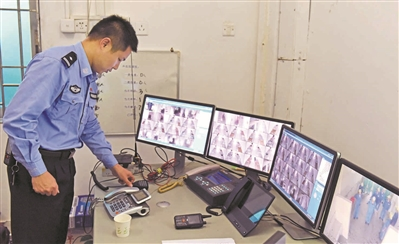
Police specializing in aids addiction on duty in the control room。
On 1 december this year, the 31st world aids day, the theme of the event was “initiative testing, aids awareness, shared health”。
The provincial health board informed that guangdong had largely contained the rapid increase in the aids epidemic, with overall aids epidemic control at low levels throughout the province, with 39. 3 per cent fewer people reported infected with injecting drug use in 2017 than in 2012, especially with blood transfusions and blood products reaching zero, while the rate of mother-to-child transmission of aids fell to 4. 7 per cent of the lowest ever。
Wen/guangzhou daily
All media journalists, ho xuehua, wu xian
The correspondent, rin wei-shin
Second-year male screening for hiv:
I'm clean. I'm confident
The 31st world aids day on 1 december this year. In the morning, a campaign on the theme “world aids day” in guangdong province was held at the south china polytechnic university, where presentations were made on the occasion of the “consultative month of hiv testing in guangdong province” and the “third youth aids counselling and testing monthly school tour service in guangzhou city”。
The general population is increasingly at risk due to the fact that the current pattern of hiv transmission in guangdong province is dominated by heterosexual transmission. The expert recommends that people at high risk of behaviour, as well as marriage and pregnancy tests, should be tested for aids. The centre for disease prevention and control of guangzhou has developed an appointment platform for hiv counselling and testing, which allows citizens to make appointments for testing by telephone, computer or micro-credit。
At the site of the event, the cdc and social organizations set up booths to promote hiv/aids awareness. At the aids rapid testing stand, a university student in the city's second-year high school, kosuke kosuke, took the test in the media: “i have no girlfriend and i have no tattoo. I believe i'm safe because i've always loved myself." he said that he was also an hiv/aids advocacy volunteer in school and therefore wanted to experience the aids screening process first-hand. Aware of the trend towards increasing the proportion of young students in new cases, he hoped that more awareness-raising campaigns on hiv/aids would be conducted in schools in the form that students liked。
The results are clear:
It's almost zero blood
According to the provincial health board, the overall aids epidemic was contained at a low prevalence level throughout the province during the period of the 13th five-year plan, and the rapid increase in the epidemic was largely contained, with clear results。
Specifically, transmission through blood transfusions and the use of blood products was close to zero reported; the number of people reported infected with injecting drug use decreased by 39. 3 per cent in 2017 compared to 2012 and the rate of new hiv infections in drug dependence maintenance was maintained at less than 0. 2 per cent of the treatment population; the rate of mother-to-child transmission of aids fell from 6. 8 per cent in 2013 to 4. 7 per cent in 2017, the lowest rate ever; the number of people tested increased from 7. 7 million in 2012 to 1. 86 million in 2017; the number of people receiving antiretroviral treatment increased from 9410 in 2012 to 44190 in 2017; and the coverage of antiretroviral treatment in 2017 stood at 82. 6 per cent and the success rate of treatment remained above 90 per cent. In addition, the involvement of social groups, volunteers and enterprises in the fight against aids has been further boosted, social discrimination is decreasing and the social environment for combating aids is improving。
The situation remains critical:
Sexual transmission is the main mode of transmission
The provincial health board noted that the current situation in the province with regard to hiv/aids is still critical and that the task of combating it is daunting. In accordance with the classification criteria for the level of hiv prevalence in china, the province is classified as a “category i province” and as a province with a higher prevalence。
In january-october 2018, there were 9011 newly detected cases of hiv infection (hiv) and aids (aids) throughout the province, of which 6262 were infected and 2749 were patients, an increase of 1. 0 per cent and 4. 1 per cent, respectively, over the same period last year; and 1,395 newly reported deaths, an increase of 0. 9 per cent over the same period last year。
As of october 2018, guangdong had cumulatively reported 60,324 cases of hiv infections and patients living in the province, of which 24147 cases were aids patients and 18848 deaths were reported. Cumulatively, the number of survivors and patients is the fourth highest in the country。
In guangdong province, it is described that the overall prevalence of aids is low and that some parts of the population are more serious; sex transmission throughout the province is the main mode of transmission, mainly heterosexual transmission, which in january-october 2018 was reported to be 61. 6 per cent of infected persons and 31. 3 per cent of male homosexual transmission; the proportion of cases in the higher age group over 50 years of age and among young people continues to increase; and the proportion of infected persons and patients who are mobile is high and difficult to manage。
Combating aids in society:
Promotion of the one dragon service
In view of the fact that sexual transmission is the province's main route of transmission of aids, which is wide-ranging and has a complex and diverse impact, the provincial health board has proposed that prevention and control measures must be strictly implemented。
First of all, the public security services should step up their efforts to combat criminal activities such as prostitution, prostitution and drug and drug trafficking by strengthening the comprehensive management of sexual transmission and injecting drug use. The public security services should also take full advantage of the role of a network of agents in the integrated management of society at the grass-roots level and coordinate their efforts to achieve comprehensive management。
Secondly, efforts to prevent and control the spread of aids among key populations should be intensified, student awareness of the disease should be increased, research on the causes of hiv infection and strategies for responding to it should be strengthened among the higher age groups, and internet technology should be used to increase the capacity and efficiency of hiv prevention and control among mobile populations。
Thirdly, the quality of counselling, testing and treatment services should be improved, public awareness of hiv testing should be increased, active testing, early testing and early diagnosis should be promoted, the maximum number of infected persons should be identified, the “one-stop” services for testing, counselling, diagnosis and treatment should be promoted, and the coverage and quality of antiretroviral treatment should be continuously improved。
Lastly, it is necessary to promote universal access to and acceptance of hiv/aids prevention and treatment information, to raise awareness of hiv/aids prevention and treatment, and to involve social organizations, organizations and volunteers in hiv/aids prevention and treatment activities, in order to create a social climate for combating aids。
The clothes are washed separately. The family doesn't understand normal
Reporters walk into the aids section of the detoxification facility, where they specialize in civilian police life
“outside, i'm known to be drug addicted and infected with aids, despised and far away.” “here, the police treat me like a human being, not to discriminate against me, to care for me as much as the family does for me”. The phrase “here” in wei's mouth refers to the fourth branch of nandong compulsory seclusion detoxification in guangdong province。



