Overview of integrated irrigation systems for water fertilizers
(i) definitions
Integrated water fertilization techniques are agricultural techniques that integrate irrigation with fertilization. Using pressure irrigation systems, the technology accurately transfers soluble solids or liquid fertilizers to the root soil of the crop, along with irrigated water, according to soil nutrient content and the pattern and characteristics of the crops grown, so that the main root soil remains loose and suitable water content to meet crop growth needs. Generally speaking, integrated water fertilization techniques are irrigation fertilization techniques, designed for the whole reproductive period in accordance with the growth and development needs of crops, and providing water and nutrients to crops directly, regularly and proportionately。
(ii) core principles
The core principle of water fertilizer integration is synchronized supply and pipeline transport:
1. Synchronization: water and fertilizer are mixed at source (in fertilizers or fertilizers) and become evenly fertilized。
Pipeline transport: using pressure pipeline systems (drop irrigation, micro-jet, spraying, etc.) to reach the root areas of the crops directly with a combination of hydrofertilizers, minimizing losses during transport (evaporation, deep seepage, surface runoff, volatilisation), maintaining the proper water and nutrient status of the main root layer (root area) of the crops over a long period of time, creating the best root micro-environment and promoting healthy growth and efficient absorption of the roots。
Ii. System components
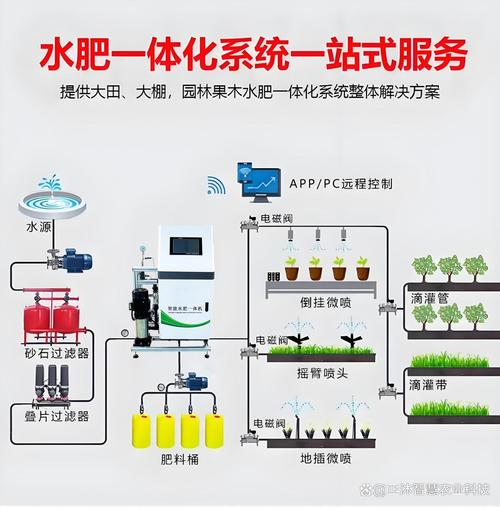
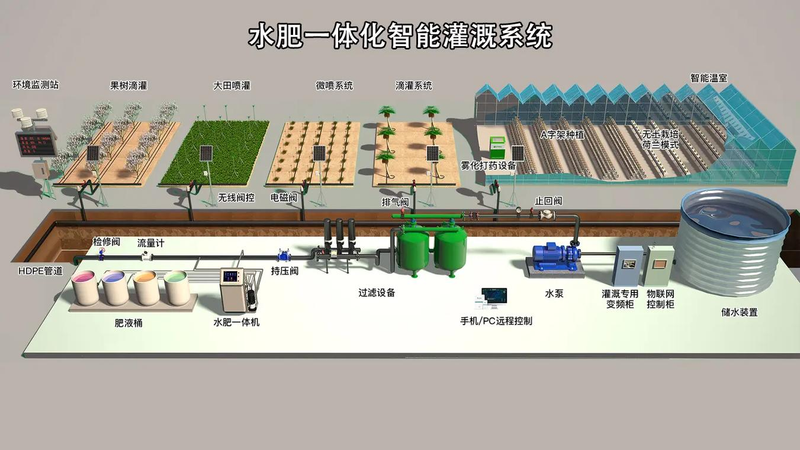
A complete integrated water fertilizer irrigation system consists of six core modules of water engineering, filtration systems, fertilization devices, a pipeline network, water rechargers and smart control systems, forming a complete transport chain from water sources to crop roots。
(i) water project
Water collection facilities, including machine wells, reservoirs, reservoirs, etc., need to be equipped with water quality detection devices to ensure that irrigation water meets standards. Water quality is the basic guarantee for the proper functioning of the system as a result of the significant increase in drip zone congestion caused by over-standarded water sources。
(ii) filtering systems
Use a stacked + web-based double filter combination to intercept impurities of more than 98% diameter 0. 1 mm. Practical tests have shown that single-stage filters are not functioning when they exceed 50 ntu so that filtering systems are essential to prevent dripping or jet plugging and to ensure the proper functioning of the system。
(iii) fertilizers
Wenchuan syringes and smart fertilizers are the main programmes:
1. Munchuria syringes: a low-cost but 5 per cent precision suitable for small-scale cultivation areas or for scenarios that require less precision。
2. Smart fertilizers: 2% precision control through ec/ph sensors capable of controlling water fertilizer ratios according to the long-term demand for water and the need for fertilization of crops, suitable for cash crop cultivation areas and large-scale planting sites。
(iv) pipeline network
Pe is responsible for the design of the side valves, which form a scalable “tree-tip” layout. The pressure of the tube network needs to be maintained at 0. 8-1. 2 mpa, with pressure fluctuations above 20 per cent affecting even drip irrigation, and a reasonable network design ensures that the water fertilizer is evenly delivered to the irrigation areas。
(v) water pump matrix
Drip flow 1-8l/h optional, nozzle covering radius 0. 5-3m adjustable. Different crops are suitable for different types of irrigation, such as tomato cultivation, where pressure compensation drips are recommended, while vineyards are more suitable for micro-jet mix programmes。
(vi) smart control systems
The smart control system integrated product networking technology is central to achieving precision irrigation fertilization。
Sensor network: provides a basis for decision-making through real-time collection of soil moisture, nutrients, temperature, etc., such as soil temperature and humidity sensors deployed in the field, ec/ph value monitors, nitrogen phosphorus potassium sensors, etc。
2. Data transmission: the data collected are transmitted via the gprs module or 5g + network to the core control system。
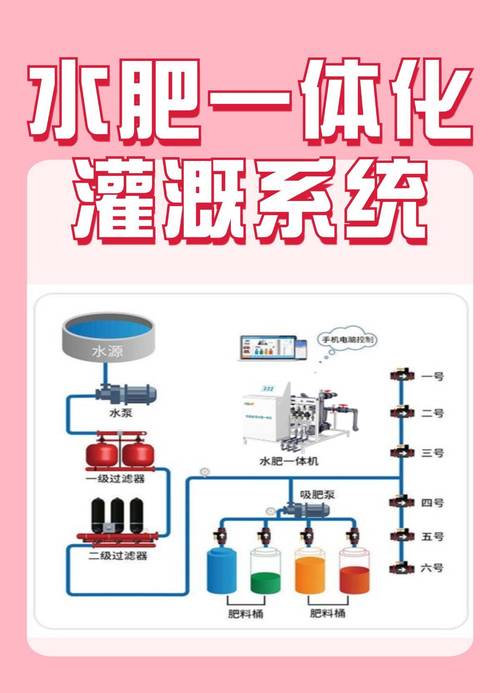
3. Core control units: consisting mostly of plc (programmable logic controller) modules and touch screens, which are responsible for the analysis and processing of data and the generation of optimal water fertilization programmes based on crop demand and pre-set irrigation fertilization strategies。
4. Implementation equipment: including pumps, electromagnetic valves, etc., responsible for the implementation of the instructions for the core system and for the automated control of irrigation and fertilization。
Modern water fertilizer integration systems usually offer three control models:
1. Smart irrigation models: systems can network cloud service platforms, model analysis programmes for automatically downloading platforms that automatically control water pumps, fertilizing pumps and land-wheel irrigation valves according to crop demand, fertilization and reasonable irrigation times, achieve fully automated precision irrigation fertilisation, and carry out 10-year data retrospective and trend analysis。
2. Artificial irrigation models: users are allowed to set parameters such as irrigation time, irrigation water, type of application and fertilization through the touch screen of the equipment, which is implemented according to the parameters, guaranteeing precision and giving users some autonomy。
Manual irrigation model: operators directly control the operation of equipment and valve switches through touch screens, suitable for small-scale precision irrigation or emergency response in exceptional circumstances。
Iii. Rationale
The process of integrated irrigation systems for water fertilizer consists mainly of the following steps:
Data acquisition: the sensor network collects soil moisture, nutrients, meteorology, etc. In real time and transmits it to the core control system。
2. Data analysis and decision-making: based on the data collected, the core control system analyses the water fertilization needs of current crops and calculates the appropriate water fertilization ratio and irrigation levels, taking into account water demand patterns for crops and pre-set irrigation fertilization strategies。
3. Water fertilizer mixing: fertilizer application mechanisms proportionally dissolve soluble fertilizers in water and produce evenly balanced fertilizers in accordance with the control system instructions。
4. Fertilizer transmission: water pumps transport fertilizers through the network of pipelines to various irrigation areas, and water pumps transport fertilizers evenly to the root soil of crops。
5. Process monitoring: the system monitors, in real time during operation, parameters such as network pressure, flow, concentration of fertilizers, etc., to ensure stability and evenness in the process of fertilization of irrigation。
6. Purge pipes: once irrigated fertilization is completed, the system washes irrigation systems with non-fertilized water to prevent the plugging of fertilizer residues。
Iv. Technological advantages
(i) water saving
The combination of drip-drink fertilizer, which is delivered directly to the root of the plant with water evenly, and the “difficult-drinking” of the crop, has significantly increased fertilizer utilization, reducing fertilizer usage by 50 per cent and water by 30-40 per cent. The irrigation fertilization system saves 50% ~70% of fertilizer compared to conventional fertilisation, while significantly reducing water pollution from excessive fertilization in vegetables and orchards。
(ii) savings in labour and capacity
The use of integrated hydro-fertilizer systems, which are traditional ditch irrigation and fertilizers and are time-consuming, can result in automated irrigation fertilization by setting parameters through control systems, with almost no on-site worker operation and a single system that manages 200 acres of land, significantly increasing the efficiency of agricultural production。
(iii) increased yields
Anthropometric regulation to meet the need for crops to “eat and drink well” during critical fertility periods eliminates any symptoms of deficiency and can contribute to crop growth and development and improve crop yields and quality. Practice data show that this technology can contribute to an increase of 15 per cent in maize and soybean monolithic production in arid areas. In facility agriculture, greenhouse strawberries are used for tidal irrigation + water fertilizer integration, which is 2. 3 times more productive than the traditional field model. The investment in drip irrigation (including pipelines, fertiliser pools, power equipment, etc.) is approximately $1,000/acre, which can be used for about five years, saving at least $700 per year for fertilizers and pesticides, increasing production by more than 30 per cent, with a net increase of over $800 per acre。
(iv) eco-environmental protection
Volatilization losses and dissolving problems associated with the availability of fertilizers in the more dry surfaces were avoided, in particular ammonium and urea-based nitrogen fertilization losses to the surface, saving nitrogen fertilizer while contributing to environmental protection, and reducing soil sheeting and water body pollution due to over-fertilization。
(v) precision control
The ability to accurately control the availability and timing of water fertilizer, in accordance with the long-term demand for water in different crops, to maintain the laxity and proper water content of the main roots of crops, to create optimal root microenvironments and to promote healthy growth and efficient absorption of the roots. For example, during tomato omelet, the system automatically increases the ec value from 1. 8 ms/cm to 2. 2 ms/cm, while reducing irrigation by 30 per cent and achieving precision regulation。
(vi) disease reduction
Many of the diseases of the crops in the shed are home-borne, spreading with water, such as chili disease and tomato atrophy, and the use of drip irrigation can directly and effectively control the occurrence of home-borne diseases. At the same time, drip irrigation reduces humidity in the shed and reduces the incidence of disease. The use of drip irrigation during the winter is used to control water irrigation, reduce humidity and increase the temperature of the ground, avoiding problems such as crop roots and yellow leaves caused by overwatering。
Application scene
(i) facility farming landscape
The facility greenhouse is one of the most widely used scenarios for the integration of hydro-fertilizers, suitable for growing vegetables such as strawberries, tomatoes, cucumbers, peppers and fruits. Greenhouse strawberry cultivation is based on tidal irrigation + hydrofertilizer integration, which is produced on the occasion of the anniversary of foundational cultivation, which is 2. 3 times higher than the traditional field model。
(ii) daejeon cash crops
For field cash crops such as cotton, maize, soybeans and wheat. The application of this technology reduced the single irrigation cycle from 72 hours to 18 hours, resulting in a 2000 acre/person management efficiency in conjunction with drone patrols. Inner mongolia, the heineken farmer group has grown over 70,000 acres through integrated water fertilizer technology, with an increase in maize acre production of about 100 kilograms, reduced water use for irrigation from 120 to 60 cubic metres per acre, over 50 per cent water conservation and an increase in fertilizer utilization of over 10 per cent。
(iii) mountain orchards programme
Solving water pressure instability on the slopes through solar pumping stations + a combination of gravity drips, suitable for mountain orchards such as citrus, apples and grapes. This technology increases the weight of citrus single fruit by 15-20g and the sugar level by 0. 8-1. 2 degrees, improving the quality and production of fruit。
(iv) other cash crops
It also applies to other crops that are more economically efficient, such as flowers and chinese medicine, and that are able to accurately control the supply of water fertilizers, improve the quality and yield of crops and increase the incomes of growers。
Vi. Technological imperatives and implementation steps
(i) system design
In terms of design, the depth, length and area of irrigation of the piping system are to be designed according to basic conditions such as terrain, fields, units, soil surfaces, cropping patterns, water characteristics, etc. Integrating water can take the form of pipe irrigation, spraying, micro-jet irrigation, pump-pressure drip irrigation, gravity drip irrigation, seepage irrigation, small tubing outage, etc., with a particular reluctance to flood with large water, which can easily cause nitrogen losses while reducing water utilization。
(ii) fertilizer selection
Selective liquid or solid fertilizers, such as ammonia, urea, ammonium sulfur, ammonium nitrate, ammonium phosphate, ammonium phosphate, potassium chloride, potassium sulphate, potassium nitrate, calcium nitrate, magnesium sulphate, etc.; solids are preferred in powdered form or in small blocks, requiring water solubility with low impurities, and should not normally be combined in particulate form (including intermediate and foreign products); if fertilized with biomerage or emulsive acid, they must be filtered to avoid jamming pipes. All-water soluble fertilizers must be selected, and composite fertilizers containing more than 20% phosphorus produce sediment, and the test has shown that the production of crops using special water soluble fertilizers has increased by 12-18% compared to the average fertilizer。
(iii) irrigation fertilization
1. Fertilizer solution and mixing: the application of liquid fertilizers does not require mixing or mixing, and general solid fertilizers need to be mixed with water into liquid fertilizers and separated if necessary to avoid problems such as deposition。
2. Fertilizer control: dosage is required at the time of fertilization, with an appropriate concentration of approximately 0. 1 per cent of the flow of irrigation. For example, irrigation flows are 50 m3/acre and fertilizer injections are about 50 litres/acre; over-applications can kill crops and pollute the environment。
3. Procedures for fertilization of irrigation
:: in the first phase, water-humid soil free of fat is selected to avoid crop damage due to excessive concentrations of fertilization。
:: phase ii, application of fertilizer solutions for irrigation and delivery of fertilizer to crop roots。
:: phase iii, cleaning irrigation systems with non-fertilizer-free water to prevent fertilizer residues from blocking pipes。
(iv) operational maintenance
1. Maintenance of equipment: a monthly back-washing filter system, quarterly monitoring of network pressure loss, timely clean-up of fertiliser residues to prevent the blocking of equipment and pipes with fertilizer residues. The failure of a certain park to clean up fertiliser residues in a timely manner resulted in a 15 per cent burn rate of the first crop in the following year。
2. Periodic testing: periodic detection of parameters such as ec values, ph values for soil nutrients, moisture and fertilizers and adaptation of fertilization strategies for irrigation based on the results of the tests。
3. Equipment protection: the drip zone should be protected against insect bites, rodent bites and bird pecks. The agricultural university of china, the gansu dynamite conservation group and others have successfully developed a three-part targeting technique, “first-water, second-dip, then-washing”, to reduce the bite rate by more than 80 per cent。
Vii. Common problems and solutions
(i) blockage
Blockage is the most common problem in the practical application of integrated hydro-fertilizer systems and is divided into three main categories:
1. Sediment congestion: mainly from fertilizer and water quality problems. Some fertilizers (e. G. Calcium sulphate) left behind in drip irrigation by drip fertilization are deposited and the drip stream is blocked. At the same time, the hard-water environment produces mud by dripping the walls of the inner pipe, causing congestion。
:: solutions: select suitable fertilizers to avoid the use of fertilizers that are susceptible to sedimentation; regularly wash pipes with acid and remove water and sediments。
Physical congestion: is the main cause of drip congestion, often due to poor irrigation water quality, inadequate filtration systems, entry of impurities such as mud into pipes and drip irrigation。
:: solutions: strengthen the maintenance of filter systems and regularly clean filters; pre-process water sources to reduce impurities in water。
3. Biological congestion: the growth of algae and other micro-organisms in irrigated water is the result of intrusion droplets from crops。
Solutions: add appropriate amounts of microbicides to irrigated water to inhibit the growth of micro-organisms; install droplets or filters that prevent root causes from intrusion。
(ii) equipment failure
1. Pump failure: the failure of the pumps to function normally or due to insufficient pressure may be caused by power failure, jamming of water pumps and damage to electrical power。
:: solutions: check the power supply for normality, clean the pumps, repair or damage the power。
Electromagnetic valve failure: emp failure to perform normal switches may be caused by circuit failure, damage to the electromagnetic valve coil, clogged core。
• solutions: inspection of circuit connections, repair or replacement of damaged electromagnetic valve wires, cleaning of valve cores。
(iii) fertilisation
Fertilizers are mainly caused by high levels of fertilization or by high concentrations of fertilizers, such as the burning of roots and yellowing of leaves。
• solutions: strict control of the application of fertilizers and the concentration of fertilizers; rational application of fertilizers in accordance with crop requiring patterns and soil nutrients; small area testing prior to fertilization to determine the appropriate fertilization and concentration; timely washing of the soil with a large amount of water in case of fertilization。
Viii. Future trends
With the continued release of policy dividends, the breakthroughs in technological innovation and the accumulation of practical experience, water fertilizer integration technologies are moving from “one-point breakthrough” to “system integration”。
1. Smart upgrading: the current industry is upgrading from phase 1. 0 to 3. 0; 1. 0 to achieve basic water fertilizer coupling; 2. 0 to introduce network controls; and 3. 0 to integrate ai decision-making models. Future integrated water fertilization systems will be more intelligent, allowing for automatic adjustments of water fertilization formulations and irrigation strategies to achieve higher levels of precision agriculture based on a variety of factors, including meteorological data, crop growth status, soil environment, etc。
2. Mobile innovation: the mobile smart for integrated irrigation first system developed by the agricultural irrigation institute of the chinese academy of agricultural sciences successfully addressed the high cost, low utilization, vulnerability and maintenance difficulties of the traditional fixed irrigation head pump. This innovative system, integrated into a car-board platform, has two models of self-driven and towed movement, transport, decomposition and adaptation to the current state of multi-planting patterns in the country, can reduce the average acre investment by 40 per cent and manual input by more than 20 per cent, and will be more widely applied in the future。
3. Eco-development: future integrated hydro-fertilizer technologies will focus more on eco-environmental protection, the development of more environmentally friendly fertilizers and irrigation methods, the reduction of pollution from agricultural sources and the promotion of sustainable agricultural development。
4. Scaled applications: with the development of agricultural scale-up operations, integrated hydro-fertilizer technologies will be applied to more large-scale plantations to standardize, consolidate and efficiently produce。
Integrated irrigation systems for hydrofertilizers are a practical and advanced efficiency-efficient technology that will provide strong technological support for the modernization and development of agriculture, with front-loading of investment and technology support in rural areas in a position to do so。