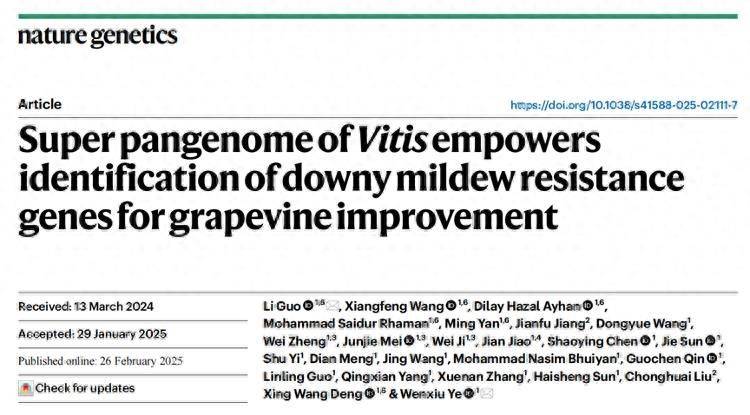
On 26 february, a team of ye mansoo researchers and guo li researchers from the modern agricultural research institute of beijing university published on-line the results of a study entitled super power of vitis empowers evaluation of downy mildew research sources for glapeviine improvement in the international leading journal nature genetics. This is a landmark achievement in the field of grape science。
It is known that for the first time, the research team produced a single-multiple super-genome mapping of 72 grape-mass materials covering three major world species of grapes in eurasia, north america and east asia, revealing the rich genetic diversity and complex hybrid history of grapes. Based on data from grape fusion, the research team succeeded in digging up genetic mutations and resistant genes associated with the resistance of grape frosting, accelerating the breeding of pure molecules of grapes, opening the way to the innovation of grape quality and the use of new times。
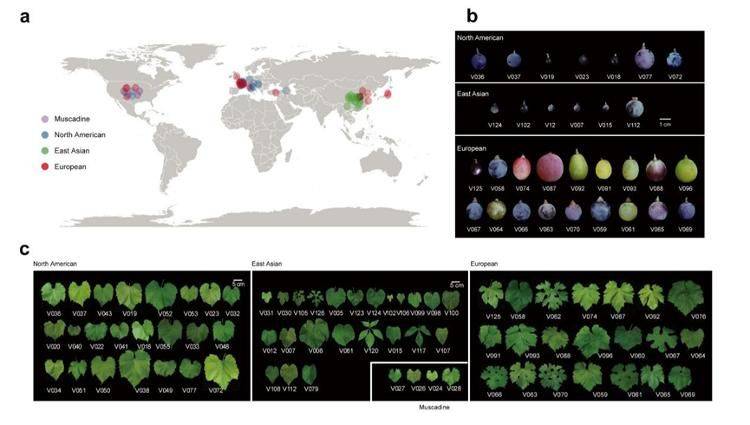
Grapes are grown on a global scale and belong to grapes, consisting of two sub-divisions, musk grapes and real grapes, with a total of more than 70 species; they can be divided into three major groups based on geographical distribution, eurasian, north american and east asian populations。
As one of the ancient crops of domestication, grapes have undergone long periods of continuous domestication and years of improved breeding. While this process has produced many modern grape varieties, it has also led to a reduction in their genetic diversity and the loss of resistant genes, leaving modern grape varieties vulnerable to adverse conditions such as insects and adversity. In recent years, wild grapes have once again become the focus of research because of their rich genetic diversity and powerful resistance to genetic diversity, with successive releases of the north american and european grape genomes. Despite these advances, however, the graded pangenomics covering major varieties (especially those containing wild grapes from east asia) based on large groups of chromosome-grade genome assembly have not been reported. Therefore, the construction of a pangenomic group covering the whole of grapes will be a key resource for understanding the genetic diversity of grapes, conducting functional genomics studies, identifying hidden genetic properties and improving the accuracy of grapes。
In this study, scientists carried out a group genome analysis of 591 grapes and selected 72 representative materials for single-multiple genome assembly at chromosome levels. These high-quality genome sequences provide strong resource support for the study of grape genetic breeding。
It is worth noting that for the first time, scientists built a single-multiple-system developmental tree, revealing the complex breeding history and rich genetic diversity of grapes. Studies have found that there is a greater degree of interconnectivity within grape varieties in north america and europe, while within east asia there are fewer interconnections and limited intercontinental incidents. This indicates that east asian grapes have potentially great breeding value and their genetic diversity has not yet been fully exploited。
In addition, the study analysed the pangenomic family of 72 grapes, found more than 64,000 gene families, and systematically analysed the immunoreceptor proteomic family nlr. In combination with anti-disease data, scientists have found significant differences in the nlr genes of the tir-nbacc-lr family in the number of anti-disease (field grapes) and in the number of sensitive grapes (planting grapes), which may be one of the major factors in the difference in the pattern of anti-frost disease in grapes. The super pangenomic analysis provides a comprehensive genome base for research into the genetic diversity, evolutionary history and functional genetic excavation of grapes。
In order to dig up the functional genes associated with the importance of resistance and resource efficiency, scientists have also drawn up the most complete current map of genetic transformation (sv) of the grape genome. Scientists have also built the first graphic pangenomic group, covering the three major populations of europe, asia and the united states. The super pangenomic group of grapes built up in this study not only deepens understanding of the evolution of grapes and improved breeding, but also provides an important scientific basis for precision improvement in the disease resistance and diversity of grapes。
It was described that this study, which provided the most comprehensive resource available to date for the grape genome, provided a comprehensive analysis of the complexity and diversity of the grape genome, leading to the efficient extraction and use of excellent genes in grapes, especially wild grapes. The study, which combines grapes with super-pane genomes, group transfer groups and cosmetics, and the in-depth exploration of the mechanisms for the genetic diversity of grapes and the important agronomic formation of grapes, provides a theoretical basis and new thinking for the future cultivation of super-graves, marking a new stage in the study of the grape genome and is bound to accelerate the high-quality development of the country's grape quality innovation and the grape industry。
Modern agriculture laboratory, beijing university
Presentation by the laboratory for the innovation and use of portuguese grapes in the city of luburo

The centre for the innovation and use of portuguese grapes in the city of polio, the institute of modern agriculture of beijing university, is dedicated to research in the field of genogenomics and functional genomics, genome innovation and post-mining. There are currently more than 70 scientific staff, including four from the provincial level and above, three senior researchers and 15 doctors. Since its inception, the laboratory has been highly scientific, with the release of the first full t2t monomultiple genome of grapes and grapes, a detailed analysis of the mechanisms of vtp immunopathy, the identification of several fungus resistance and water management critical genes, the establishment of a grape resistance design breeding platform, and the development of a new “twixious show 1” anti-frost species. At the same time, the laboratory actively served the industry by publishing the country's first specialized book on the planning and construction of wine houses, " planning and management of wine breweries " , and by developing a series of wine wines consistent with the chinese population's perception, "the great red north"; based on the theory of immunity from gas holes, the laboratory and the cooperative company anhuihara biotech, inc., successfully developed and industrialized a high-impact product for the control of frosting disease, "the original twinning" and developed new mass productivity for the prevention and control of grape diseases, which contributed to the high-quality development of the grape industry。