The process of technology transfer is the hot spot and focus of domestic and foreign research. A number of diversion processes were summarized。
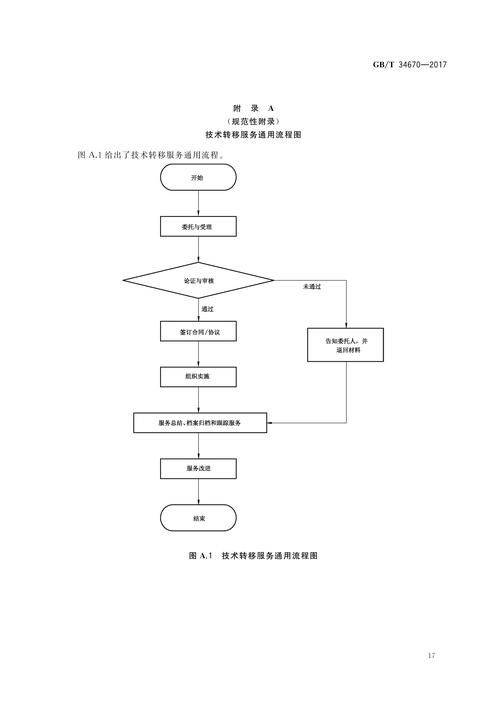
On 29 september 2017, the general directorate of state quality inspection and the national standards commission approved the publication of the national standards for technology transfer services (hereinafter referred to as “the norms”), standard no. Gb/t 34670-2017. The regulation, which was implemented on 1 january 2018, is the first recommended national standard for technology transfer services。
A total of 12 chapters, covering scope, normative reference documents, terminology and definitions, general requirements, common processes, service evaluation and improvement, and major types of technology transfer services, are provided in the tts code, together with five appendices, including guidance information such as common flow charts for technology transfer services, and flow charts for technology evaluation services。
The author's study found that the general process of technology transfer was too broad and general, focusing on contracting and implementing technology transfer services rather than on how to carry out technology transfer services. The tep service process, which focuses on tva (which can serve as a service process for the provision of sti and assessment reports), is not a common process for technology transfer projects. To this end, the author summarizes the “six-step approach to the conversion of technology to a common process” in the context of work practices and learning。
The following is a brief description:
Step 1: technology supply analysis and inventory
Analysis and periodic inventory of the technical results of providers of technology transfer projects, such as universities, research institutes and technology holders. Conduct surveys and needs-gathering and review follow-up public disclosure. Using technology maturity trl analysis models, hierarchical management of scientific and technological outcomes for conversion according to technological maturity, technology implementability, market areas and industry direction of application, level of confidentiality, etc., classification management, technical outcome analysis evaluation, and initial design and development of pathways for conversion (which can be multiple or one)。
Ttl-1-trl3 is generally considered to be the theoretical research and preliminary test stage in the ttl analysis model: to develop or define practical application scenarios based on the underlying principles of technology and to carry out basic research and feasibility analysis for the development of technology. Trl-4-trl6 is the applied r & d phase: piloting or detailed analysis, testing the feasibility of application scenarios, initiating r & d to produce results demonstration, and undertaking technical improvements. Trl 7 - trl 9 is the technical implementation phase: provides the final conclusion on the feasibility of continuing development through a test or test, a test validation of the product or key technology. This is accompanied by a system debugging and a subsystem for further implementation and improvement。
Step 2: intellectual property protection
Prior to the formal disclosure and dissemination of technical results, intellectual property rights protection is provided, including high-value patent layout excavations, trademark protection, copyright and software copyright rights, new varieties of plants, integrated circuit layout designs, etc., and overseas intellectual property layout and protection. In addition, there is confidential compliance with know-how, a technical secret that is not intended for disclosure. For particular categories of “technology”, such as old characters, geographical indications, traditional cultural heritage, genetics, etc., a complete intellectual property strategic planning and protection is required. Ongoing intellectual property protection of emerging scientific and technological achievements and, where necessary, research and dissemination of technical standards。
Step 3: business plans and road shows
Business plans tailored to the characteristics of technology transfer projects are tailored to different versions and applications on different occasions, and a variety of business models and conversion pathways are designed, such as transfer, licensing, capitalization, production research cooperation, incubators, financing, m & as, etc. The organization of different forms of road shows, such as closure and disclosure, has enabled information symmetry and the identification of business partners. For projects that are highly confidential and have precise targets for commercial negotiations, closed circuits can be arranged. Open and specialized shows could be organized for projects that need to be expanded in terms of advocacy, broad investor attraction and solicitation of funds. The focus is on achieving information symmetry。
Note: the three above steps should be primarily completed by the technology supplier and, if necessary, assisted by outside specialized services such as technology transfer intermediaries, technology brokers, etc。
Step 4: due diligence and risk analysis
Based on the specific needs of the project, usually on the technology demand side, full and due diligence is undertaken on the various potential risks of the project, in particular the freedom to conduct due diligence (fto) focused on key technologies, risk identification, risk assessment and risk prevention, and respective early warning and prevention and response measures for different tort risk analyses. Objective and credible advice on technology demand and business decision-making。
There are very few specialized institutions in the country that conduct due diligence on patented technology and technical secrets, which also leads to the blindness of technological results and the uncontrollability of risks. Many projects have failed. The author has been in this business for 16 years and has a deep experience。
Step 5: value assessment
Assessment bodies and evaluators develop value-assessment reports on intellectual property rights and technology outcomes, i. E. A comprehensive value assessment of the overall technology results, analysis of the technical, legal and economic dimensions, and use of valuation algorithm models (e. G., cost, market, benefit methods, etc.) for subsequent commercial negotiations. A specific valuation of value is usually made。
The valuation of supporting values also includes other types of analytical reports, such as market survey reports, scientific and technical outcome evaluation reports, risk survey reports, intellectual property analysis review reports, and technical implementability reports。
Step 6: commercial negotiations and facilitation
Through the preparation, organization, facilitation and landing of commercial negotiations, technical suppliers and demand-side actors involved in the negotiations are not only represented, but also employ professional negotiators or external technology transfer brokers to assist in the negotiations and facilitate commercial cooperation and landing. The negotiators should stand in their respective positions and engage in commercial negotiations. For example, negotiating strategies, the application of negotiation techniques, flexibility in resolving negotiating dilemmas and problems, and the drafting of effective and compliant contractual texts in accordance with the corresponding laws and regulations, will lead to a multi-party win-win cooperation. Often the negotiation process and cycle are long, the failure rate is high, the business returns are high and the risks are high. Professional staff are required。
The above three steps should be driven by the technology demand side, with the technology supply side working proactively and, where necessary, with outside specialized services such as technology transfer intermediaries, technology brokers, etc。
For this common process, tto, a technology transfer expert from several countries, including the united states, the united kingdom and israel, has been the subject of numerous exchanges and discussions. Among them, the united states colleges of higher education conduct value assessments as a first step and even multiple assessments over time. Adequate fto due diligence and risk control are also conducted. It's worth domestic learning。