


What are the demands and responses to orange infarction
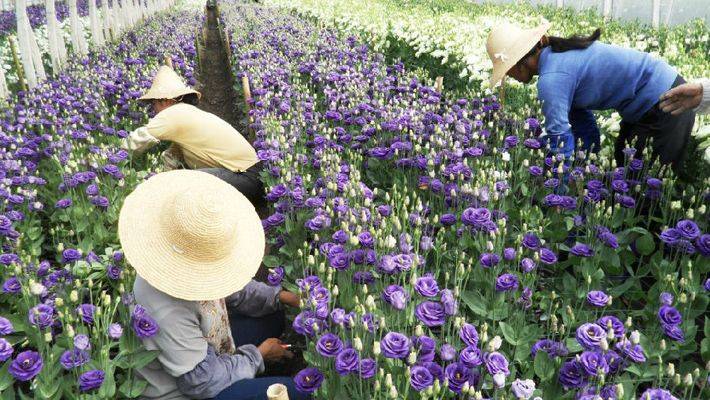
The orange infestation (eustoma grandiflorum shinn. ) with the reputation of a roseless rose, is a herd of herbs, also known as the texas lantern, the lilies, the savannah urchins, originating from the limestone-rich desert of nebraska, colorado, and texas. Orange infarction, which is rich in variety and has a long duration, is currently used for the main ceremony of marriage. In recent years, new varieties have emerged, especially rose-type varieties, which have dominated the market, resulting in rapid increases in consumption, and more carnation and lilies-shaped varieties have recently been selected, and future market developments should not be underestimated。
Orange infarction is one of the fastest-growing cut flowers in the world market in nearly 20 years. As early as 2001, japan's annual cut flowers had reached 129 million, ranked fourth in terms of sales. European sales also reached 122 million, one of the top 10 cut flowers. Our yunnan province, which is currently measured by seed seed sales, produces about 200 million branches per year, growing at a rate of about 15 per cent per year, rising to four of the main cut flowers。
Orange infarction is one of the world's most difficult flowers to cultivate. When problems arise in the planting process, there is either a significant decline in quality or a significant reduction in production as a result of the large number of deaths of plants. The main problems that arise in the process of orange infarction can be summarized in six areas, or in the context of traditional cultivation, which are: (1) small seeds with long and difficult breeding cycles; ... (2) sensitivity to adversity and prone to hysteria, leading to a substantial increase in production time; (3) sensitivity to high temperatures and long-term photos, prone to short-duper flowers in the summer autumn and lower quality; (4) high water fertilizer management precision, regardless of the risk of death or poor growth as a result of poor management of large seedlings; (5) high levels of endemic disease and high rates of conjunctivity; and (6) high levels of foliage pests represented by frost, with greater difficulty in plant management. It is difficult to make it easier for the authors to analyse the difficulties in order to gain a better understanding and understanding of the techniques used in the cultivation of oranges and to contribute to the sustainable development of the field。
1 nursery
1. 1 child-rearing difficulties
Orange insects are the only seed breeding species in the top 10 cut flowers in the world. Orange infarction seeds are very small, at 0. 005 g per grain, with little self-nourished nutrition and slow growth in the preceding period, and therefore they last up to three months. The extraction of f1 hybrid seeds remains the only form of reproduction, and successful models of commercialization of sexless reproduction have not yet been observed at home or abroad. Cultivation by small-scale test groups and adhesive reproduction can produce seedlings, but there are some problems that need to be overcome. The orange infarction has the term “smuggling”, which means that once a seedling of good quality is produced, the cultivation is half as successful. Orange seedlings are a highly technical undertaking that depends more on highly self-controlled facilities, good environmental control and fine management. Despite the fact that there are flower farmers who raise their own seedlings, it is not common for them to rely more on professional nursery companies, even a large proportion of which are imported from the netherlands。
1. 2 feeding requirements
Orange seedlings generally use 200 - 860 percre discs as seedlings, and light matrices such as imported peats, leachate and pearl rock as seedling matrices. The investment costs are higher for modern equipment facilities such as seed cold storage, precision seeders, self-controlled greenhouses, self-propelled water tankers, wet curtain cooling and artificial light. Orange infarction requires natural processes such as “low-temperature seedlings, high-temperature flowering” and even with the above-mentioned mechanical equipment, cold weather, strict light-temperature conditions such as fertilizing and mature empirical techniques. Poor management and substandard conditions in the production process can easily lead to problems of seedlings, carrying pests and diseases, flowering of troughs and weak resistance to disease。
2 leaning rest
2. 1 factors leading to hibernation
The wild properties of the orange infarction indicate that the lichenization phenomenon is a state of growth caused by a bad environment and a way for the orange infestation through long-term evolution. Orange infarction is likely to take place during nursery periods, planting periods, swing periods and even during flowering periods. In addition to the major factors of temperature, the occurrence of hysteria is associated with drought, root break, drying, strong light, the use of seeds matured during high temperatures, and genetic characteristics of varieties. In the process of artificial orange infarction, the period of planting will be significantly prolonged if there is a hysteria, resulting in a severe reduction in production. After the planting of the plant, the leaf is thick and the management of the shed is inexperienced, creating a low-temperature, wet environment, which tends to induce the outbreak of frost and, in extreme cases, even to lead to the loss of harvests。
2. 2 the relationship between temperature and hibernation
Orange seedlings are sensitive to temperature and adult temperatures have a decisive influence on their growth and development. Temperatures are the main cause of hysteria: when night temperature is 15°c and 25°c, orange cut flowers are of the best quality; when average temperature is less than 10°c, orange infarction is almost stagnant; when night temperature is less than 8°c, large late- or very late-born varieties grow slowly, prone to low-temperature-induced hysteria, with a delay of 3 to 4 months; when night temperature is higher than 23°c, most of the yoghurt species are prone to high-temperature-induced hysteria, sometimes requiring a revival in the spring of the second year, with production delays of more than six months。
2. 3 method of avoiding the hibernation of orange infarction
(1) cold and warm seedlings: an environment at 23/18°c every day and night after seeding can avoid hysteria, or through 10°c during saplings from 2 to 4°c 30 d to break the hysteria. (2) do not use seeds collected at high temperatures (33/28°c day and night). (3) in the early stages of field planting, adverse environmental factors such as strong light, high temperature and water scarcity should be avoided. (iv) the use of den-painted seedlings to avoid root injuries during transplants and to pay attention to water management so as not to age the seedlings. (5) selection of varieties with low demand for premature birth or low temperature. (6) control of night temperature during the high-temperature season 15 ~ 17 °c, even if it reaches 30 ~ 33 °c in the daytime, does not cause leeching。
Three, shorts bloom
3. 1 period of occurrence
In the absence of heating and cooling equipment, winter flowering is difficult, and summer and autumn tubing is more likely to be encountered in orange infarction. In general, early-cooked varieties bloom early in the spring of winter, but summer plants are prone to the flowering of troughs, and 20 cm highs are likely to appear in buds, and it is necessary to pick the bud repeatedly or to take the heart to extend the branch to make it less qualified. It is difficult to bloom in the winter and early springs of late ripe varieties, but less so in the summer and autumn. It would be more difficult to balance quality if the anniversary were to occur twice。
3. 2 reasons for occurrence
The flowering reaction of the orange infarction is a relatively long solar crop of a cumulative nature, i. E., flowering early under long-day and high-temperature conditions, but with relatively small heights and fewer flowers. On the other hand, oranges can bloom under short-day conditions, but they are later, with higher heights and more flowers. The induction period for orange insects that cause the lumber to grow is about 45 - 80 d, real leaves 2 - 3, at a time when high temperatures and long sunlight tend to divide the lumber early, resulting in the flowering of short-stamped troughs. It is also prone to the flowering of troughs when the planting coincides with a high summer temperature with a long sun and an average temperature above 20°c. At the right growth temperature, the longer the sun rises, the earlier the buds split, the earlier the flowers bloom, but the shorter the branches, the smaller the branches, the smaller the flowers on the same flower. According to a japanese study, oranges tend to grow up at 10. 5 h a day to divide the buds. At 15°c night temperature, the same type of 16 h day long treatment is approximately two months ahead of the 8h short day treatment period。
Orange infarction is sensitive to water scarcity, low growth due to inadequate water supply, and high soil ec values, leading to poor nutrient absorption, damaged root systems and possible short-duper blooming。
3. 3 solutions
In order to address the problem of the opening of orange truncheons and the hibernation of the lichen, high-quality anniversary production was achieved with four recommendations for production only in low-latitude high-altitude climate areas, reduced seed costs, cold seedlings and the introduction of black screens. In the summer, our country has high summer temperatures, except in the low-latitude highlands, such as yunnan, and in the harsh northern areas, so that it is not suitable for the anniversary production of orange arteries. In order to ensure quality and to facilitate management, orange infarction production abroad is generally 1 seedling producing only 1 flower, while domestic dependence on imported seeds is expensive,1 and the production of 2 seedlings is cost recovery. The importance of cold and warm seedlings can be seen in the cold of the dutch climate anniversary, which gives rise to more than 200 million seedlings per year and supplies to china, israel and africa, in addition to locals. The introduction of dark-covered temperature protection facilities, which can keep warm during the winter and reduce the length of the summer, is a good way of simultaneously improving production and quality。
4. Fertilizer management and endemic diseases
4. 1 importance of water fertilizer management
Orange infarctions are exotic plants, and the conditions of artificial cultivation vary significantly from the wild semi-arid environment. Orange infarction is sensitive to the water supply, and inadequate supply causes growth stagnation, and oversupply leads to a severe decline in soil air permeability, disease and shortage of ponds. The demand for moisture over the whole reproductive period has been decreasing steadily at a high level. Before and within one week of planting, more adequate water is to be given to maintain a higher moisture content of the soil, and once the roots grow and gradually extend down, attention is to be paid to gradually reducing the soil water content and increasing its permeability. During any reproductive period, excessive moisture may cause the direct death of orange infarction, accompanied by water-borne or soil-dwelling diseases。
4. 2 high incidence of endemic diseases
Orange infestations are unresistible to the overwhelming number of endemic diseases, and sickleella, as well as pessimism, disease and cylindrical scavengers can cause large amounts of orange infestations, while root worms can cause severe growth and induce other fungi diseases. In general, flower farmers grow orange in the form of cabbage wheels, usually for no more than one year. According to micro-observations and field surveys, sickleella is the most common of all kinds of endemic diseases. Japan has now selected anti-scausal strains, which have significantly reduced the shortage of ponds, but the growth of anti-scausal strains has continued to be observed to decrease significantly and, following the evolution of the pathogen strains, it is possible that the anti-scaus species will become resistant. Soil decontamination therefore remains important. Root worms are also common in the absence of water dryer work and soil disinfection, and are in a state of emergency and can cause harm in the first instance. When surface water is cultivated without disinfection, there is also a significant increase in the likelihood of transmission of various earth-borne pathogens through irrigation。
5 connection barriers
5. 1 main reasons for the obstacles
The main obstacles to orange infarction are the high incidence of endemic diseases, the weak growth of plants, the yellowing of old leaves, the yellowing of roots, the bad death, etc. Continual barriers to orange infarction can be created by the large accumulation of earth-borne pathogens and nematodes in the soil, especially when the frontal pits are already abundant. The high levels of sodium and chlorine plasma are also important reasons for the high levels of soil sheeting, soil ec values and sodium and chlorine plasma. Japanese studies have shown that orange infarction on sandy soil is more sensitive to ec values than to clay. A comparison of soil ec values and post-planting seedlings for both soil and water was tested, with the full active ec values of 1. 0 ds/m below for sandy soils and the partially dead plant values of 1. 0 ds/m above and 1. 9 ds/m above. The total active ec value of the clay soil is the same as that of the sandy soil, at 1. 0 ds/m below, and the ec value exceeds -1. 0 ds/m, while the plant is partially dead and all the plants above 2. 8 ds/m die。
Studies from abroad have shown that the large accumulation of chemical substances produced in the process of orange infarction is also an important cause of the obstacles associated with it. In the netherlands, orange infarction is based on the production of 1 seed and 1 cut flower, which is collected five times a year. High-temperature vapour disinfection of the soil is carried out before each planting, whether or not there is a large shortage of ponds, one of the aims of which is to remove the chemical material accumulated in the soil through high temperatures。
5. 2 settlement recommendations
Even obstacles occur on many horticultural crops, but are more pronounced on orange arteries. This is closely related to traditional methods of production, such as the carrying of pathogens from irrigated sources of water, the rapid deterioration of soil physicochemical properties as a result of the lack of scientific formulation methods, the excessive use of fungi pesticides for rooting, the reduction of the beneficial bacteria in the soil and the rise of resistant pathogens. Even the cost of using steam disinfection is too high and low in the country, while the cost and effectiveness of chemical disinfection is high and unstable in the case of the use of cotton and acre. Flower farmers are more eco-friendly by rotation, but there are obvious problems of economic efficiency and production instability. International experience has shown that barriers cannot be solved by a single agribusiness approach and must be tackled in a multipronged manner, with integrated approaches, relying on science, technology, innovation and the diffusion of new technologies. In recent years, international progress has been made in the area of eco-environmental disinfection methods, such as solar energy, biomass and lime nitrogen combined flooding, which should be vigorously researched and promoted。
6 part of the earth's pests
The main pests of orange infestation are night moth pests, parrots, white lice, red spiders, tectonic flies, etc., which are more persistent pests, and other pests such as aphids, thorium, thorium, etc. Not only are some pests difficult to control and costly to use, but the key is the rapid outbreak of viral diseases following infection with seedling orange infarction, and the entire plant suffers from the symptoms of leaves, eutrophication and malformations, which do not allow for normal flowering。
The main diseases of orange arteries are frosted, greyy, powdery, etc., which are similar to most greenhouse flower crops, but they are unique in that not only leaves are damaged but plant deaths are more likely to occur. Growth has stalled and death has gradually occurred as a result of the infection of the citrus infestation by young children. After the initial infection, growth stops and the spray is controlled with repeated infections and poor growth, which does not produce yield. The long-term effects of orange infarction can lead to the death of a plant due to the wetness and depression of the soil and the exposure of its roots to ashilosis. Orange infarction during the flower season is exposed to cold, high-humid conditions at night in large huts, and is also prone to frost and ash. The orange infarction is produced in dry and less rained savannahs, which are cool and dry and grow with an appropriate air humidity of between 50% and 75%. The vulnerability of hot, wet and high-temperature environments in hot sheds, which vary significantly from their original location, increases significantly the risk of infection with orange infestation。
7 comprehensive approach approach
The difficulties in the six areas mentioned above are the problems faced by oranges in the context of traditional production patterns, which hinder the expansion of the production of oranges, which cannot be solved by the application of generic spraying measures. In the case of froste, which is a more dangerous disease in the process of planting oranges in the yunnan province-ocean sea region, it is an acute and rapid disease, the key cause of which is the decline in night temperatures, the continuous distillation of gas water in high-temperature air, the formation of condensed water on leaves, the most easily transmitted during the moist seed season and the intensive harvesting period of the soil, which cannot be controlled simply by spraying. The best and fundamental solution is to prevent the creation of foliage through warmer and warmer measures。
In short, the orange barrage market has great prospects and potential. As labour prices continue to rise, traditional production methods are risky and uncertain, and need to be upgraded. The development of new orange infarction production should be guided by the concepts of technological innovation and eco-environmental protection, as required by the industrialization and intensification of modern flower production. Sustainable development can only be achieved with stable benefits by combining the constraints and mutually reinforcing dialectics of pathogens, host and environment3 and the design of production systems that combine ecological factors such as light temperature and humidity, soil fertilizing water and disease grass, through standardization, specialization and scaleing。
What are the demands and responses to orange infarction



