The report notes that current global energy discussions are over-focused on the demand side and that supply-side “reducing rates” are becoming the core variable determining market balance. Since 2019, about 90 per cent of upstream investment has been used only to counter the decline in production of established oil and gas fields, rather than to generate new supplies. Global upstream investment is expected to be about $570 billion in 2025, but even a small decline could shift supply from growth to stagnation. This structural feature means that the maintenance of production itself has become a capital-intensive task。
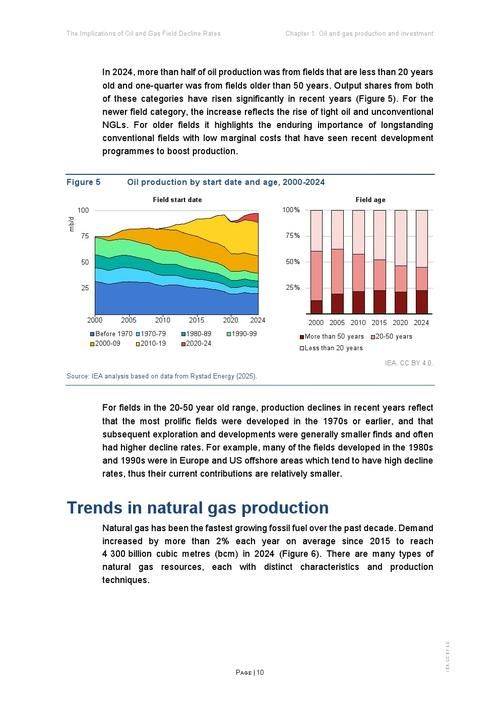
From the supply structure, hydrocarbon production is undergoing profound changes. Traditional oil fields accounted for 97 per cent of global production in 2000 and declined to 77 per cent by 2024; about 70 per cent of natural gas still originates from traditional gas fields, but the proportion of shale gas is rising rapidly. At the same time, the supply is highly concentrated, with a small number of super-heavy oil and gas fields contributing nearly half of their production. This concentration increases stability in the short term, but magnifies systemic risks over the long term。
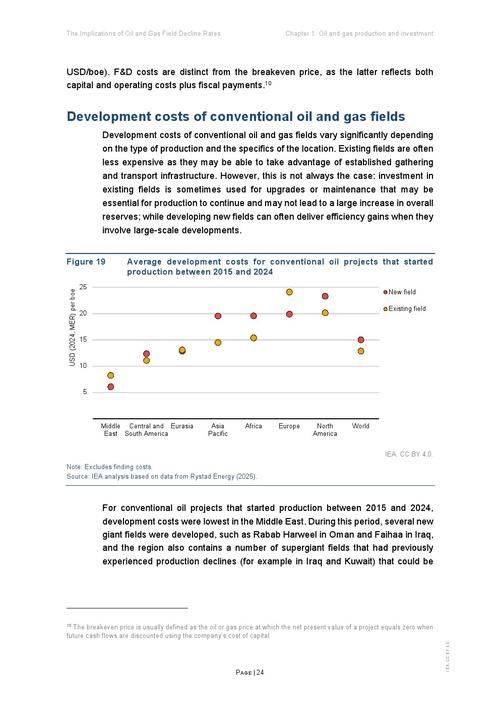
Deduction data reveal “hidden wear and tear” at the supply end. The global traditional oil fields peaked at an average annual decline rate of 5. 6 per cent and natural gas of 6. 8 per cent; however, the difference is significant, with smaller oil fields declining at a rate of over 11. 6 per cent, deep-water oil fields reaching 10. 3 per cent and large land oil fields in the middle east at 1. 8 per cent. This means that global supply is increasingly dependent on a small number of low-reducing regions, while high-cost, high-reducing resource share increases volatility。
More crucial is the “natural decline rate”. If all capital inputs are discontinued, global oil production will decline by about 8 per cent per year (about 5. 5 million barrels per day) and natural gas by 9 per cent (about 270 billion cubic metres). This decrease, compared to 2010, has increased significantly, reflecting structural trends in the increase in the share of non-conventional resources and the decline in the quality of resources. This is particularly true for shale oil and gas, which, if stopped, would result in a sharp drop of more than 35 per cent in one year。
The dependence of supply maintenance on additional resources has increased significantly. To maintain current production until 2050, about 45 million barrels of oil per day and 200 billion cubic metres of natural gas supply will be required. At the same time, some 28 million barrels/day and 1. 3 trillion cubic metres of resources have been identified but not developed, but gaps remain. In addition, the industry average development cycle is close to 20 years, further exacerbating the lag in supply responses。
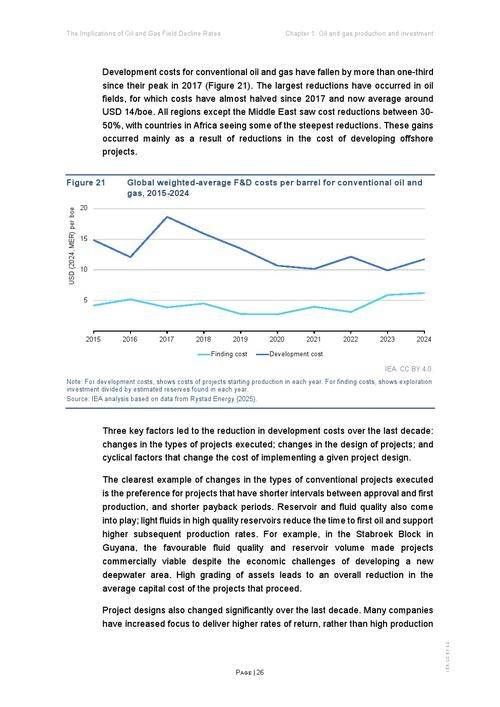
From an investment and cost perspective, the industry has a “high input, low discovery” structure. In the 2020s, about 9 billion barrels of oil equivalent were newly discovered, 90 per cent lower than in the 1960s; the scale of individual discoveries dropped from 150 million barrels to 40 million barrels. At the same time, while development costs have fallen by more than one third compared to 2017, exploration costs have increased by about 50 per cent, reflecting increased difficulties in accessing resources。
Overall, the oil and gas industry is entering a phase where “the faster, the less back”. High rates of erosion, long development cycles and capital constraints have put triple pressure on supply elasticity. Future trends suggest that, if underinvestment or demand fluctuations increase, the global oil and gas market will be more dependent on the middle east and a few low-reducing areas, with supply concentration rising in tandem with geo-risk, and energy security will shift from “resource adequacy” to a new paradigm of “supply resilience”。
The document link will be shared on the 199it knowledge planet and can be accessed by scanning the 2d code below