In the context of the accelerated modernization of agriculture, liquid fertilizers, with their core advantages of high nutrient utilization and flexibility in application, are becoming an important support for the upgrading of the fertilizer industry and the efficiency of agricultural production. At present, the perception of the application of liquid fertilizers in the industry is mostly concentrated on the scene of leaf spraying, while ignoring its significant value as a pursuit of fertilizer in drip irrigation, flushing, etc. This paper will provide a theoretical and practical reference for the scientific application of liquid fertilizers in the main agricultural producers by analysing the technical characteristics and core advantages of liquid drop-downs and flashing for fertilization, and by distilling the adaptation scenarios of different applications。
Liquid fertilizers are easily absorbed in their nutrient form and the formulation is highly adaptable, breaking down the limitations of traditional solid fertilization methods. Unlike the function of leaf spray, which focuses on the rapid mitigation of crop deficiency symptoms, the core fertilization method of drip irrigation and flushing as liquid fertilizers focuses more on the continuous supply of nutrients throughout the whole reproductive life of the crop, matching the development needs of scale-based cultivation with intensive management, the technological advantages of which are gradually emerging in production practice。
Dripping in pursuit of fertilizer: efficient and precise selection of scale cultivation
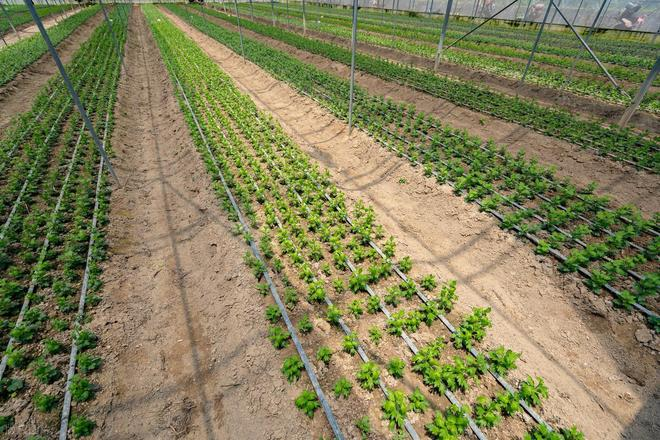
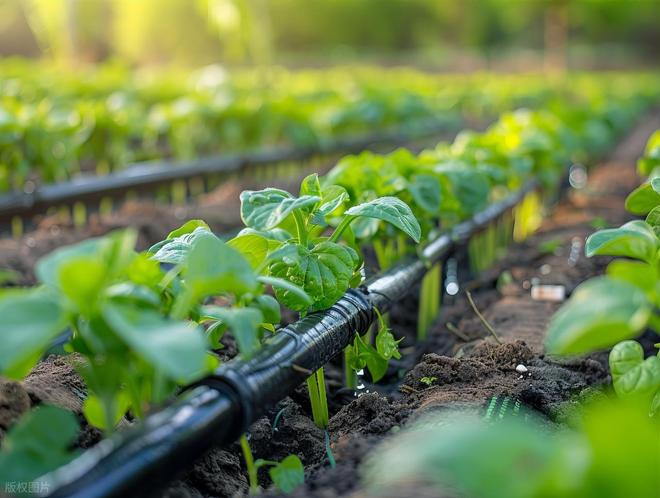
Dripping fertilizers are typical applications for the deep integration of liquid and hydrofertilized techniques, which are widely applied in the cultivation of fertilized fruit and vegetables, and in the cultivation of cash crops in daejeon, with core advantages in terms of precision, efficiency and ecology. In terms of the accuracy of nutrient supplies, liquid fertilization is diluted and transported directly through drip irrigation systems to the root zone of the crop, where nutrients exist in the form of ion and can be absorbed directly by the root system without the soil conversion process, effectively avoiding such problems as traditional solid fertilisation, nutrient volatilization from ditch application and solubility. The data show that the utilization of nutrients from liquid droplets can be as high as 85 to 90 per cent, with an increase of more than 40 per cent over traditional solids, which significantly reduces fertilizer waste。
An acre of enthusiast
In terms of productivity efficiency improvement, drip-tracking can automate and intelligently manage fertilizer and significantly reduce manual inputs through precision control of fertilizer concentrations, application time and usage by matching fertilizer application equipment. In particular, in the context of high labour-cost planting sites such as the facility sheds and the hills orchards, single operators can complete the fertilizer-hunting of dozens of acres, which is 5-8 times more efficient than artificial ditches. At the same time, the synchronous supply of water fertilizers through drip-catching, the precision control of soil moisture in the root system, and the avoidance of soil overdry or wetting have reduced water consumption and the probability of pests and pests due to abnormal field humidity, creating a stable soil environment for crop growth. In addition, the long-term use of liquid fertilization drips to catch up on fertility can improve soil physicochemicality, avoid problems such as soil sheeting and salinity accumulation due to over-fertilization of solids, and help improve the quality of arable land。
At the rate of fertility effects, nutrients from liquid fertilisation can quickly permeate to the soil depth, the roots of the crops can be absorbed within 24 hours, increasing by three to five times the rate at which solid fertilizers can achieve effects, and meeting the critical fertility periods such as crop bulge periods and mortuary periods with precision. In the case of fruit and vegetable crops, for example, high potassium-type liquid fertilizers are used during the expansion period to rapidly replenish the potassium element, promote the expansion of fruit and the accumulation of sugar, and significantly improve the quality and production of fruit. It is important to note that the application of liquid fertilization is subject to the principle of “reduration” by fully mixing liquid fertilization with a small amount of clean water, followed by uniform application in irrigation water to avoid local over-concentration leading to the rooting of crops; and by rationally regulating irrigation levels in conjunction with soil lumbers to ensure a balanced distribution of nutrients in the root distribution area。
An acre of enthusiast
An acre of enthusiast
The function of leaf spraying and the pursuit of fertilizer is complementary
It needs to be made clear that the application of liquid leaves is not a substitute for drip irrigation, but rather a functionally complementary application system. Leaf spraying, which focuses on the rapid replenishment of micronutrients and the mitigation of acute crop deficiency symptoms, is applied to nutrient control during special periods of fertility, such as crop seedling and flowering, while drip irrigation and rushing for fattening focus on the continued supply of large amounts of elements throughout the whole reproductive life of the crop, is the core method of fattening that ensures crop yields and quality. In production practices, coordinated application programmes for “leaf-spray + drip irrigation/push-and-fertilize” need to be constructed to maximize the nutrient supply value of liquid fertilizers, taking into account crop varieties, planting patterns, fertility stages and soil conditions。
Industrial values and development outlook for multiple application of liquid fertilization
The full realization of the advantages of liquid dripping and flashing for fertilizers not only provides technical support for the boosting efficiency of agricultural production, but is more compatible with the efficiency of fertilizer reduction and policy orientation towards green agricultural development. In the context of labour shortages and the urgent need to improve the quality of arable land, the promotion of multiple applications of liquid fertilizers can effectively reduce the cost of agricultural production, reduce the pollution of fertilizer sources and enhance the production of integrated cropland. In the future, with the iterative upgrading of liquid fertilizer formulation technologies and the proliferation of integrated water fertilizer equipment, drip irrigation and poaching of fertilizers will be scaled up in more planting scenes, facilitating the transition of agricultural production towards precision, intensification and ecology。
Summary
The application value of liquid fertilizers goes far beyond leaf spraying, dripping and rushing for the core advantage of efficient, accurate and fast energy efficiency, and is the preferred method of finding fertilizer in different planting scenarios. Agricultural producers should break traditional knowledge of application, choose the method of application of liquid fertilization in combination with their own planting needs, fully exploit the nutrient supply potential of liquid fertilization and inject new kinetic energy into high-quality agricultural development。
May you all have a good harvest in the land
The details open an acre network
We'll consult an acre of the network