


Lenin, in the constitution of the party and the organization of the party, not only argued the basic view of the proletarian arts “to serve the millions of working people”, but also clarified the political-dependent, “tool theory” theory of the arts and culture to achieve its political objectives of politicization and organicization of intellectuals with strong political organization and force. These theories were accepted by mao as a weapon of thought for the integration of revolutionary forces, the creation of cultural leadership and the establishment of the maoist ideology as a party-wide guide。
The challenge of intellectual liberalism and the historic opportunity to establish “cultural leadership”
The political situation on the national unity front of japan has brought about relative calm in the domestic political climate and unprecedented historical opportunities for the development of the communist party. With the invasion of the japanese army and the failure of major cities such as shanghai, the displacement of a large number of cultural elites and the influx of people called for by the democratic climate in the ganning region became a major feature of the socio-cultural ecology of the time. In contrast to the culture under the dictatorship of the political culture of the state system and the great rear, janan is considered to be “a vibrant heart of the nation's culture, not only politically but also culturally” (welcome to the scientific arts, emancipation daily, 10 june 1941)。
On 1 december 1939, mao zedong drafted for the centre a decision on “the enrichment of intellectuals”, stating: “in the long and brutal war of national liberation, in the great struggle to build a new china, the communist party must be good at absorbing intellectuals in order to form a great resistance, organize millions of peasants, develop revolutionary cultural movements and develop a united front for the revolution. The triumph of the revolution is impossible without the participation of intellectuals.” he reminded the party and the army of the need to overcome the fear and exclusion of intellectuals, while proposing for the foreseeable future that intellectuals should be “educated”, “drived”, “to serve the army, the government and the masses”, “and gradually overcome their weaknesses in the long struggle to revolutionize and popularize them, so that they could be in harmony with the old cadres of the old members of the party, and so that they could be in harmony with the workers and farmers”. It goes on to say that “the creation of the proletariat's own intellectuals must not go away from using the former intellectuals of society”. [mao zedong selected series 2, pp. 618, 619, 620. ♪ i'm sorry ♪
The democratic politics of the communist party and the courtesy of intellectuals have made the cultural life of the janan and the community particularly active. A large number of cultural and artistic societies and publications have emerged, and various artistic and creative activities have flourished, yet their work has become physically difficult to accept by the general public, owing to elite consciousness and the struggle to escape. The intellectuals and artists from the zone have demonstrated their individualistic quest for creative practices and political participation. For example, in february 1942, during a caricature exhibition organized by zhang zhang, hua junwu and choi joo-hoon, in march, the daily newspaper emancipation published tin ling's "sense of the 38th festival" , aqing's "know the writers, respect the writers" , roh zheng's "or the era of monument", wang's "the wild lilies" , and the wall's "light riders" , all of which were individualistic and showed a liberal tendency to exclude party leadership. In march 1938, at a feast, the first-come-on-yan'an xiao jun spoke “not in agreement with the yan's approach to literature for political service” and said “to reduce the level of literature”. After being subjected to anonymous criticism, the xiaojun withdrew from the table. [see suh yin: some contacts between me and chairman mao, yen an recollections, p. 85. ♪ i'm sorry ♪
This phenomenon has attracted serious attention from the cpc, which considers it to be “absolutely equalism”, “the obscurantist ideology of the small bourgeois that is detrimental to unity”. [mau zedong: speech at the re-edited colloquium, mao zedong news work selection, xinhua press 1983 edition, p. 91. On 17 april 1942, when the central political bureau of the communist party (cpc) discussed the study and inspection of yanan, mao spoke about the situation in the yanan arts and culture: it was now necessary to correct the issues of egalitarianism and extreme democracy. The arts and the arts are resistant to the wind, and now we have a party-wide exercise, as are the members of the arts and the arts, and the daily newspaper liberación takes the opportunity to discuss the party's cultural policy. [see chen jin: mandarin mao zedong, shanghai people's press, 2005, p. 226. As a result, the revision of the party's literary and intellectual policies in the context of the windstorming campaign became the focus of mao's thinking. This thinking directly points to the political objective of creating “organic intellectuals” who serve their class and thereby take over cultural leadership. On 20 april 1945, in the resolution of the central committee of the communist party of china on a number of historical issues, adopted at the sixth and seventh plenary sessions of the enlarged communist party of china, it was stated: “the successive manifestations of intellectual subjectivity within our party, political `left' right, sectarianism in the organization, whether or not they form a course and lead, are clearly manifestations of the anti-max leninism and anti-proletarian class of small bourgeois ideas. For the benefit of the party and the people, an educational approach to analysing and overcoming the small bourgeois ideology within the party and promoting its proletariatization is essential.” [selected highlights since the establishment of the party, vol. 22, central documents press 2011, p. 109. ♪ i'm sorry ♪
Iii. Conclusion at the yanan summit and the enforcement of instruments
As part of the effort to achieve “cultural leadership”, the yyan renang cultural encounter was an important node。
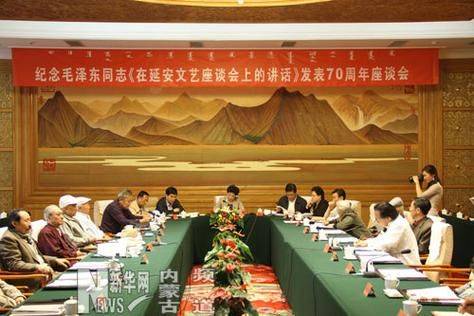
The convening of the yianan rene was proposed by mao zedang. Mao spoke of his thinking at the time: the party's central intellectual policy was in place, but there was not yet a single good decision on literary and artistic work. In the past few years, there has been a great deal of discussion about the need to combine artists with comrades who work in the party's military and economic sectors. [see chen jin: mandarin mao zedong, p. 225. On 10 april 1942, the central secretary of the communist party of china formally agreed to mao's proposal to exchange views on writers' positions, arts policies, culture and culture, objects of literature and literature。
In order to facilitate the symposium, mao focused on research and research, “in april alone, he asked artists to talk to or write to them, and if they had written about it, there were one dozen” (jan jin: man mao, p. 226). “in the memory of some of the parties, chairman mao's linguists, iqing, xiaojun, shuquan, liu baek yu, ouyangshan, hsu myung, hsu fang, yan wenai, zhou libo, cao xiaohua and xiaoqiao yao are many others.” [hujomu: statement of president mao at the yenyan rené colloquium, the spirit of china, no. 5 of 2006. ♪ i'm sorry ♪
The proceedings, views and theories of the yaa are not repeated here. What is at stake here is the question of why, after listening to mao's speech, the elite's self-proclaimed communicators “surrender” or how the “cultural leadership” of japan's zedong was established?
In his speech, mao pre-empted a logical premise for the inclusion of small bourgeois intellectuals who were not proletarians in the path of mao's philosophy: that is to say, in the chinese national revolution struggle, there are two battle lines and two armies, the cultural army and the armed forces with guns, which are in the same general direction and have helped the chinese revolution. But the two armies “do not work together in practice”, “to fully integrate” and “to make art an integral part of the entire revolutionary machine”. According to this logic of “politicization of the arts”, “militarization of the arts”, intellectual artists are required to look at the “tools” and “crickets” of the party's cause。
In this logical context, mao zedong has begun to justify: from literature to the general public, to how to serve the general public; the relationship between the party's arts work and the entire party's work, as well as with non-party arts work; the standard issue of art criticism; and the general problem of art. The logic is tight, the layers are progressive, the silk buttons。
In fact, during the yenan renaissance, there was a clear exchange of ideas among participants, thanks to the democratic style of the communist party leaders and the generous treatment of intellectual artists. Oyangshan recalls that, while mao's speech clearly points in the right direction, acceptance is not free of obstacles and contradictions, which means that “the language and style of europeanization that i loved in the past must also be retried by new farmers and new farmers' cadres. It is clear that, because their level of literacy cannot be raised at once, there is a great distance between my literary creation and their reading hobby. So i have to face a choice: do i keep my style so that they can't accept my work? Or do i change my style so that my work can be as happy as possible?” kussy acknowledges: “i was at a time when the level of marxism was low and i had a lot of little bourgeois emotions in my head, and i couldn't understand these problems in theory, even if some thought it wrong.” (yanian rene recollections, pp. 69-70, 119) ♪ i'm sorry ♪
However, these ideological contradictions and incomprehension have gradually been eliminated in the general movement since then, to accept the genuine sentiments of intellectual artists until genuine embrace. In his 45-year-old memories, the personal xiaojun also expressed his satisfaction: “president mao saw the problem so deeply, so many problems in the arts and literature, he grabbed it, he grabbed it. ... It has proved that since then, everyone has followed the direction, path and objectives of the speech, and indeed has received good results and achieved great achievements.” following the colloquium, yanan, as well as a wide range of arts and craftsmen from all the anti-japanese fields, tried to combine themselves with agricultural and industrial soldiers in an effort to win the war against japan. In particular, in the area of literary creation and theatre activities, the past has been characterized by a pattern of depravity and dissociation from the masses. People are rushing to the countryside, to the front lines, to the factories, and soon to write many inspiring works.” [shaw army: the unforgettable years of janan — reading (yanan cultural movement) at all, people's daily, 11 may 1987. “in his speech at the art colloquium, chairman mao referred to many important, fundamental issues, as well as to the writing of light and darkness. Each issue is so thorough, clear and thorough, and i feel very kind and relevant. Although i did not think in depth, i was very happy and sincere in using the word as a weapon to excavate myself so that i could wash myself of the dirt that my mind has contaminated from old societies, and i would rather take a bath in pain and pain in the wind movement and then lighten it up in order to fight again. At the time, in the institution as a whole, everyone had the spirit, the courage to meet every day, to inspire each other, to exchange criticism, and to look at themselves in reality. This serious, stressful, painful and pleasant learning experience will remain forever in people's memory and become a page of happiness throughout their lives.” (yanan rené recollection, p. 64). And she self-censored and said, "i didn't learn well enough in the three winds, but i began to realize a little bit, and i began to understand that there was a feeling of turning back. All the boredom, all the effort, all the concerns and mistakes of the past are like the feeling of tang san's presence by the river reaching the sky to see his body flow with the water, a feeling of realization, vision and fear. I know that this is, at best, the beginning of a proper understanding, and that i should hold this key firmly and step by step. There's another nine hundred eighty-one ahead." [rememberary of the jian'an central research institute, china social science press, hunan people's press, 1984, p. 140. ♪ i'm sorry ♪
How does this “twilight-to-see” and “twilight-to-see” work out?
The reorganization of the liberté daily literary section marked the beginning of a fine-tuning process. Since then, the arts and crafts community, like the rest of the party, has gone through a period of consolidation, censorship, vetting of cadres and liquidation of the army, under a unified central arrangement. Initially, the arts and culture were characterized as “the problem of ideas”. As mao said, “it is our policy to carefully guide them in their conscious, rather than reluctantly in the fight with the workers and farmers. It is a matter of thought, not of reluctance, not of brutality, that a few should not be allowed to form one. Our general approach is to combine literaryists, the majority of artists and workers and farmers, so that they look at the lower and middle class and at ordinary literary workers.” 2 mao zedong, people's press, 1993, p. 430. But with his intervention, the trial and rescue movement took a tyrannical approach, creating a strong political pressure on intellectual artists, and then even the royal tragedy. Although mao has, on various occasions, “compensated” the excesses of the rescue campaign, the politicization of ideas has objectively contributed to the transformation of intellectual artists。
The logic of the factual dimension has also forced intellectuals to submit to party leadership. One, compared to large cities like shanghai, where they live mainly on the cost of individual writing, and the other in yanan, where they enjoy security of supply; and the other, the intellectual artists. Many of them are members of the communist party. Although “artistic instrumentalism” contradicts the pursuit of individualistic values within them and still contradicts the cultural and creative patterns they share, the security of life and organizational belonging give rise to an intellectual identity。
The speech was the most dramatic for intellectuals, and it also succeeded in deconstructing their elite mentality by opening ethical arguments in mao zedong and placing intellectual artists in a moral dilemma, so that they could be faithful to their role as primary students and loyal fighters on the party's artistic front。
The idea is an integral part of the cultural identity of chinese intellectuals. In this context, “the popularization of literature” and “services to industrial and agricultural soldiers” have a moral priority without suspicion. Mao seized on this point and said, "what is popularism? It's the mentality of our literary workers and of the general public of industrial and agricultural soldiers. In order to form one, the language of the people should be carefully studied. If there are many people who don't know their language, what art is it? Heroes are useless, that is to say, your great wisdom, and the people don't appreciate it. The older you get in front of the crowd, the more you look like a "hero" and the more you sell it, the less people will buy you. If you want to get to know you, you have to get to know the crowd, you have to be determined, through a long and even painful process." ♪ i'm sorry ♪
Mao tactfully converts the great mission of “publicizing” the intellectual artist into a “publicizing” reality, depriving the intellectual artist of a high psychological basis. Mao took the example of himself: “i think that the clean people in the world are only intellectuals, and workers and farmers are always dirty”, “revolutionary, together with workers and soldiers of the revolutionary army, i became familiar with them, and they became familiar with me. It was only then that i fundamentally changed what bourgeois and small bourgeois relationships taught me. At that point, the unreformed intellectuals and the worker farmers felt that the intellectuals were unclean, and the cleaners were the workers farmers, who were cleaner than the bourgeois and small bourgeois intellectuals, despite their black hands and cattle shit on their feet. It's called emotional change, one class to another. In order to make our work popular, as intellectual artists, we must transform our minds and feelings. Without this change, without this transformation, nothing can be done well, nor can it be done”. 3 mao zedong, 851-852. ♪ i'm sorry ♪
By so doing, mao has completed the process of organicization of intellectuals by removing the resistance to the individualist ideology of intellectuals, through their eloquent intellectual argument, strong factual logic and clever moral pursuit, thus completing a crucial step in the decision to establish the leadership of the chinese communist party。
The statement was issued as a key step in the integration of the “cultural army” of the communist party of china (cpc) to seize “cultural leadership”, guided by neo-democratic theories. The mao zedong idea, which was formed through the consolidation and organizational integration of the yon an tung-tung movement, has been further developed and deepened by the idea of “cultural leadership” that was proposed and established by the speech. Not only did the speech integrate the revolutionary forces in terms of culture, cleansed ideas, created a new chinese cultural team, but it also shaped the subsequent leadership of the party in the arts and the direction and uniqueness of the socialist arts。
The author of this book is fahrenhei, deputy editor, central documentation research office, ccp, beijing



