


Network traps are targeting minors。
In the recent past, in the “two elevens”, a number of merchants launched a red bag, watching adults shop in large quantities, and the junior high school student tsui was so excited that she received a message from the “red bag return, 100 to 200” that she had decided to try, but did not expect to fall into the trap of a liar。
Due to the lack of social experience and the ease of access to the network, minors such as tsui have become the most easily seduced target of many frauds, and fraud schemes such as part-time billings, back-to-backs, play-playing, etc. Have become “traps” that can easily be used by minors。
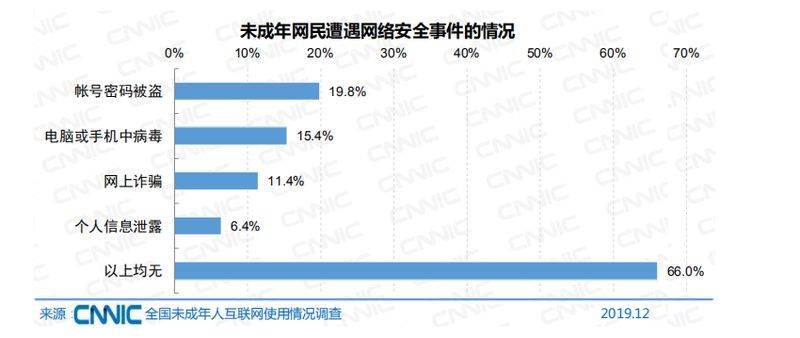
According to the 2019 national study on the use of the internet by minors, published jointly by the central department for the defence of young people's rights and interests of the communist youth league and the china information centre on the internet (cnnic), there were 175 million minors, 93. 1 per cent of whom had access to the internet. In addition, 66. 0 per cent of all types of cybersecurity incidents have not been encountered in the past six months. In other words, 34 per cent of minors have experienced cyber-security incidents within six months。
Recent investigations by newkyo shell financial reporters have found that in various types of cyber-security incidents, return scams, bill-laying scams and game-related scams are among the three most easily “moderated” frauds of minors, and that such “simply” easy-to-identified scams are often easy to hook up with minors, with a number of black dealers setting up frauds through rent numbers, buy numbers, forged payment muzzles, and dispatching wooden horses。
Red bag return trap:
100 bucks for you? There were students who found it worth $200,000
“a long time ago, when i was shivering, a private letter was sent to me, asking me to chat with qqq, then to his qq q space, to see a red bag return, and to give him $100 to $200, and i thought it would be okay to give him $100 with the money he saved, so he not only didn't return me $200, but he asked me to transfer another $800 to $1,000, and to return me $3,000, and i think this guy should be a liar.” suh, a junior high school student living in tianjin, told ninkyo shell financial reporter that he was suspected of having been subjected to cyber-fraud。
Suh stated that she had occasionally been added to the unknown qq by various means, and that the space of the qq q was also marked by propaganda images claiming to be profitable。
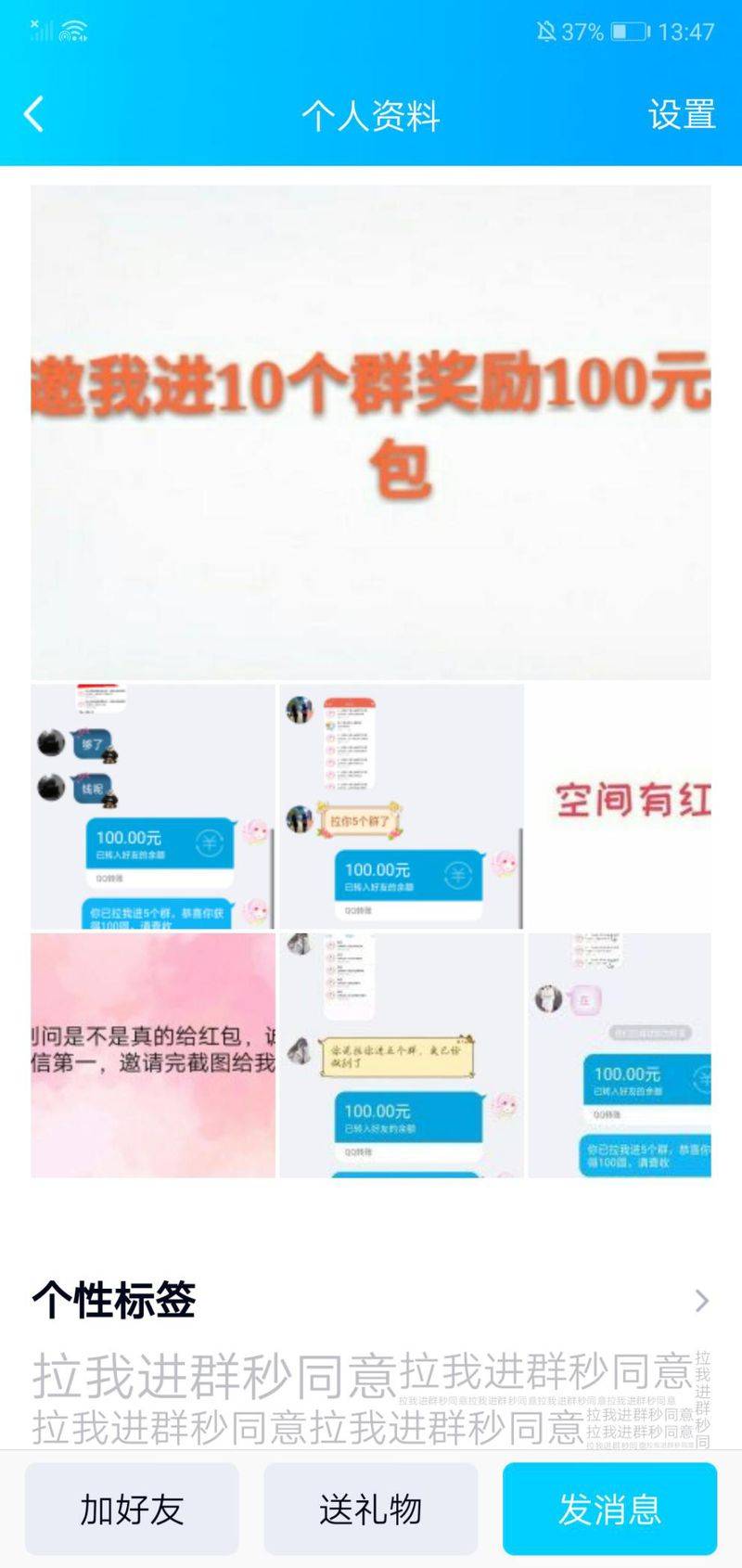
A reporter from the new kyoto newspaper shell financial reporter logs in with seo's q q-user, named "the ghost" q-q-user, via a group of q-q-lists, to send a temporary message to him, saying, "do you have a return to your sister?"
Following the reporter's reply on “how to play”, ghosts soon sent a picture showing a “return to profit, all seconds”, ranging from $100 to $999 to $800 to $18888。
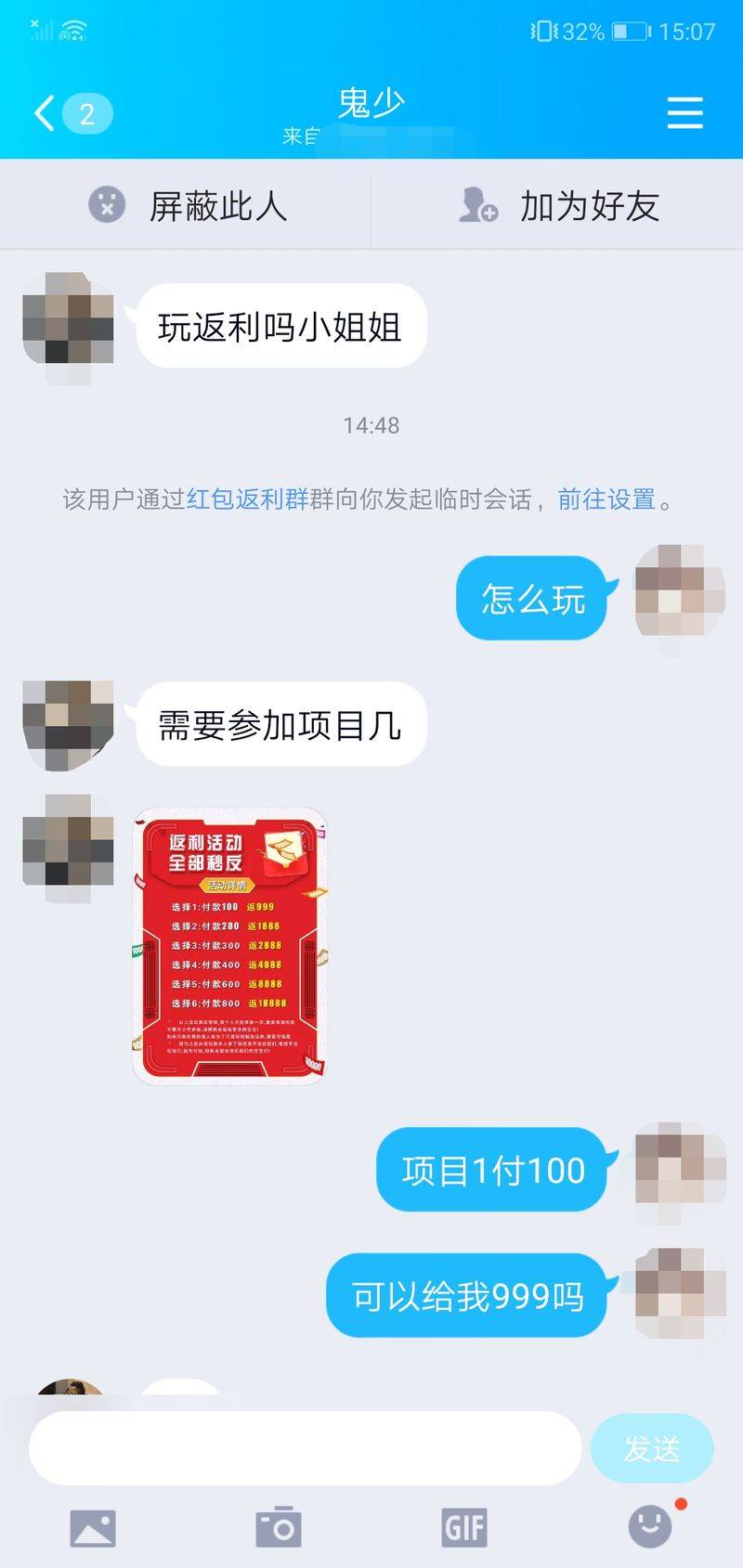
In response to journalists' questions about “return” activities, ghosts did not answer directly, but instead sent a change figure of over $350,000, indicating “no shortage of money, no direct”。
Journalists who tried to ask how the "ghosts" could pay, indicated that they could write up the money and drag the journalist into a newly established microclinic "return pack", when the journalist indicated why he could not return $899 directly, or pay 10 dollars, or whether he could return $20, saying that “the event is over in 10 minutes, let's not play" and that the group was disbanded 10 minutes later。
Coincidentally, 10 minutes later, another user, integrity releasing, sent his friend's application to the press and directly stated, “i am a welfare worker to participate in the return? Ten dollars to 20 dollars, “and sent a map of the success of the return, stating that “the student party will not be deceived”. The journalists tried to send them a red envelope of $10, but they did not return, as stated in the cut-off, but continued to ask for a larger amount of red bags, and after the journalists failed to respond, the “good faith return” blacked out seo's qqq。
In response, tienjin network sources have indicated to ninkyo shell financial reporters that such schemes have a low “technical content” and are mostly aimed at low-intensity fraud-prevention populations, “prejudicing victims with false micro-credit records, petty money, etc., and creating a sense of urgency with words such as “the end of the activity immediately”, and that when victims begin to transfer money, more money is lured into various ways”
Shell economics journalists found that there was a team that had specifically targeted minors for such enrichment fraud. On 2 june, the public security bureau of ishijia zhang city gave a similar example at a press conference on the results of the "sword light 2020" campaign: on 21 april this year, zhang qi, a student from ishikoshi, added to his mobile phone an official qqq number claiming to be a star, and saw in his q q space an event of full return. At the instigation of the other party, zhang used his mother's mobile phone for more than 200,000 and found it fraudulent。
According to the ishi jia zhang public security bureau, the case was the first telecommunications fraud against a minor in the city this year, and the task force carefully combed the records of the chat and the flow of funds and found that the victims had transferred to suspects in the form of scrutinizing codes, most of which were public receipts at convenience stores or on-line in guangdong, hunan, etc. The task force immediately went to the local investigation, successfully mastered three off-line split-money-laundering groups and one on-line money-laundering group, leading to the arrest of a number of suspects, including fraud, money-laundering, and the qq q q q ration。
Part-time billing trap:
Use your father's phone to draw up a bill and log in
Shell financial reporters found that the part-time billing was another type of fraud that was easy for minors and student parties。
Because of their lack of means of subsistence, they can only buy what they want from the pocket money provided by their parents, and when parents do not support the cost of some games, many student parties want to do part-time work to make money。
"the part-time customer service started by sending him flowers, sesame credit and running water information, and then asked me to apply for a reserve, and by scrutinizing it to the other party's account, so i knew i had been deceived."
In response, shell financial journalists found a similar “part-time recruitment” information on the network and contacted each other as junior high school students. When the other party learned that the journalist was still in school and had not paid for the treasure, it immediately taught the journalist how to log in the parents' payment account, “speak to me on your father's phone”
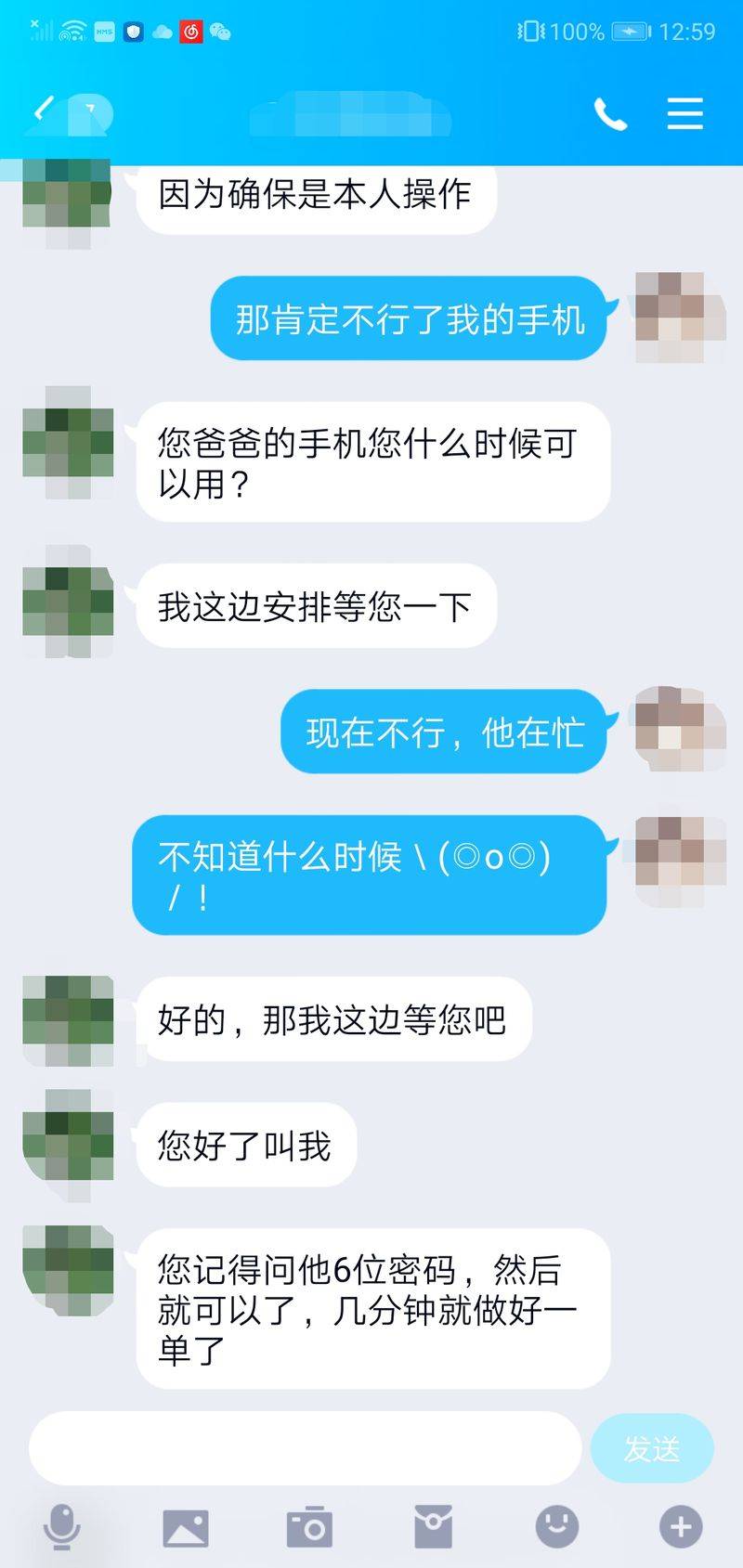
Subsequently, journalists were repeatedly asked to log on to qq on the “daddy's mobile phone” on the grounds that “you can only use dad's money brushes” and that you can get a commission of $30 for one. After the press said it had been logged in, the other party sent an apk link called “swipe helper” for downloading installation. However, when it was about to be installed after downloading, the journalist's mobile phone posted a virus risk alert。
“the apk link is likely to contain a wooden horse, and payment after installation is susceptible to the risk of financial disclosure.” in response, shell financial reporters were told by relevant staff at tianjin network that “it would be preferable not to click or download such strange apk links easily, even without a wooden horse, and that there is a high risk that the seductive `fishing' interface may be used to deceive users”
The daily newspaper kim hua has reported similar schemes. On the afternoon of 25 may, a 14-year-old girl, quiet (alias), using her mother's mobile phone, was subjected to a payment code fraud from a fraudster, and was immediately “squeezed” off the payment account after scrambling and filling in the payment account numbers, passwords and cell phone numbers. After a while, the money was finally recorded, but the flowers, the loans were overdrafted, the loans were recorded totalling $11,000, and her qq was hacked. In this regard, the police station of the yiu city public security bureau reminds parents and minors of the need to strengthen their sense of self-protection, bearing in mind that fraud prevention techniques such as not clicking on strange links, not sweeping 2d codes, not filling in critical personal information, and not disclosing authentication codes prevent them from falling into the fraud trap of communication networks。
A survey of shell financial journalists found that such part-time billing traps often reach ordinary users by means of a variety of posters, forums and job categories of “recruitment stickers”, or by renting micro-signs, qqqqs, etc., “bombing groups” in large chat groups。
Previously, shell economics journalists had been in contact with black sellers of micro-letters, and ordinary users could rent their micro-letters at $60 a day. In order to investigate, journalists rent their tweets and find that they add dozens of “part-time groups” in a day and repeat messages about “part-time activities” in machine scripts in part-time groups to attract users。
Game fraud trap:
Unblocking, free skin delivery, billing? Watch out for the money. The account's gone
In addition to the above-mentioned offences against minors through the qq, the wireless group and short video private correspondence, the game fraud is another trap that minors are vulnerable to。
The national study on the use of the internet by minors 2019 (hereinafter referred to as the report) shows that mobile phone games reach a wider audience among minors than computer games. According to the survey, over 50 per cent of internet users in all academic groups play mobile games, while 51. 1 per cent of primary school students play mobile games; 61. 2 per cent and 59. 2 per cent of middle school and high school students do so, respectively; and 71. 7 per cent of secondary school students do so。
Shell economics journalists have learned that many student party players “just needed” to charge vouchers, purchase gaming devices such as “skin” and remove their addiction, and that many frauds have been committed against them。
The “students party's” glory player, gael, met with such a scam: “if i had found someone who had been known to help unflinch the obsession, i turned around for $30, and then i received an e-mail that had been sent congratulating me on unflinching it, thinking it had worked, and then found the mailbox to be superstitious and undisturbed.”
“ghal” told reporters that such scams are small, and that there are a variety of hoaxes around the game, “for example, those who claim to give their skin free of charge, who actually log in the account and who actually transfer their micro-mails, and those who say that 100 generations charge 300 coupons, which are easy for the inexperienced.”
On 17 april, a 10-year-old child, using his/her parents' mobile phone, was logged into his/her account number and password in the name of a “teacher, free of charge, skin-skin delivery” on an app game。
Reports indicate that in the case of cyber-security incidents involving minors, accounts codes were stolen in 19. 8 per cent, viruses in computers or mobile phones in 15. 4 per cent, online fraud in 11. 4 per cent, personal information leaks in 6. 4 per cent, and that 66. 0 per cent of underage internet users indicated that they had not experienced cyber-security incidents in the past six months, up from 55. 6 per cent of the total internet users. According to the report, this may be due to the fact that underage internet users have less access to the internet than adult internet users and are less likely to encounter cyber-security incidents; and to the low awareness of cyber-security among underage internet users, who are not aware of the abuses they encounter。
With regard to the internet “traps” encountered by minors, such as profit-return schemes, the anti-fraud centre of the west lake public security directorate stated that parents should be safe from paying for their own mobile phones and should not easily inform their children of the key information on the payment codes for their mobile phones, bank payment codes, etc. At the same time, through interaction, they are told not to blindly sweep the 2d code in order to prevent malicious software and carpvirus from being forcibly installed, let alone blindly click on an unknown link to prevent access to fishing sites。
I'm a reporter for new kyoto's shell



