


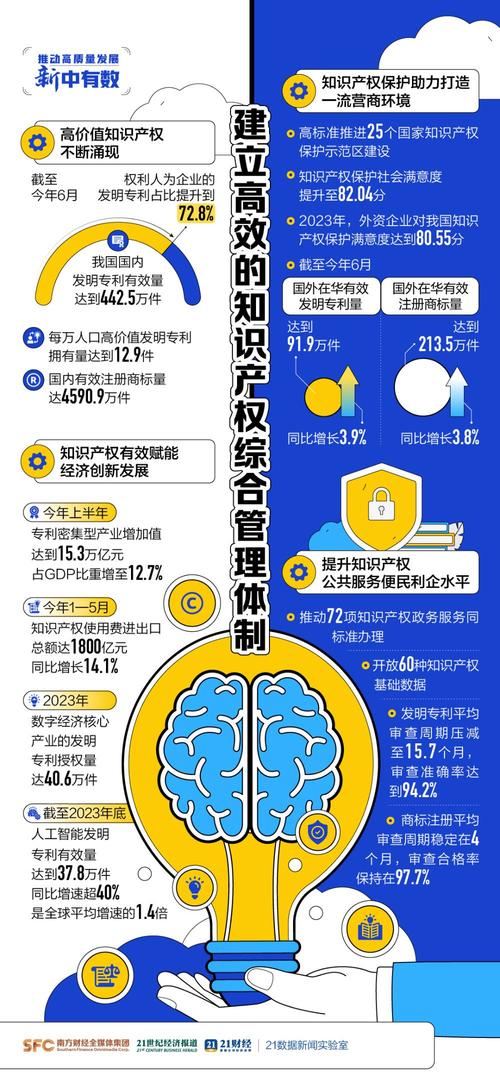
In recent days, at a press conference organized by the press office of the state council, the deputy director of the national intellectual property administration, ri wenzhu, stated that by the end of 2025, our country had 16 patents per 10,000 people for high-value inventions, that the number of domestic (excluding hong kong/australian) invention patents had increased to 5. 32 million, and that social satisfaction with intellectual property protection had risen to 82. 81 points. The country's intellectual property rights create an environment for science, technology and innovation, promote a culture of respect for knowledge, talent and innovation in society at large, and stimulate the dynamism and potential of various subjects of science, technology and innovation。
In 2025, our intellectual property work continued to provide high-quality, autonomous and innovative results. While the number of patenting licences granted throughout the year reached 972,000, the number of pct international patent applications reached 78,000, with a steady increase, the patent review cycle for inventions was reduced to 15 months, the resolution of cases was increased to 95. 6 per cent, and efficiency and quality were reviewed for both efficiency and quality improvements, allowing innovation to move faster and better out of the laboratory and to the market, thus opening the critical path for scientific and technological results to real productivity。
Intellectual property rights (iprs) are the bridge and link between the transformation of science and technology results to real productivity, with innovation and markets. At the policy level, the country has continuously strengthened its orientation and incentives for the conversion of scientific and technological results, significantly improving the overall quality of its scientific and technological achievements and intellectual property rights. In 2025, the number of patent transfer licences filed nationwide reached 697,000, an increase of 13. 7 per cent over the same period, patents were converted to universities and scientific research institutions nearly 90,000, patents for enterprise inventions reached 54 per cent, patents were increasingly converted into real productivity, economic values continued to be released, and they became a hard nuclear resource to enable the real economy and support industrial upgrading。
As the level of intellectual property protection in our country continues to rise, so does the voice in international affairs of intellectual property. Between january and november 2025, the total national import and export of intellectual property user fees amounted to 38. 287 billion yuan, an increase of 7. 4 per cent over the same period, of which exports increased by 23. 1 per cent over the same period. In 2025, we established 36 new platforms to guide responses to intellectual property disputes abroad, bringing the total to 116. Our technology and patents are steadily participating in the international division of labour as an important component of the export of technology elements in trade in services。

In the area of branding, 4. 206 million brands were registered throughout the year, and nearly 50 million brands were effectively registered in china (excluding hong kong and australia), with china's brand worth $1. 81 trillion out of the top 5,000 brands globally, the second highest. The constant strengthening of trademark protection systems provides a stable expectation of competition in the market and allows firms to work hard on branding。
At the same time, the landscape of the application of intellectual property rights in the country is expanding and is deeply integrated into all areas of economic development. By the end of 2025, a cumulative total of 5066 geographical marker products had been identified, contributing to the development of the specialty industries and the region; over 40,000 registrations of intellectual property rights in data had led to nearly $15 billion in financing transactions; and 93,000 integrated circuit chart designs had been cumulatively registered, creating barriers to industry security in key areas. From traditional industries to new business practices in new areas, the enabling boundaries of our intellectual property rights continue to extend。
Intellectual property protection is not the best, but the best. In 2025, our system of intellectual property protection was improved, and this has become a vivid reminder of the evolving intellectual property industry in our country. In the future, the country's intellectual property rights work will need to further improve the system for the protection of new industrial intellectual property rights in new areas such as big data, artificial intelligence and genetic technology, accelerate the improvement of relevant laws and regulations, further dismantle the institutional barriers in the area of intellectual property, provide institutional safeguards for innovation-driven development and enhance the country's economic innovation。



