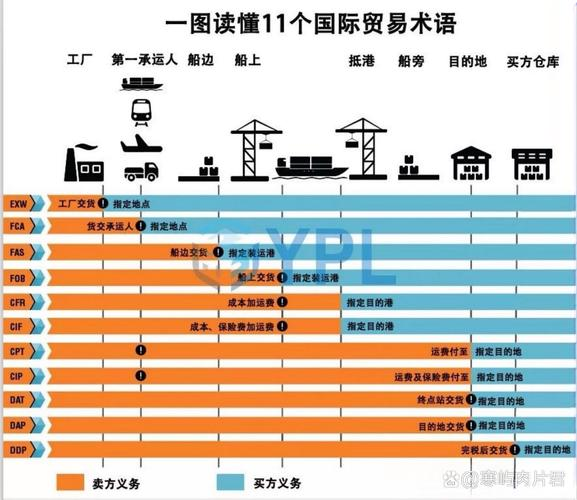
Reproduction - concept and content of trade terms (fob, cnf, cif), basic concept trade terms (tradeterms), also known as terms of trade, price terms (priceterms), a short concept (shothande)Xpression, which establishes the division of costs, risks and liabilities between buyers and sellers, as well as the obligations of buyers and sellers in the delivery and delivery of goods, is an important part of the price in trade. Ii. Three main international usages of trade terminology are the oxford rules of warsaw, 1932 (warsaw-oxfordrules 1932) and the revised definition of united states foreign trade of b 1941 (revisedemeranforeagradefinions 1941). C. General principles 2000 prepared by the international chamber of commerce (iccpubicationno. 560) were combined by icc, the first letter of the three words of the united states foreign trade definition. Incoterms, based on the three words of the internationalcomememememers. Iii. The current trade terminological practice, which is widely used in international trade,1 is the international chamber of commerce (icc) international chamber of commerce (icc) incoterms 1990 or incoterms2000,2 which was established in 1919 with membership in more than 140 countries and territories and is a worldwide private business organization with significant global implications, and is a high-level advisory body of the united nations established to promote the development of international trade and investment through effective action in the economic and legal fields. China obtained membership of icc in november 1994. 4 incoterms 1990/2000 is widely recognized in the world and is widely used in international trade contracts and l/c. Fob trade terms 1, definitions: fob is the capital of the first letter of the three freeoboard words, meaning delivery on board the port of embarkation, with a specific shipping port designation. Applicable modes of transport: sea and inland transport. Key points: risk allocation points, delivery points, cost allocation points are on the shipboards designated by the buyer at the port of shipment (in practice they are loaded into the cabin). 4. The seller's main obligation a is to deliver the goods in conformity with the contract at the designated port of shipment at the date or time specified in the contract to the ship designated by the buyer in the usual manner and to give the buyer sufficient notice to load the ship. B. The procedure for the export of goods (customs declaration, export reservation, etc.) is carried out in order to obtain an export licence or other authorization (business certificate, certificate of origin, etc.). C. Covers all costs and risks (actually up to deck) for goods to cross the port of embarkation. D. The usual documents (shipped sea waybills) for the provision of commercial invoices and proof that the goods have been delivered to the ship. 5. The buyer's primary obligation a is responsible for the payment of the price of the goods as contracted. B. Responsible for booking or chartering the ship, payment of freight (maritime charges) and giving the seller sufficient notice of the name of the ship, the place of loading and the time required for delivery, (in practice, the buyer informs the seller of its freight forwarder at the port of shipment and requires the seller to order the ship for payment of the sea carriage fee, which is paid by the buyer, usually 10-20 per cent less than the seller itself). C. Obtaining import permits for self-risks and fees (quota in importing countries are also sought by buyers from domestic administrative agencies) or other authorizations, and following all customs procedures for the import of goods and, if necessary, transit through another country. To cover all costs and risks of goods crossing the shipboard at the port of embarkation (actually beyond the cabin of the port of embarkation), to receive the goods delivered by the seller as required by the contract and to accept documents consistent with the contract. Point a in the actual business, the port of departure is indicated in the trade contract: the port of departure shall be the port of port or river (south china, chongqing, etc. For inland water) b, the seller is required to provide a clean-up loaded bill of lading in the trade, and the point of transfer of risk and costs is within the cabin designated for the port of shipment. C. The shipping connection shall be specified in the trade contract as to who will pay additional costs, such as air travel, demurrage and warehousing insurance. D. Who will bear the loading costs at the port of shipment, i. E., who will pay the costs of the thc, and who will pay the costs of the thc in international trade principles. E. And u. S. Clients and other inter-american customers, when making trade contracts, are mindful that customers choose to use the u. S. Foreign trade definition amendment of 1941 as a trade practice, or as an internationally common incoterms 1990/2000, in determining price terms. Because of the different interpretations of the two practices of the same fob terminology, the risks, costs, responsibilities and obligations are very different. F. Negotiate with the client that it can only designate a shipping company or a ship-substitute company, that the freight forwarder should be lined by our side and that the port of destination should also be designated by our freight forwarder, which would significantly reduce the risk to trade. V. Cif trade terms 1, definitions: cif is composed of the first letter of the three words cost, insurance, andfreight (..... Namedprotofofestination) in chinese meaning cost plus insurance and freight. (designation of port of destination) means that the seller completes delivery when the goods cross the port of embarkation (actually inside the cabin). While the seller pays freight premiums, for example, from the port of shipment to the port of destination, the buyer bears the risk of damage and loss following loading of the goods. Applicable modes of transport: sea and inland transport, country of trade (seaport or port where goods eventually arrive). 3. Key points: risk points, delivery points on board the port of departure and fee-splitting points on board the port of destination. The seller's main obligation a, within the time period specified in the contract, delivered the goods in conformity with the contract to the ship's port of destination and gave the buyer notice to load the ship. (b) responsible for the export of goods, obtaining an export licence or other authorization (origin, commercial inspection certificate, etc.)c, chartering or booking of ships and payment of shipping fees to the port of destination. D. Responsible for cargo insurance and payment of insurance premiums. E. Responsible for all costs and risks of goods crossing the port of embarkation. F. Responsible for providing commercial invoices, insurance policies and bills of lading for the loading of goods. 5. The buyer's principal obligation a. Payment of the price as contracted. B. Responsible for obtaining import permits or other authorizations for import. C. Cover all costs and risks of goods crossing the port of embarkation. D. Receipt of goods delivered by the seller under the contract and acceptance of documents consistent with the contract. 6. Focus point a in actual business, conceptual error zone: cif and fob, where the term " delivery point " and " risk point " are on the ship at the port of shipment, where the seller completes the seller's obligation to safely load the goods on board the ship, and where the risk that the goods may arise after shipment ceases to be liable. The seller placed insurance policies, bills of lading, etc., on the buyer, and risk claims were processed by the buyer. B. Scheduled cargo: under the cif conditions, the seller orders the ship independently, chooses the freight forwarder of the shipping company, pays the freight, terminal fees, etc., generally does not accept the buyer's designation of the freight forwarder/shipman, etc., and in the actual business the customer chooses a well-known shipping company with better service abroad, such as ma*ki, apl, which generally confirms the freight charges with the buyer and is acceptable after the date of the ship, but may not normally be shipped by the buyer's nominated freight forwarder. C. The seller is insured at the port of shipment, generally specifying the amount of the insurance at the time of conclusion of the contract, the insurance coverage and the application of the insurance terms, as well as the duration of the insurance liability, the choice of the association or the chinese insurance clause, and the transfer to the buyer of an endorsement when the insurance policy bank makes its submission. D. Offloading costs: terminal operating costs, etc., cif generally uses porttoport as a port-to-port clause, the costs of the port of departure are borne by the seller, the costs of the port of destination are borne by the buyer, e. Notice of loading and the date of transit, arrival, etc. 1. The seller completes its delivery obligations upon the loading of the goods at the port of shipment, upon obtaining a sea waybill and handing over the main shipping documents to the bank or to the buyer on its own initiative, upon obtaining an insurance policy to pay for the sea waybills and port charges. After loading, the seller gave the buyer sufficient notice of the loading. 3. Responsibility of the seller for the inevitable arrival of the unguaranteed goods and for ensuring when they reach the port of destination. 4. The seller is liable for damage, tide, loss, etc., if the goods are not loaded on a ship. If, at the time the seller submitted the documents, the goods had been damaged or lost, the buyer would still have to pay the voucher, and the buyer could rely on the bill of lading to the shipping company/ship, and on the insurance policy to claim damages from the insurance company without being able to claim damages from the seller. 6. It is unreasonable for the buyer in the actual course of business to have the goods in transit port, to have failed to make a timely turn-off, to have the goods transferred to port twice or three times in transit, to have the delay in the arrival of the goods in transit affecting its claim for the cost of work done in respect of the delivery of the garments/works, the cost of the air transport, etc., and to avoid the obligation to indicate at the time of conclusion of the trade contract when the goods arrived at the port of destination after the seller had not loaded the ship, and to have no guarantee of the date of transit. Vi. Cfr/cnf trade term 1, definitions: cfr/cnf is a combination of one of the three words of costandfreight, which in chinese means cost plus freight, with the designation of the port of destination, meaning that the seller completes delivery when the goods cross the port of embarkation, the seller pays the sea freight necessary to transport the goods to the port of destination, and the risk of loss and damage after delivery is transferred to the buyer from the time of delivery。applicable modes of transport: maritime and inland transport (to the port of destination of the trading country, seaport, port of river). Key points: the point of delivery, the point of risk is on board the port of shipment, the point at which the costs are divided, the sea freight is paid to the ship at the port of destination, and the insurance is processed and paid by the buyer. The difference between the obligations of the seller and the seller in the cfr/cnf contract is that the seller is not responsible for insurance, does not pay insurance premiums, does not provide insurance documents, and insurance for the carriage of goods by sea is left to the buyer. Other obligations are the same as those of cif. Point a of care in the actual obligation, transfer of the risk point: the risk point is that the seller loads the goods into the cabin at the port of shipment and the risk point is transferred to the buyer, who must have insured the insurance company prior to doing so, so that the seller in the actual business should agree on an approach for the pre-shipment and foreign buyer to issue notice of how and when to ship, and the trade contract should also indicate the content, mode, time of delivery, etc. B. Port charges, port charges, thc costs are borne by the seller, port charges at the port of destination, delivery charges, etc. C. Other attentions are the same as those of the cif. 7. Fob/cif/cfr common denominators1 and the three price terms apply to both sea and inland transport (e. G. The yangtze river in china and the great lakes in the united states) whose carriers are generally limited to shipping companies. 2. Each of the three price terms of the delivery point is the point of risk on the port of embarkation (actually inside the vessel) from the seller to the buyer when the port of embarkation crosses the ship (actually inside the ship). Cost point: the seller bears all the costs of the goods crossing the port of shipment. Bill of lading: the seller is required to submit to the buyer a bill of lading for cleaning of the ship. Notice of loading: the seller shall give notice of loading to the buyer in a timely manner before and after shipment. Risk point: the seller shifts the risk after loading the goods to the buyer at the port of shipment. Import clearance, fees, etc. At the port of destination are handled by the buyer; loading, land transport, export declaration, licensing, etc. At the port of shipment is performed by the seller. The seller has an obligation to book and ship at the port of shipment. Viii. Fob and cif price terms differ1 and post-price terms are different in nature. Ports after fob refer to seaports or river ports in the seller's country, whereas post-cif ports refer to seaports or river ports in the buyer's country. Ports after cif price terms should then indicate the country of the port, such as victoria port, in hong kong, in the united kingdom, and in brazil, have to be country-specific. The cost composition is different and the price is different. The fob price was to take into account all the costs and profits of the goods purchased from the raw materials and produced until the export customs declaration was loaded to the buyer's assigned cabins, while the cif was to add sea freight and insurance costs to the fob price. 3. The costs of operating at the thc terminal are different. In accordance with the principle of who pays the shipping fee and who pays the costs of the thc, the costs of the thc in the fob price clause are to be borne by the buyer, the costs of the thc in the cif are to be borne by the seller, the current domestic thc standard is $20 `box 370' and the costs of the thc are to be specified in the trade contract. 4. Payment of premiums, different: fob, cnf insurance is handled by the buyer, the seller should notify the buyer before loading the ship; cif insurance is handled by the seller and the premiums are paid, the seller insured under the terms of the contract and the insurance terms and hand over the policy to the buyer. International usage of price terms differs, fob prices are common to the united states and icc general principles 1990 and 2000, and cif is mostly icc practice 1990/2000, where trade contracts are entered into or customer letters of credit are issued with care to distinguish. Air cargo: fob seller only covers all costs incurred prior to the arrival of the goods on the aircraft and the port of destination for air transport is covered by the buyer. Cif sellers were required to bear the costs of air transportation for fob in addition to the costs of air transportation, as well as insurance coverage for air transportation of goods, as required by the buyer. Upon delivery of the goods by air, the ownership of the goods is transferred to the buyer. 7. Chartered vessels differ: fob prices are arranged by the buyer's designated shipping company/suppliers or even freight forwarders, and the buyer's ability to charter space in a timely manner may affect the seller's timely delivery and bank statements. The price of the cif is chosen by the seller on its own initiative. The notice of loading of a ship is given to the buyer at different times: the fob price and the cnf inform the buyer before loading the ship that the contents of the ship, the details of the loading of the ship give the buyer sufficient time to secure the goods at sea and cif is insured by the seller to inform the buyer of the notice of loading of the ship within days after loading of the ship. Post-shipment tracking services differ: the fob price terminology, which is normally the responsibility of the buyer for the second-way, third-way intermediate transfer because the customer has appointed the ship's agent/cargo agent, and the cif price term, which provides better services to the seller, is generally communicated to the buyer by the seller in timely contact with the freight forwarder, the destination port agent, the time of arrival, etc. The risk of force majeure is different (but the seller does not have such an obligation in the cif price, as the buyer would normally require in practice)10 and the risk of force majeure is different: the difficulty of the claim is different in the actual export business if the goods are loaded on board a ship, if the goods are exposed to force majeure natural disasters or accidents in the port of shipment or during transport, and the documents submitted by the seller are different from the risk that fob, cnf and cif would be exposed to a non-conformity clause under l/c in the case of non-payment. In cif terms, the seller is insured and is insured at the port of embarkation and, in the event that the customer refuses to pay the refund, the seller can claim against the local insurance company under the policy. In the case of fob and cnf, where the buyer is insured, the insurance policy is in the hands of the buyer and the insurance company is mostly abroad, the seller has difficulty in claiming from the insurance company, especially in fob terminology, and it is more difficult for the seller to obtain timely and accurate evidence from the company/ship agent whom the buyer assigned to charter the ship. Fob terminology for customer-designated freight forwarders/ship companies in current actual export operations