Lower secondary language knowledge — classification of words (word sex introduction)
I. Terminology:
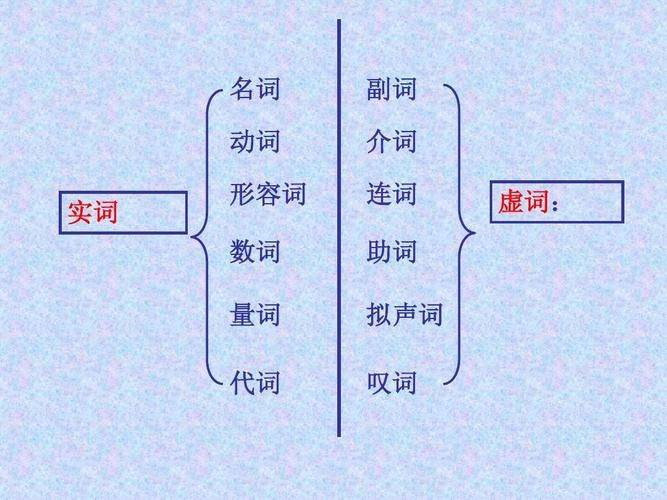
Words: words that express a real meaning, with nouns, verbs, adjectives, words, quantitative words, pronouns。
Verdicts: words that are not meaningful but that are grammatical in meaning are: adverbs, adjectives, synonyms, adjuncts, adjectives, adjectives。
Specific definitions and examples:
1. [nouns] are words that indicate the name of a person or thing. It's also terminological. It's an actual word. For example: china, the world, results, efficiency, morality, father, master, li, lunatics, faults, children, etc。
Terminology can be divided into the following subcategories:
An individual term, also known as a number of terms. For example: (one book), (three flowers), (five rivers)。
The grouping of terms, which cannot be accompanied by an individual number of words, corresponds to the collective number word or non-quantification word ", batch, part, part" etc., e. G. (a couple), (a part) vessel, (a number of) vehicle。
Admitted terms such as beijing, tiananmen, confucius, yangtze。
Time terms such as spring, morning, now, spring, tuesday, just now。
Place names, e. G.: tanya park, shop, asia, beijing, china。
Azimuth, e. G. East, west, upper, in, forward, inner。
Main syntax characteristics of terms:

(1) no "no" can be used to deny, if not "no hat"。
(2) the sentence is often used as the principal, guest or qualifier. Time and place names can be used, such as li, who was late yesterday。
(3) nouns generally cannot overlap and only those of a quantitative nature, e. G., persons, years, days。
2. [verbs] are words that indicate the movement or interaction of human beings, things (means action, development, psychological activity)。
The verb can be divided into:
And verbs and verbs. The verbs that can be used in the guest language are the verbs of objects, such as eating, beating, knocking, writing, and they can appear or not. There are also parts of the verb that have to be accompanied by guest words, such as: hard (hard) and big (high). Not enough verbs to carry a guest such as cough, rest, graduation。
Psychoactive verb. Such verbs can be qualified by adverbs such as "very, too". Like love, yes, yes, yes, yes。
Judge the verb. The main thing is "yes," to say yes or yes. In expressing judgment, "is" behind is "judgment" like, "i'm chinese."
The verb is also called the verb indicating the possibility or willingness of the act. For example: can and should
A verb indicating the state of a tendentious action or action. For example: (continue) down, (get) up, (go) in。