


Iii. Our strawberry production development response (i) enhanced screening and promotion of new strawberry varieties
The different geographical locations and the wide diversity of soils and climates make the choice of strawberry varieties dependent on local realities. The preference of local citizens for strawberry colours, flavors and appearances, the demand of farmers for abundance, maturity and resilience, the market's demand for sustainability, the establishment of a well-developed system for the evaluation of strawberry varieties, and the screening of many new varieties that are ready for early and late. The new varieties selected were first piloted through three channels: the nucleus parks, the lead enterprises and the typical farmers, and, after successful seeding, the extension to farmers to meet the diverse needs of citizens and farmers for the properties of strawberry varieties。
There is a need to continuously explore, study and improve the quality of seedlings through the development of high-quality seedling techniques, as well as to regulate the quality of seedlings. The continuous development of quality seedlings lays the foundation for the healthy development of the strawberry industry。
Food security is receiving increasing attention from consumers, and strawberries are not only delicious and sweet, but also safe to eat. The main indicator of choice is to combat disease. Growers have to work hard on production management measures and use pesticides with biological agents. The area under cultivation is currently expanding year by year for such varieties as beads, christmas reds, kyoshi incense and red paint。
(ii) production technology services
In the case of the changping region of beijing, while the strawberry industry has grown, the changping region has set up a strawberry work team consisting of units of the agricultural system, which is responsible for the region-wide production of strawberry technical services, providing technical guarantees for new technologies in production, the application of new varieties and the resolution of production problems。
In recent years, the country has promoted a combination of soil disinfection, soil fertilization in solar hothouses, water fertilization, bee fertilization, carbon dioxide fertilization, green control and so forth, which have been extended to the production line by means of demonstration and training workshops. On this basis, more efficient extension models are being explored and state-of-the-art production technologies are being put in place to promote strawberry industry development and farmers ' incomes。
(iii) development of multi-planting models for the production of precision strawberries
In parallel with the development of the solar greenhouse strawberry industry, various cultivation models, such as high-planting, semi-basic cultivation, pellets of strawberries, stereoculture and strawberries, are being actively developed in various regions, with the aim of attracting citizens to view and pick up, while producing fine strawberries. In recent years, with strong financial support from the government, local financial support has been provided for high-structured foundational cultivation models, which have greatly expanded the area under cultivation and raised the commercial and reputational profile of strawberries, which are well received by growers。
Precise strawberries are produced locally through a range of technical means. In order to ensure the safe and quality production of strawberry, the government should strengthen regulation at the source of pesticide production, the production of low-toxic and low-conservative residues, the monitoring of production, circulation and use, the sensitization of growers, the promotion of the use of low-toxic pesticides and the safety of strawberry food。
(iv) accelerated implementation of the strawberry industry standardization system
Standardized production is difficult because many farmers are based on economic interests, most of which are small-scale, without uniform implementation of standardized seedlings, standardized medicines, standardized management, etc., production is more random and production and quality are unstable. There is an urgent need for strawberry industry development to establish two standardized systems for seedling production and production, ensuring that the entire process of strawberry production is within standard ranges, ensuring the safety and quality of strawberry, as evidenced by seedlings, fertilization, soil treatment, disease control, preservation of fresh fruit after harvest。
(1) clean and robust seedlings of strawberry seedlings (both in europe and in japan, tissue culture is used as the main means for large-scale breeding of viral seedlings). Specialized nurseries often use false, nutritionally abundant seedlings and, depending on the method of planting, use special means to break or delay hibernation or to promote chromatization and supply for cultivation. Detoxification techniques are in place, but their application is low. The country's strawberries are mostly a one-year plant, with large per-unit capacity and higher production costs for seedlings from nurseries. As a result, home-grown seedlings are widely used by farmers, and the uneven quality of seedlings results in lower yields. The establishment of standard seedling bases for the development of healthy seedlings is a necessary path to the healthy development of the strawberry industry。
(2) soils and fertilisation. For example, after the strawberry harvest in california, united states of america, the whole plant of strawberries was crushed to the ground with a rotor and then sterilized with bromomethane added to cobalt chlorinated fumigation, as most of its soil was fine sandy soil, the farming layer was deep, the strawberries roots were so deep that they were applied with long-acting and liquid fertilizers. The problem is exacerbated by the fact that we are currently using strawberry fertilizers, which are used to fertilize strawberries by using traditional fertilizers, and the frequent use of low-fibrous animal excreta, which causes year-to-year differences in strawberry fertility, owing to the fear that strawberry strains will become a pest of infectious diseases. The widespread use of bromomethane or bromomethane with chlorinated cobalt fumigated soils abroad can address the root causes of strawberry root disease (i. E., red tremors, yellow atrophy, dead atrophy) and ensure that the planting of strawberries on the heavy ground is one of the important technical measures for a year of strawberry planting abroad. Countries such as the united states of america, israel and japan are replacing bromomethane fumigation with suntans because of the contamination of groundwater and the destruction of the ozone layer. The netherlands and belgium have eliminated or restricted the use of bromomethane. Strawberries are grown using a herb-char matrix and non-kids to address the problem of strawberry. Very little attention has been paid in the country to the application of soil fumigation and substitution techniques, with some old strawberries producing areas and a considerable incidence of curing in the redberries. Strawberry health development has been severely affected. The healthy development of the strawberry industry therefore requires a holistic approach, ensuring that each of the relevant stages of strawberry production is regulated and standardized。
(v) strengthened regional marketing infrastructure
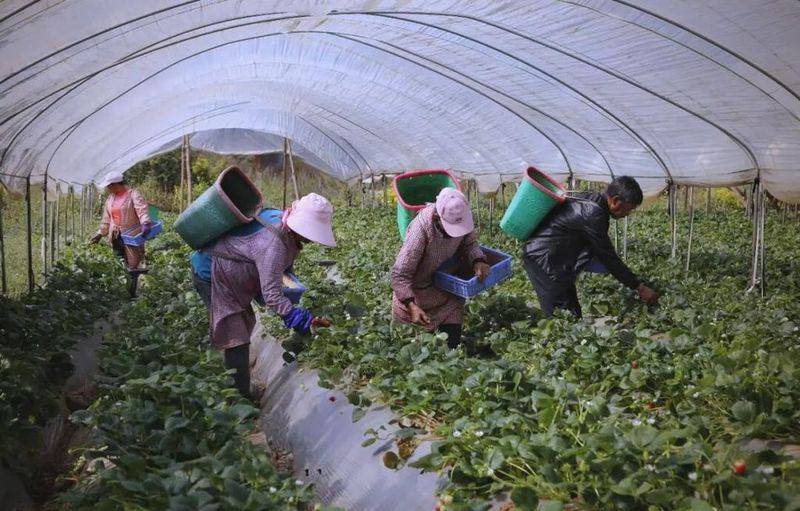
It is proposed to strengthen the construction of marketing agents, represented by cooperatives, to take advantage of the main advantage of driving the whole strawberry industry through sales-led radiation to farmers in neighbouring villages and towns. Cooperatives can absorb a larger number of strawberry growers around them, conduct daily demonstration demonstrations of new technologies and training farmers in science and technology, provide marketing assistance to staff in strawberry sales, integrate in-house resources, host a large number of pickers and leverage strawberry sales。
(vi) development of industrial models combining leisure extraction with deep processing
On the basis of the development of recreational extraction, strawberry deep processing should be supported, and a range of strawberry derivatives could be developed by the conditional lead firms, such as strawberry houses, by-products such as strawberry sauce and strawberry wine, which would increase the benefits. The development of cold-chain transport and the remote marketing of frozen fruit at the time of surplus is used as a supplementary marketing channel. The development of ancillary distribution channels and derivatives will contribute to the steady development of the strawberry industry。
With the improvement of strawberry varieties, the rate of use of detoxidated seedlings has gradually increased, the methods of breeding, cultivation and management technologies are being upgraded; resources are being consolidated to improve the production, ecological, service and social functions of the strawberry industry; and there will be a greater expansion of the prevalence of non-hazardous, green and organic cultivation, with a greater increase in the production and quality of strawberries and better prospects for the strawberry industry。



