


On 23 april 2026, on the eve of the 26th world intellectual property day, the city intermediate people's court of qingdao held its third press conference this year to inform about the proceedings of the qingdao court in intellectual property cases, as well as the implementation of diversity and the publication of typical cases。
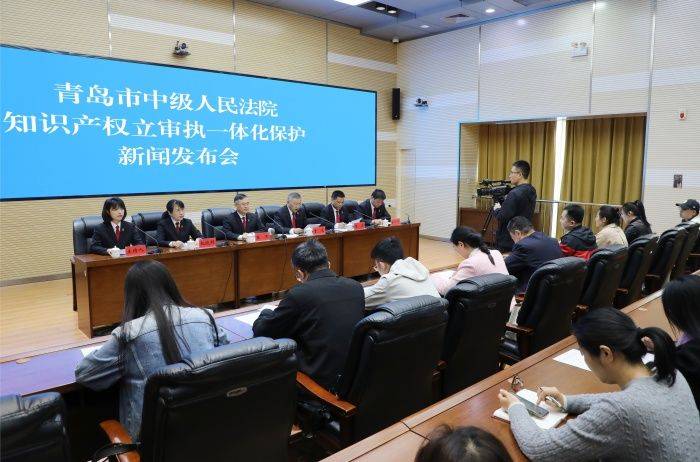
In 2025, the qingdao court focused on the city as a whole, leading the development of new quality productivity with scientific and technological innovation and building “10+1” innovative industrial systems. The three main lines of work were “precision trials, innovation layouts, institutional safeguards” to support and service modern chinese-style qingdao practice with high-quality intellectual property judicial protection. A total of 6311 civil, criminal and administrative cases of intellectual property have been handled by the city-wide courts, and 6186 cases have been resolved, of which 1,083 were dealt with by the aoshima intellectual property tribunal and 1,026 were disposed of. The new form of new business is emerging, and the aoshima seymour court receives 54 per cent of all first-instance cases in the technical category of patenting inventions, technical secrets and monopolies. The second is the strict enforcement of the punitive compensation system, which was applied in four cases, resulting in awards of $5,0465 million, increasing the cost of intellectual property violations and violations. Thirdly, there has been an increase in the number of cases where rights holders have voluntarily chosen the jurisdiction of the aoshima court, and the aoshima intellectual property tribunal has increasingly become a “optimal forum” for rights holders。
The aoshima courts have continued to implement the “overall-to-total” diversity dispute resolution mechanism around intellectual property protection, consolidating resources, absorbing 24 professional mediation organizations and recruiting 218 experts from various fields to join the specially invited mediation teams. In 2025, city-wide courts commissioned conciliation of intellectual property cases, with a success rate of 59. 1 per cent, an increase of 5 per cent over the same period and an average of 14. 6 days. The three cases in the city-wide courts were selected for the supreme court's multi-multiple resolution case book and three for the province-wide multi-multiple resolution of intellectual property. In the implementation of intellectual property rights cases, following the philosophy of good civility and wisdom, enforcement is balanced with the protection of scientific, technological and technological innovation and the protection of scientific and technological innovation. The grid+enforcement collaboration platform is spearheading a national interface between the implementation of the casework system, the implementation of the app and the grid-enabled work platform. In 2025, the qingdao central court opened 139 cases of enforcement of intellectual property rights and concluded 134 cases, resulting in an increase of 7 per cent over the previous year and implementation of more than 1,926,000 yuan, an increase of 72. 7 per cent over the previous year。
The year 2026 was the beginning of the “fifty-five”. The qingdo court will fully implement the party's 20 major deployments on “strengthening the rule of law guarantees of intellectual property rights as a base system for supporting comprehensive innovations” and will implement the people's court implementation programme for the judicial protection of intellectual property (2026-2030) in earnest, focusing on the needs of economic development, upholding strict and fair justice and writing a new chapter on intellectual property protection with solid initiatives and tangible results. The first is based on the qing island location, which continues to take advantage of the cross-border jurisdiction and to wipe out the model window card of the qingdao intellectual property tribunal for intellectual property protection in the jingdong peninsula. The second is to anchor the need for new qualitative productivity development and to strengthen the protection of emerging industries and key core technologies, with a view to bringing justice to promote the deeper integration of sti with industrial innovation. Thirdly, there is a focused institutional collaboration mechanism to enhance the synergistic protection of intellectual property and promote greater protection synergies. Fourth is the persistence of digitally enabled intellectual property cases, the continued advancement of the “3d evidence management system” and the deeper integration of scientific and technological innovations with intellectual property trials. Fifth is the ongoing extension of justice services, the strengthening of the branding of special features, such as the “academies” “accessful eyes” and the creation of new highlands for education on the rule of law in intellectual property。
The aoshima court has been committed to a good trial strategy and to the successful processing of difficult cases into good ones, to the successful processing of high-profile and high-impact intellectual property cases and to the efficient and effective resolution of intellectual property disputes in a multifaceted manner. The 10 typical cases of judicial protection of intellectual property and the 9 typical cases of multi-dimensional settlement of intellectual property rights, which are marked by a focus on the subject of new quality protection of productivity, a focus on the protection of intellectual property rights in new and emerging areas, a focus on the building of a unified national market, highlight the strong tendency of the aoshima courts to protect innovation, to protect both middle and foreign parties on an equal footing, to promote administrative and judicial synergy, to deepen the development of multi-mediate settlement mechanisms and to combat intellectual property crime vigorously. Zhu ben teng



