Quantification efficiency: key technology for planting the coloured sweet pepper facility in ningi county
Zhou hua
1 varieties selection
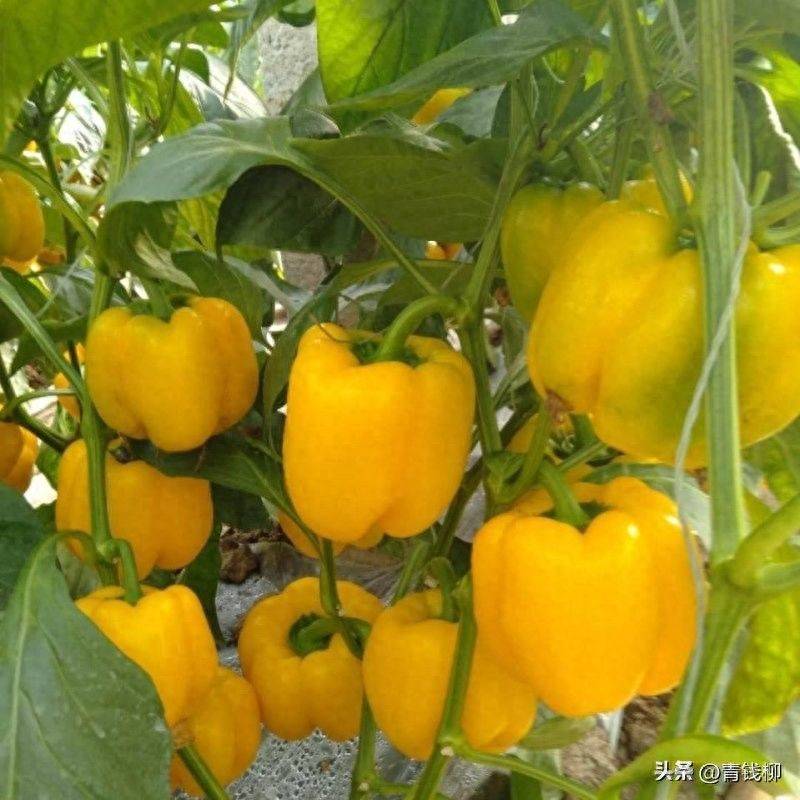
Colored sweet pepper varieties need to be adapted to the facility environment, with preference given to low-temperature, low-prevalence, disease-resistant and good-commodity varieties, such as the “red taipol” and the “yellow taidra” hybrid species. Red varieties such as "red tai chi" and "mandi " , are flat-tangled fruit, become bright red when mature, have durable transport, weigh 150 to 200 g, and are suitable for early spring and fall-lated planting. Yellow varieties, such as " yellow tai chi " , " golden princess " , golden yellow fruit, square fruit, sweet mouths, low temperature and weak light, are suitable for hothouse production over winter. Purple varieties, such as `turkish vips ' , juvenile purple, mature and red, rich in vasectomy, disease-resistant and suitable for plant development。
2 plantation environment and facility preparation
2. 1 cultivation environment
Colored sweet peppers are warm and warm and grow at 20 - 28 °c, below 10 °c or above 35 °c; glamorous but timid light directly requires 20,000 - 40,000 lx; sandy soil suitable for sterility and ph values of 5. 5 - 6. 8 is associated。
2. 2 choice of facilities
Solar greenhouses or plastic sheds are planted with sunnets (30%-50%), drip irrigation systems and co2 fertilizers. Pre-plant 15 d soil disinfection using 50 kg of lime + 10 kg of sulphur powder per acre。
2. 3 substrate and fertilizer preparation
Pneumo-based fertilizers are applied prior to planting, and the matrix is mixed with decomposed organic fertilizers on a 4:6. Deep 30cm back rise, 20 cm tall, 80 cm long, 40 cm wide。
3 feeding techniques
3. 1 seed treatment
Sterilized, 55 °c warm water impregnated 30 min, during which time the process of mixing continued to impregnate 6-8 h, extracting 10% sodium phosphate sodium sodium impregnated 20 %, preventing viral transmission, washing and then wrapping in wet cloths, placed in a 28 - 30 °c incubator sprouts and seeding at 70% dew. The seeding method, using a 72-cunched lacquer, is one grain per lacuna, covering 0. 5 cm thick matrix, covering the membrane soaking, maintaining temperature from 25 to 30 °c and releasing the membrane in time。
3. 2 shrimp management
Temperature is controlled, with a temperature of 28-30°c before seeding, 18-20°c at night, 22-25°c after seeding, 15-18°c at night, with a humidity of 60% to 70% to avoid high seedlings. Fertilizer management, with 0. 2% urea + 0. 1% potassium phosphate solution per 7 d sprayed with water following “dry-dry-wetage” and the water content of the matrix maintained at 65% to 70%. Refinery techniques, preplanting 7 d, gradually reducing temperature to 20 - 22 °c, night temperature to 12 - 15 °c, controlling water irrigation and increasing the resilience of seedlings。
4 key technologies for field management
4. 1 plantation techniques
The temperature in the facility is stable at more than 12 °c and is set at 35 - 40 d and 5 - 6 leafs, with the choice being made in the morning. Plantation density, 40 to 50 cm, with 1,800 to 2,000 plants per acre, at depths appropriate for flat soil cover of the leaves, and then watering down the roots and covering the membranes。
4. 2 environmental regulation
Temperature management, day temperature during flowering season 22-25°c, night temperature 15-18°c; fruit expansion at day temperature 25-28°c, night temperature 16-20°c, ventilation over 30°c and exposure to sunnets. Light management, during summer high temperature periods, maintains adequate dispersion light through sunnets and ventilated cooling, and can be filled by multilayered or temporary heating equipment during winter (led lamps, 10-15 h/d). Humidity management, with air humidity of 60-70 per cent, control of soil moisture of 65-80 per cent by drip irrigation, and prevention of high humidity-induced epidemics or low humidity-induced pollination。
4. 3 fertilizer management
Base fat is predominantly organic. It focuses on high potassium-type water soluble fertilizers and is based on the principle of “a small number of times”. Accumulation of potassium nitrous phosphorus (15:5:20) 10 kg per acre during the period of fruit expansion has increased the utilization rate by dripping under the membrane to avoid causing lumber root. Spraying of 0. 5 per cent of the potassium phosphate solution on the leaves enhances light co-operation and prevents umbilical disease. The concentration of co2 was maintained at 800 - 1000 μl/l at 9 - 11 a. M. On the winter sun, for co2 fattening by ammonium carbonate + sulphuric acid reaction or via cylinders。
4. 4 plantation adjustments
Double-dry branches or triple-dry branches are used to retain the main tubers and one to two robust side branches, the remainder of which are removed in a timely manner and, as a result, are fixed with a rope or a stubble. The removal of the first flower and the deformity, the infirmity and the infirmity, and the preservation of 10 to 15 high-quality fruits each, promote a concentrated supply of nutrients. The bouquet period promotes natural pollination by shaking the plant and avoids the use of bouquets to cause malformations. In addition, old and sick leaves are regularly removed, ventilation is improved and pests are reduced。
5 green pest prevention and control technology
Facility environments are prone to pests and diseases and require a “preventive, integrated” approach。
5. 1 major diseases and prevention
The virus is mainly infested with aphids, which are treated with 10% aphids 2000 times the fluid, and 20% acetate 1,500 times the fluid at the beginning of the disease, while removing the strain. The disease is highly prevalent during the rainy season, with a rotational interval of more than three years, which is prevented by 72 per cent of frosting manganese zinc 600 times the fluid before the outbreak, and by 52. 5 per cent of venom and cyanide 1,000 times the fluid after the outbreak. In order to prevent white powder, ventilation is maintained, with 10 per cent of the phenylether acetate 1,500 times the fluid or 25 per cent of the ethylene ester 2,000 times the spray spray per 7-10 d and 2-3 times in a series。
5. 2 major pests and control
Aphids and white lice carry yellow sticky boards of 30 to 40 pieces per acre, with 1. 8 per cent of avulse 3,000 times the fluid or 25 per cent of aqualone 1,000 times the fluid spray. In the evening, the masts used 10% bromocyanide 1,500 times more liquid or 6% ethylidosterin 2000 times more liquid to spray the back of the leaf, in conjunction with blue viscos. During the dry season, red spiders had high hair, with a focus on leaf spraying using 15 per cent dictums 1,000 times the fluid or 43 per cent phenylethrin 3,000 times the fluid spray。
6. Collection and post-natal treatment
Colored sweet pepper fruit needs to be collected in a timely manner after it has changed colour, so as not to overcook the commodity nature。
6. 1 collection criteria
Colored sweet peppers are collected when they are fully expanding and the colours are smooth, red and yellow fruit needs to be completely coloured, and purple fruit is harvested when the colour is stable. (b) keep the handle during harvest and avoid mechanical damage。
6. 2 classified packaging
Classified in single fruit weights (150 g for cylindrium and 100 to 150 g for second stage) and coloured zea, in foam nets or in boxes, stored in 10 to 12 °c, 85 to 90% humidity and shelf duration 10 to 15 d。
Conclusion
Colored sweet pepper cultivation needs to optimize environmental regulation in combination with the characteristics of varieties, achieving high-yield quality goals through precision breeding, scientific hydrofertilization and green control techniques. With standardized techniques, the greenhouses can produce four to five consecutive months of sweet pepper production, with an annual acre production of 6,000 kg and an increase of $300,000 to $5,000 per acre over traditional patterns. The extension of this technology to nining county can build on the agricultural advantages of the facility and combine organic fertilizer substitution policies to further reduce production costs and improve product market competitiveness. The integrated application of organic matrix cultivation, water fertilizer integration and smart temperature control technologies could be further explored in the future to enhance industrial economic efficiency and sustainable development capabilities。