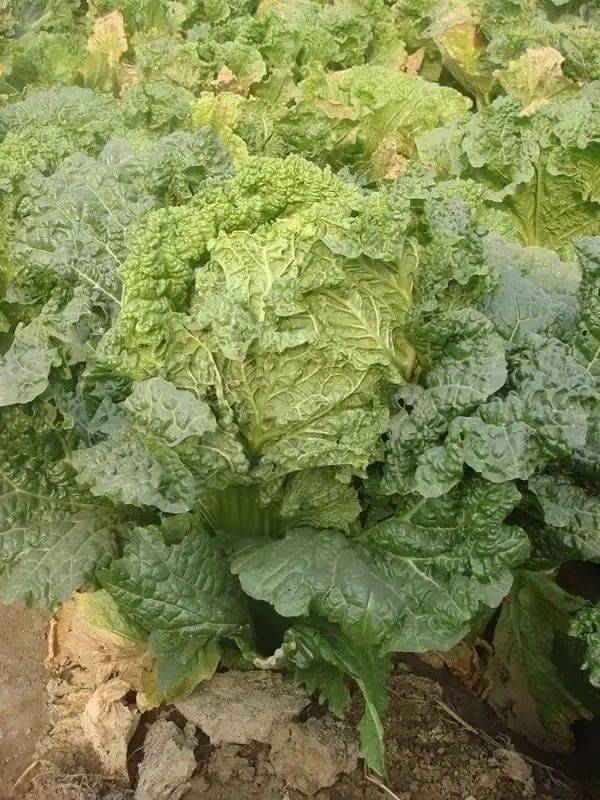
The traditional cabbage varieties in beijing, which have been selected by vegetable farmers for many years in the process of planting, have been favoured by a wide range of consumers and are among the best-quality in the mid-twentieth century. Because of the wrinkled face of the leaves, which resembles the wrinkled walnuts of the walnuts, the distinctive advantages of this type are the softness of the leaves ball, the small amount of fibre, the ease of cooking, and the effect of “cooking”, not only of the fragrance, the fragrance, but also the sweet taste, the infinity of the taste, and the excellent quality of the old beijing veggie。
Varieties
Plants are 45 to 50 centimetres high and are active 60 to 65 centimetres. More than 20 pieces of outer leaves, deep green leaves, rewinding cylindrical shapes, and light green sides. The leaves were covered in wrinkles like walnut skins, so they were called walnuts. The follicles are in a straight barrel, about 40 centimetres, microrounds, and a little rough on top. It's tight, it's good quality, it's rich. Poorly resistant, with a fertility period of about 85 days, suitable for field cultivation in the autumn, with a single net of 2. 5 to 4. 0 kg and acre production of 4,000 to 5,000 kg. Cold tolerance and storage are excellent and can be stored in the cellars until march of the following year。
Land selection
Land blocks with deep, loose and fertile soil, full of water and drainage and organic content of more than 1 per cent should be selected. Land that is too sandy, although in favour of seedlings, is not well supplied with late nutrients; land that is too sticky to pre-plant seedlings; and the taste quality and production of products that are grown on both plots are not optimal. It is best to pick a plot of watermelon, beans and beans that is not a cross with the previous year。
Prepare for planting
Cleaning of fields: cleaning of residues, rotten leaves and weeds (including weeds around plots) in a timely manner, after pre-harvesting, and concentrating out of the field for non-hazardous treatment such as high-temperature compost or ozone treatment。
Fulfilled organic fertilizers: 5,000 kg of high-quality, sufficiently decomposed, shredded organic fertilizer per acre or 3,000 kg of bioecological fertilizer per acre; 20 kg of biobacterial fertilizer per acre applied at seeding, applied on the oscillation surface prior to seeding, which can be useful in improving soil physicochemicality, mitigating heavy barriers and promoting growth and quality. Two thirds of the organic fertilizer is distributed in front of arable land, while the remaining one third is applied in the process, allowing for a timely supply of nutrients during the seedling period。
The seeding is scheduled
The planting time: beijing and even the northern plains of china are suitable for direct planting from 5 to 8 august, and high-altitude mountainous areas such as yanqing, ming yun and huairou, on the outskirts of beijing, are seeded three to seven days earlier than the plains。
Cultivation: if land cannot be planted directly in time due to the weather and the lateness of the pre-surgery land, three days before seeding can take place, it is possible to select land with a high level of land, using a chassis of 72 or 128, which is conducive to breeding. The seedlings were moved to daejeon when they had three to six real leaves。
(b) land cover: land parcels on the border should be planted in small, high and flat. Take an additional east-west direction and dig a drainage ditch about 15 metres apart. The operating procedure for high-frequency live broadcasts is to flatten the soil tillage and make it at a distance of 55 to 60 centimetres, requiring straightness and even height and width; moderate pre-sprout repression, with the seeding of the back of the back 10 centimetres above the bottom of the ditch. After the rise, the backs of the soil are beaten with tools such as pyres, so that the backs are flat and watered in a three-thousand-thousand slope. Seeding: the density of cultivation should vary depending on the size of the strain, which is smaller than the variety of hybrids, with a density of 2,800 to 2,200 plants per acre, with an average range of 55 to 60 cm and a range of 33 to 35 cm, and a direct planting pattern of 100 to 150 g. The seeding takes place in the form of an open den or an open ditch, which is open at a distance of two seeds per lavender, and a shallow ditch on the back, with a depth of 1. 5 to 2 centimetres, including the earth that rises when cutting, requiring a gap between the back and the same depth. Squeeze the seeds with two fingers, squirt them evenly in shallow ditches, sow them and scratch them with rakes or low feet, fill the shallows where the seeds have been sowed, and evenly cover the soil between 0. 5 and 1 cm after repression。
Post-broadcast repression: it should be immediately repressed. When the soil is soaked, it can be suppressed with a lighter suppressor, or people can step on their backs, so that the seeds are in close contact with the soil and so that they can grow strong. If the soil is adhesively wet, it can be used to light-tap the back with iron tweeds or with one foot at the bottom。
Field management
(c) soil moisture conservation: during gestation and seedling periods, seeding is followed by the prevention of soil drying and compaction, the creation of a good gestation environment and the promotion of seedlings, the timely flow of small water into ditches to reduce temperature and increase growth, the avoidance of high-temperature and dry seeding environments and the prevention of viral disease。
Cultivated pine soil: 2-3 times during the sapling period, in order to ease the surface and prevent soil sheeting, especially once after the sapling, with depths of 5 to 6 cm, and with the principle of “deep girdles, shallow backs”. A combination of water-controlled seedlings for about 10 days to promote root growth. Weeding should be cultivated before the plant is sealed, but it is appropriate to do so when the sun leaves are softer, so as not to damage the leaves。
(c) small seedlings, replanting: the sapling of small and congested seedlings at crosses and at times, and the early filling of missing seedlings and the planting of seedlings on 6 to 8 leaves. Saplings and seedlings should take place in the middle of the sun, during the evening of the evening, and be ploughed in time to promote the seedlings。
Fertilizer management: first, catch up with weight. The condensation period is the fastest-growing period, with the largest amount of fattening water, combined with the need for fertilization, and with the application of potassium nitrogen phosphorus fertilizer, which can be followed up with water at the beginning and mid-term to absorb rapid organic liquid fertilizers 2 to 3 times, provided that the ratio of potassium nitrogen phosphorus content must meet the growth needs of large cabbage, with 15 per cent per acre followed by organic phosphorus fattening (8-10 litres or 10 kg) per acre (of which 6 per cent is phosphorus: 6 per cent is potassium); it can also be followed by organic flushing of 8-10 kg in other brands; and it is also possible to open a cave or ditch before the lycée, with a better effect of approximately 100 kg per acre of cormorated slag or bean pie, or by 500 kg of fully corified organisms at the end of the grounding. Second, the leaf spray. During the whole reproductive period, three to four fertilisations of the leaves may be taken from 500 times the soluble amino acid water fertilizer, or from a urea mix of potassium phosphate with 0. 5 per cent concentrations at 0. 3 per cent, or from a variety of leaf fertilizers such as algae acid and curate. Spraying time should be avoided when the light is strong at noon and when there is dew in the morning, and as far as possible spraying on the back of the blade will facilitate absorption, with the head being 30 centimetres from the side of the leaf. Third, application of bacterial fertilizers. Biobacterium fertilizer was applied with water three times during the ball term at a rate of 0. 5 litres per application. Fourth, evenly watered. The season is the period of greatest growth and the period of greatest water demand, and soil moisture should be maintained on a regular basis. The water is usually poured every five to seven days, requiring that the water be evenly distributed to prevent flooding, which could otherwise lead to diseases such as soft decay. Water was stopped 7 to 10 days before the harvest。
Pest control
Based on years of production experience, the main diseases of cabbage are viral, frost and morbid diseases, three of which are interrelated; the main pests are leopard pests such as cabarets. The strategy focuses on agricultural control and cultivation measures, supported by integrated chemical control measures。
Frost: the most suitable conditions for an outbreak, mainly in the “lean term” of cabbage, are low temperature, continuous rain and soil water. Not only is the epidemic widespread, but it is also devastating, with the epidemic reducing production by more than 30 per cent per year. Symptoms of harm: frosty is the main threat to the leaves. The prophylactic leaves of the saplings are positive in form of light green spots, which expand and turn yellow. The backs of the damp leaves grow white molds, and at high temperatures the disease forms a near circle of dead spots. In the process of development, the strains are greened or yellowed, and are constricted by leaf veins. When conditions are right, there is a rapid development of the disease, with leaves dying from the inside. Plants are injured, flower infarction or swelling, and the flowers and herbs form bad death spots, while the aroma of the air produces molds. The disease is highly likely to occur and spread in warmer rain or in poor drainage. In many areas, the infection occurred during the shrunk season, which brought the disease to the field with the seedlings, and in mid-october the disease peaked. Response: one is the selection and treatment of seeds. The second is the introduction of rotational and scheduled seeding. It would be best to avoid cross-facing or neighbouring with the field crop for two to three years. Reasonable planting, reduction of field humidity and reduction of the incidence of foliage and morbid diseases. Thirdly, there is a rational application of fertilization and water. Deep-burned soil, ground-based fattening, increased phosphorus fattening over a period of time; leaf fertilization, rational water filling, peaking in september in the incidence of frostic infections, with proper and no overwatering; and timely chinese farming, with attention to timely drainage, promoting root growth and increased resistance to disease. The initial spraying of 3% of the biopesticides was combined with a 1000-fold treatment of the amino acid water soluble fertilizer (with a life-saving anti-worm-type). It is also possible to use 2% vulcanin 500 times liquid spray, and the production of green foods can be based on 72% fsm (crunchi) wettable powder 600 times liquid or 72. 2% fsm (prick) water spray 600 times liquid spray。
Viruses: viruses are most likely to occur in high-temperature dry conditions; aphids are prone to increase the spread of the virus; weeds are also the initial source of transmission. There are many viruses that cause cabbage viruses, mainly cucumber leaf virus, tobacco leaf virus and radish leaf virus. Symptoms vary slightly depending on the type and variety of cabbage. The heartleaf of the diseased seed season is green and leaves are followed by heavy and uneven green clots or leaves, with severe fracturing. The strains have severe wrinkles, are hard and thin, and many small brown spots are often born, and the tan on the back of the leaves has a slight dent in the dead strips, and the strains are clearly constricted. When the cabbage is sick, the ball is loose or loose。
Response: one is good seed treatment. Seed poisoning is one of the main sources of viral disease. If the seeds are poisoned, the plant is infected with the disease during the seeding season and has a significant impact on yields. The second is the treatment of insects in the nursery. The infestation of the virus is weak, it can only be broken into the host by micro-breeding, and it is often transmitted through insects such as aphids, fly lice and foliage, so it is necessary to combat them in a timely manner. Thirdly, there is the strengthening of field cultivation management. Plantation is done in a timely manner in order to produce strong seedlings, promote the growth of strong plants and improve the capacity of plants to combat viral diseases. The fourth is drug control. A 2000-fold liquid spray can be used for gold digestion no. 4 (for the virus). Four times in a row, every five to seven days。
Soft rot: soft rots are known as rots, creeps, kegs, decouples, etc., and occur all over the country. It usually occurs in the middle and late stages of the condensed ball and is a bacterial disease. One of the more difficult ills of vegetable farmers is the heavy loss of 30 per cent to 40 per cent, the heavy loss of 60 per cent to 70 per cent, and even the loss of harvests. Symptoms of hazard: the onset of water stains on the very roots of the leaves quickly becomes paste, and the odour of brown colours is stenching; sometimes it spreads from the heart to the outer leaves, and the edge of the leaves rots to the veins of the leaves, which generally develop quickly from the sight of the disease to the point where it takes about five days to decomposition. There are three common types of atrophy of the outer leaves, the midday decomposition of the omelet, the early recovery of the larvae, the decomposition of the leaf handle or root tissue, the flow of grey-coloured sticky tissues, the intrusion of the fungus from the base wound of the cabbage, the formation of water humid, followed by a light-coloured ash, the tissue of the disease glitter, the intrusion of the fungus from the edge of the leaf or the upper end of the leaf, causing decay and the odour of the disease, which is an important feature of the smoky disease that can be distinguished from the black curation of the large white vegetable. The disease occurs rapidly and severely when it is associated with plots, low-lying areas where drainage is poor, overflowing or co-mericating, and when it is applied with unperformed organic fertilizers. Method of prevention: 1000 times the chlorobromo-isocyanate (golden decoration 1) + 450 times the amino acid water soluble fertilizer (e. G. Life-resistant against disease and insect-type). Forty-seven per cent of the spring ray wang copper humid powder 400 times the fluid or 77 per cent of the hydroxide humid powder 600 times the liquid spray。
Blue night moths and other wing pests: these are referred to as night moth hazards, which are hidden in the shadows or earth sews during the day and come out after the evening. The timing of prevention is therefore very important, and the application of pesticides in the daytime is often ineffective and effective only at night or in the morning when open water is not dry. An optional biological pesticide, bacillus souyun (bt), can be treated with 500 times more humid powder or 1,000 times chords pyrethroid or 25% more than 600 times pvp。
Collection and storage
Cutting the vegetables in the early part of november, before the winter season, with the heads drying southwards for two to three days and stacking them in the ground. In late november, they will be stored in a cellar, refilled in time for a temperature of 1-2°c. If appropriate, they may be kept beyond the spring festival. Kang nam goose zhao