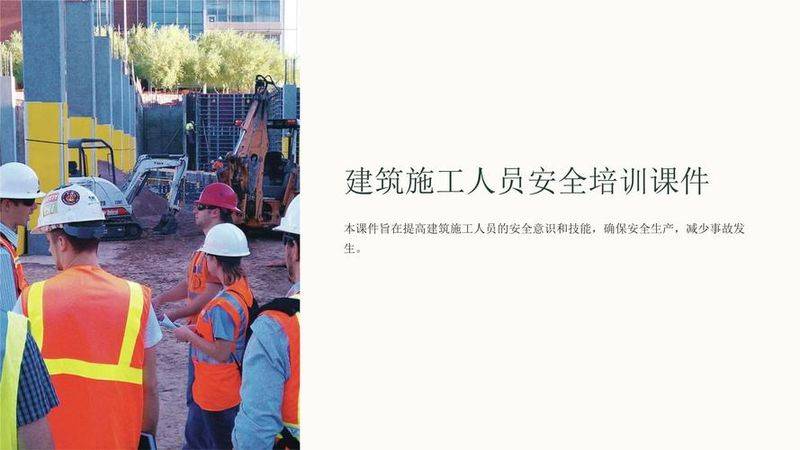
• reporter of the workshop on safety training in the workplace: xx catalogue 01, safety knowledge base 02, safety at work site 04 personal protective equipment 04 safety operating protocol 05, safety prevention and handling 06 safety training and examination of the nuclear safety knowledge base 01 safe production concept, which focuses on pre-preventive measures to reduce the likelihood of accidents. The definition of safety ensures that there are no accidents in the production process and the safety of personnel and equipment. Safety regulations and standards, such as the safe production act, ensure that site operations comply with the legal requirements of national security production. Workers are regularly trained in safety education to ensure that they are aware of and comply with safety protocols and emergency response measures. Implementation of security education training on building industry safety standards, such as building safety inspection standards, to guide day-to-day safety operations. The importance of having a safety culture in industry safety standards is to increase workers ' awareness of potential hazards and prevent accidents through continuous safety culture education. The safety culture 01, which promotes safety awareness, emphasizes the norms of behaviour, directs workers to comply with operational protocols and reduces the harm caused by irregular operations. The promotion of a good safety culture of safe behaviour02 can facilitate communication and collaboration among team members and work together to maintain a safe working environment. Strengthened teamwork03 establishes a security-centred and continuous improvement mechanism that encourages workers to propose safety improvements and continuously optimizes security measures. The ongoing improvement of mechanism 04 on site safety 02 on site risk identification is one of the main risks during the construction process, with high-altitude operations requiring protective measures such as safety nets, seat belts, etc. The stacking of materials that identify irregularly operating risks at high altitude may result in collapses and injuries, and the stacking area should be reasonably planned to ensure access. Inadequate operation of hazard construction machinery, such as excavators, cranes, etc., can cause serious harm and operators require professional training. Electrical equipment is frequently used at construction sites where mechanical operating risks are identified, and electrical wires and outlets are regularly inspected to prevent electrical accidents and fires. The complexity of the construction site environment for the identification of electrical safety risks requires that attention be paid to identifying potential risks such as slippages and trippages and that appropriate precautions be taken. Workers with safety precautions to identify environmental safety risks must wear personal protective equipment such as helmets, safety shoes and glasses at the construction site to prevent accidental injury. Regular inspections of mechanical equipment, electrical lines, etc. At the construction site are carried out with personal protective equipment to ensure their safety and reliability and to detect and eliminate hazards in a timely manner. Regular safety checks place clear warning signs in dangerous areas at construction sites to alert workers to safety and prevent accidents. The security warning sign 010203 emergency response plan and exercises are designed to provide detailed contingency plans for possible incidents, including evacuation routes, rescue measures, etc. After the development of the emergency preparedness exercise, the exercise was evaluated, feedback was collected and the contingency plan was continually optimized. Post-rehearsal assessments and feedback ensure that all staff are familiar with contingency plans and improve their capacity to respond to emergencies through regular emergency exercises. The type of ppe 03 protection equipment that is of importance for regular exercises is on the construction site, and the safety helmet is an important protection against head injury and must be properly worn to ensure safety. Safety helmet protective glasses, which are used to protect eyes from splatters, dust and ultraviolet light, are essential personal protective items at the site. For the purpose of preventing the inhalation of hazardous dust and particulates, workers should wear a standard dust mask for the construction. Dust masks and slippers are effective in preventing injury to the feet, especially on the wet-sliding sites, and provide workers with the necessary foot protection. The correct use of smooth slippers must be properly worn before entering the site, ensuring that they are secured and adapted to the right position to protect the head from impact. The helmet seatbelt should be tied to a solid support point to adjust the length of the tape to ensure effective protection against falling during high altitude operations. Safety belts must be worn to prevent eye injuries in the performance of operations that may generate splash or dust. Use protective glasses to select the appropriate type of dust masks and ensure that they are properly sealed to filter harmful dust and gas and to protect the respiratory system. In order to ensure safety through the correct use of dust masks maintenance and replacement standards, personal protective equipment, such as helmets and seat belts, should be regularly inspected to detect and replace damage in a timely manner. Periodic inspection of personal protective equipment should be carried out in a dry and clean environment to avoid direct sunlight and chemical corrosion in order to extend the useful life. Proper storage of protective equipment sets and follows the replacement cycle for personal protective equipment, such as helmet replacement every five years, in accordance with the manufacturer's recommendations and industry standards. Personal protective equipment such as helmets, safety shoes, glasses, etc. Is used correctly to prevent accidental injuries in the course of work, in accordance with the general operating safety guidance 01 of the safety protocol04. The 02 tool and equipment inspection performed a thorough check of the tool and equipment prior to use to ensure that it functioned properly and to avoid security incidents arising from equipment failure. Emergency response is familiar with emergency evacuation routes and contingency plans, with basic first aid knowledge to ensure rapid and effective response in emergency situations. Mechanical equipment must be equipped with personal protective equipment, such as helmets, protective glasses and dust masks, in order to prevent accidental injury, before operating the equipment. Operating operations and operations of major equipment is completely completely enjoyed, with no regard to change the operating process, to ensure use. Regular maintenance and inspection of mechanical equipment is carried out to detect and address potential safety hazards in a timely manner and to prevent accidents. High-altitude operational safety requires that all high-altitude operators properly wear and use safety belts to prevent crashes. Safety nets are installed below the operating surface using seat belts 01020304 to reduce the risk of potential harm to persons or objects below the high-altitude crash. The safety net is regularly inspected and maintained for all high-altitude operations to ensure their safety and security. Periodic inspection of equipment ensures operational safety in accordance with operational heights and conditions and in compliance with the corresponding operational restrictions, such as wind speed limits, operating time, etc. Compliance with operational restrictions on accident prevention and handling of potential accidents of 05 is followed by daily inspections at the site to identify potential sources of danger, such as unstructured equipment and wiring, and to take timely measures. Develop and use security checklists to identify potential sources of danger and ensure that all security measures, such as the wearing of personal protective equipment, are implemented. The safety check list establishes an accident risk reporting system to encourage workers to report potential safety problems in a timely manner and to ensure rapid response and resolution. The accident risk reporting system organizes regular safety training to educate workers on the identification and reporting of safety hazards and to increase safety awareness and emergency response capacity. Regular safety training on incident reporting and responding to incident report 03 to clarify the process and those responsible to ensure timely and accurate reporting of incident information to relevant departments and management. Incident reporting process 02 develops and rehearses emergency evacuation plans to ensure that all personnel are able to evacuate hazardous areas quickly and in an orderly manner at the time of the incident. Immediately after the emergency evacuation procedure 01 incident, measures were taken to protect the site, prevent the accident from spreading and provide complete evidence for the follow-up investigation. The accident site protection 04 establishes a professional accident response team responsible for the initial assessment, handling and coordination of follow-up rescue at the accident site. The site was cleared immediately after the recovery work incident following the accident in the response team, assessing the extent of damage and ensuring that there was no secondary disaster risk. The site clean-up and assessment provided psychological support to victims and witnesses of accidents to help them recover from trauma. Psychological counselling and support for the development of detailed rehabilitation plans, including equipment rehabilitation, personnel training and security checks, to ensure the safe reopening of sites. Safety training in the rehabilitation and reconstruction programme and the examination of safety training content and methods for 06 are regularly conducted in safety knowledge competitions and seminars to encourage workers to share experiences and promote safety awareness. Safety awareness is enhanced through the presentation of safety regulations, case analysis of accidents, and the awareness of workers about the importance of site safety. Organization of simulation exercises, such as fire escapes, first aid operations, etc., to improve workers ' capacity to respond to emergencies. The theoretical knowledge of practical skills training and the examination of safety criteria check the degree of theoretical knowledge of site safety protocols and operating processes among workers, usually in the form of written examinations. The theoretical knowledge test examines the rate of emergency response and disposal capacity of workers in the face of security emergencies, such as emergencies such as fire and collapse. The emergency disposal capacity assessment assesses whether the worker's safety behaviour in the specific operation meets standards by modelling the actual work scene。practical demonstration 010203 for continuing education and promotion freeze