An exchange event was held in which a pair of hands held together to bring together a consensus on intellectual property rights — to the fair, where thousands of outsiders from their homes gathered to share open market platforms; on the goose road, without the sound of a bell, the road to trade continued; and before the electronic screen, without the need to be cumbersome, moving their fingers could create a world of chinese creativity — “china's open doors will not be closed, but will only widen”. Over the past decade, china has been deeply integrated into the international rule system in the midst of a wave of change that has brought about a strong boost to economic trade. In the new era, china has become deeply involved in the global governance of intellectual property rights, creating an enabling international environment for “going out” and playing a new instrument of convergence with the world。
Promoting multilateral cooperation and contributing to development
On 10 july 2014, beijing, on the side of shisha sea, chinese and foreign guest pressed the launch key to declare the fifth office of the world intellectual property organization (wipo) to be “resident” in china。
“in recent years, china's remarkable achievements in the field of intellectual property rights, as well as its growing global influence, have been the first to choose to establish an office in china.” the original director general of wipo, francis gauthy, said so。
Since its eighteenth anniversary, china has been deeply involved in global intellectual property governance within the framework of the wipo. The establishment of an office in china provides a new link and an important platform for cooperative exchanges between china and wipo, as well as support for better participation by china in international cooperation and exchanges on intellectual property. Over the past decade, china has continuously promoted the improvement of intellectual property rights and related international rules and standards, including international trade and investment, and has promoted a more just and rational development of the global intellectual property governance system. China's increasing intellectual property rights programme has grown into an international consensus and translated into international action。
On 14 may 2017, in beijing, the agreement between the government of the people's republic of china and wipo on cooperation to strengthen intellectual property rights in the context of the road was signed during the summit on international cooperation. In recent years, china has continued to deepen its cooperation on intellectual property rights in the “one way forward”, holding two high-level conferences on intellectual property rights in the “one way forward”, establishing cooperation on intellectual property rights with more than 50 countries along its borders, implementing a number of practical cooperation projects and achieving positive results。
“promote more effective protection and use of intellectual property rights and jointly build paths of innovation for the better benefit of peoples.” the message of secretary-general xi to the high-level conference on intellectual property rights “away the way” in 2018 was both a promise for this “road of innovation” and a hope for the peoples of the region。
On 5 may 2022, the hague agreement on the international registration of industrial design entered into force in china, meaning that chinese applicants can apply for a patent for the design of appearances abroad through the hague system, and foreign applicants can apply for a patent for the design of appearances from china through the hague system. On the date of entry into force, 49 chinese enterprises had submitted 108 international applications for visual design through the hague system。
“china's accession to the hague agreement is a major advance in the global intellectual property ecosystem, meaning that the chinese design community will be easier to protect and extend beyond china's borders. Overseas designers are also more likely to enter one of the largest and most dynamic markets in the world with their appearance.” director-general deng thomson said。
According to who 2020 statistics, although china was not a party to the hague agreement at that time, the number of applications submitted by chinese applicants through other states parties to the wipo international bureau was among the top 10 in the global application ranking for the hague system, contributing significantly to the annual increase in the number of applications for global visual design。
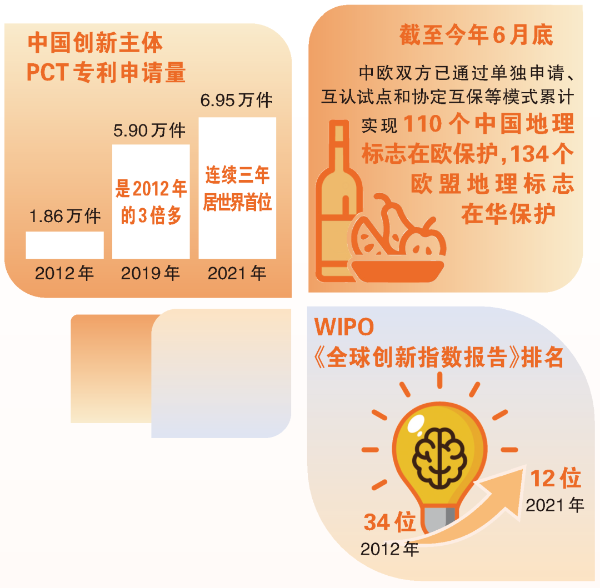
Over the past decade, china's participation in multilateral affairs under the wipo framework has expanded in depth and breadth. On 6 june 2012, the beijing treaty on audiovisual performances was officially signed, the first international intellectual property treaty to be concluded in china and named after chinese cities; it entered into force for 30 parties on 28 april 2020. On 5 may 2022, the same day the hague agreement entered into force, the marrakesh treaty on facilitating access to published works for persons with blind, visually impaired or other print impairment entered into force for china. The number of pph partners reached 30. In 2019, china's innovation owners submitted 5. 9 million patent applications through the pct channel, more than three times the number in 2012, more than the united states became the country with the largest number of international patent applications. In 2021, this number increased to 695 thousand, the highest number in the world for three consecutive years. China's ranking in the wipo global innovation index report rose from 34 in 2012 to 12 in 2021, leading the middle-income economies. China is relying on multilateral intellectual property cooperation to promote high-quality development and, with its own steady development, has become a “driver” and “stabilizer” of world economic growth。
It's a win-win game and a bright future
The festival was preceded by the busiest hour for more than 60,000 farmers in sanjan district, hunan province. And the leaves they bring forth from the mountains, which are screened and processed, will be delivered to the table of the chinese, both in and out of the sea, at noon。
How to get out of the mountains and sell to the world? In an interview with the newspaper's correspondent, the head of zhang chonghua industries ltd., peng zhongkang, said that over the years, the poverty working group of the national intellectual property agency had helped them apply for registration of geographical indications to certify trademarks and geomark products, introducing experts to develop patents for the preservation of leaf leaves and to let the leaves go and scream. At present, more than 80,000 people in the united states, japan, singapore and other locations are out of poverty through leaf-related industries. The company will export more than 200 tons of leaf this year and is expected to export more than $1 million。
“wipo is pleased to see china's successful practices in using intellectual property to alleviate poverty, and hopes that china will share its experiences and provide lessons for other developing countries.” following a visit to sang-sik, the director of the who china office, liu wah, highly valued this “world sample of accurate pro-poor intellectual property rights”。
See “one leaf” for autumn. The sansha leaves are a microcosm of the “two-way movement” of chinese industry and world markets。
In xinjiang, the technological and innovation support centre of the university of xinjiang (tisc) conducted a patent analysis study on the difficulty of the walnut industry in the city of kasshi, resulting in a patent analysis of walnut pick-up and processing technologies, which helped local enterprises to submit multiple patent applications and effectively contributed to the fight against poverty. As of june this year, tisc provided cumulatively 133,000 high-level analytical services to chinese innovation agents in china, resulting in intellectual property financing of over $10 billion。
While helping technology “incorporate”, it pushes the product “out”. The national intellectual property administration is actively involved in international mutual recognition, expanding the international reach of china's geographical marker products, especially in poor areas, and helping to promote geographical marker products out of the country。
On 14 september 2020, after 10 years of negotiations, the government of the people's republic of china and the european union signed a cooperation agreement on the protection and cooperation of geographical indications. This is the first comprehensive and high-level bilateral treaty to be signed by our foreign firms. By the end of june of this year, the two central european countries had achieved the protection of 110 chinese geographical signs in europe, 134 european union geographical indications in china, and products from poor areas such as the achilles, the silent apples, and so on. “this will contribute to deepening mutually beneficial cooperation and close trade relations between the two sides in central europe, both of which are of great importance to the countries of central europe, which are rich in geographical markers.” the relevant head of the national intellectual property agency said that these geographical marker products from poor areas would contribute significantly to local economic development, while also improving the quality of life of foreign consumers。
At this point in time, more than 40 central european banleys travel every day between china and nearly 200 european cities to send the fruits of wisdom from china to the people of europe. On 29 august this year, two trains carrying 103 autonomous intellectual property products of 36 large categories, with a value of nearly $100 million, containing high-value intellectual property rights such as core patents, well-known trademarks, new varieties of good plants, high-quality geographical indications, and high-level integrated circuit layout design, were sent to six european countries. This year, sichuan province is expected to export autonomous intellectual property products through central europe, amounting to $75 billion. A giant dragon raging in the land of asia and europe continues to wave a win-win development dynamic that injects strong energy into economic globalization。
To lead the way and show the great powers
A friend came from far away to look at shanghai. In may 2017, secretary-general xi announced at the international cooperation forum “the way forward” that china would host the china international import fair from 2018 onwards。
“china shall protect the legitimate rights and interests of foreign-owned enterprises and shall firmly punish, in accordance with the law, violations of the legitimate rights and interests of foreign investors, in particular of intellectual property.”
“in order to make better use of the creation of knowledge for the benefit of humankind, together we should strengthen intellectual property protection.”
“china will continue to improve its open and transparent foreign legal system, strengthen the protection of intellectual property rights, safeguard the legitimate rights and interests of foreign enterprises, and create a better environment for quality services.”
In their years of age, the eastern treaty was on schedule to inject “strong agents” into world trade and trade. In 2021, over 2,900 enterprises from 127 countries and territories participated in the fourth expo, displaying 422 new products, technologies and services, with a deal of $70. 72 billion, a record increase. The representatives of the developing countries indicated that the chinese government was constantly strengthening intellectual property protection, creating a good business environment and giving confidence to enterprises to invest in china。
The results of the national survey of social satisfaction with intellectual property protection in 2021 show that in 2021, the satisfaction of foreign enterprises with intellectual property protection in china increased by 2. 36 points compared to the initial “13th 5th” rating; the world bank's global doing business report 2020 shows that the global ranking of chinese state-owned firms rose from 96th to 31st in 2013 and was rated as one of the top 10 economies in the world for two years。
At the beginning of a new history, china's opening doors will only open. In 2012, our total trade in goods and services amounted to $4. 4 trillion, the second largest in the world. In 2021, this amount rose to $6. 9 trillion, the second consecutive year of global priority; of this, the share of total trade in services from the import and export of knowledge-intensive services reached 43. 9 per cent, an increase of 10. 3 percentage points over 2012; and the cost of using intellectual property rights (iprs) was 2. 1 times higher than in 2012. China is not only a “world factory” but also a “world market”。
The opening of china’s markets and the sharing of opportunities with the rest of the world were demonstrated by the fact that during the epidemic there was still a crowd of guests, and it was the world’s recognition of the state-owned business environment. China is not only a beneficiary of international cooperation in intellectual property rights, but also a contributor to economic globalization, a defender of the multilateral trading system and a builder of the human destiny community。
Time is the most powerful language, and action is the most vivid footnote. Looking back at the decade, china's open spring wind has always warmed the world. China is still young and young, as we look to the future at a new beginning. (reporter sandy)
Ten-year review:
New engines of intellectual property rights drive innovative developments in international trade
Openness is a defining feature of contemporary china. Since the eighteenth anniversary of the party, under the strong leadership of the party centre, with comrade xi at its centre, the country has accelerated the construction of a new system of an open economy, and intellectual property rights have increasingly become a new engine of foreign trade development and a new dynamic of external openness, benefiting not only itself but the world as well。
Over the past decade, intellectual property rights have grown in “friend circles”. Multilateral cooperation within the framework of the world intellectual property organization (wipo) has become increasingly extensive, as has been demonstrated by the power of china to move forward with the world; intellectual property cooperation along the way has demonstrated china's wisdom and commitment and has attracted countries to work together; and a series of bilateral, small multilateral, multilateral and peripheral cooperation has been actively promoted. China is deeply involved in the global governance of intellectual property rights within the framework of the world trade organization (wto) and the world trade organization (who), and it plays the voice of cooperation in order to bring together its aspirations。
Over the past decade, the intellectual property “high-speed roads” have become more widespread. At the international level, a number of international treaties on intellectual property rights, such as the beijing, hague and marrakesh treaties, have entered into force. China's contribution to the pct system and the madrid trademark system has been increasing. At the domestic level, new amendments have been made to the laws and regulations on patents, trademarks, copyrights and anti-improper competition law. Administrative and judicial protection mechanisms have continued to improve market access, the negative list of foreign investment entry has continued to be reduced and the liberalization of trade and investment has been actively promoted. China's big stage has truly become a world market, a shared market, a market for all。
Over the past decade, intellectual property rights have become increasingly “good voices”. Linking the contribution of intellectual property rights to poverty eradication to the united nations sustainable development agenda 2030, distilling and promoting pro-poor experiences and practices of intellectual property assistance, and creating a “world sample of intellectual property rights accurate pro-poor”. China is actively sharing its positive experience with the world, with a series of solid and deep achievements that will serve as long-distance signs for the world to share the dividends of the “china experience”。
The way is wide and wide, and it is like a path, and there is no place for those who walk. China in the new era, together with all other countries, will embark on a new journey of intellectual property cooperation along the lines of those who built the community of human destiny. (linsan)