


Tianshan-shinjia daily journal reporter, filming hotzati abudu
In the bay district, where 1. 5 million acres of high-quality arable land and abundant water and heat resources are available, a “sweet and bitter” specialty industry has been set up, using chinese pharmacist cultivation and processing as a breakthrough, focusing on quality, branding, the introduction of chinese pharmacist farming and processing enterprises, and the establishment of a chain of chinese pharmacist industries that combines cultivation, acquisition, processing and sale。
On 30 october 2025, xinjiang silver dolen pharmaceuticals ltd. Particle agent workshop, the first “combinant pyramid” lined down. The main source of this drug is tianshan veal, an innovative chinese drug of 1. 1 based on uighur medicine theory, which recently entered the national health insurance directory, marking the national recognition of new drugs in xinjiang。
The production of chinese medicinal products, such as meat, glycerine and red flowers, has been at the top of the country's list, and the marketing of pharmaceutical makeup and generic products, such as desert roses, has been increasing。
In recent years, xinjiang has moved forward with a whole-industry chain of thinking, from standardized planting to branding marketing, from precision processing to integrating innovation, and a modern chinese pharmaceutical industry system for planting, processing, trading, r & d and application is accelerating, leading to a high-quality development of the chinese and chinese pharmaceutical industry, which has contributed to the overall revitalization of villages and increased farmers ' incomes。
It's the foundation of the industry
The development of the pharmaceutical industry and the cultivation of potables are fundamental. In the summer, thousands of acres of medicinal drugs were tested in the man gardens of yuda county, and the chinese herbs, mints, dansin, etc., were sprung up in error and wind。
In the face of 66. 2 per cent of the deserted land in the county as a whole, tana county has innovatively explored the development model of the eco+mechanic herbal industry. “in 2025, we screened more than 20 of the 36 chinese medicinal plants tested for sand cultivation. This year, we plan to scale up the production of highly active varieties, to promote the standardized cultivation model of sandy pharmacist fields throughout the county, and to promote the deeper integration of ecological governance with industrial growth。
At present, 360,000 acres have been planted in developing medicines, including 240,000 acres of meat, 80,000 acres of roses and 40,000 acres of medicines in special features such as plaster root and glycerine。
New zealand has a well-known reputation for its medicinal products, which are backed by a gift that is both a gift from the day and a gift and a source of excellence in crop management, a continuing drive for technological innovation and strong policy, financial and other support。
More than 200 medicinal plants, such as glycerine, platinum, wood husk and bee-mothers, were conceived in the altai area with cold weather and sufficient light. In recent years, the local herbal industry in deep-farming has promoted, through government cooperation, the development of eight local standards for herbal medicine in the altai area, covering varieties such as plate-blue roots and small fragrances, which are promoted through production demonstrations, and the standardization and quality of herbal medicine。
The kash region has developed a model of “company + farmers + order” industrial development, leading to the regularization and scaling up of chinese medicine cultivation. By the end of 2025, over 1. 2 million acres of herbal medicine had been planted in the kash region, with a total production of 257,000 tons, and more than 200 and 600 wild medicines had been planted in the tsanda region, with 18 chinese drug-based laboratories, such as specialty roses, plasters and meats, laying the foundation for the development of the chinese pharmaceutical industry。
Xinjiang zhongxuan agricultural technology ltd. Has grown more than 20 specialty medicines such as artesin, daisy, mint, etc., and has built 3,500 acres of an artemisinin farm in the city of zhongkang; xinjiang pharmacy plantation ltd. Has built 1,800 acres of chinese medicine demonstration gardening plants for pharmacists, glycerine and meads. As cultivation continues to increase, xinjiang has established a good breeding and production base for chinese medicine, which has contributed to the steady development of the industry。
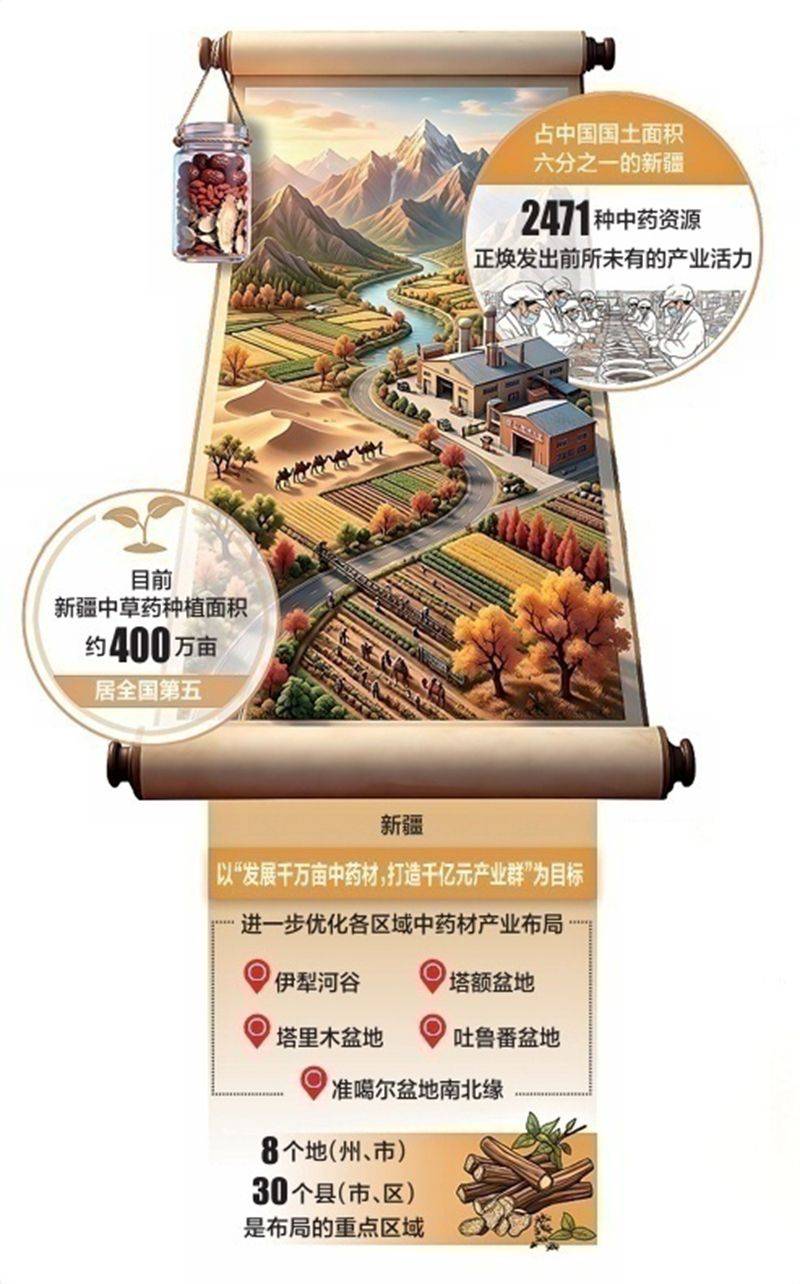
At present, herbal cultivation in xinjiang is about 4 million acres, the fifth largest area in the country. With the exception of potables, localization of varieties is achieved outside the borders of guacamole and ground root, depending on the unique geographical climate, which has a production and quality better than that of origin, and is a solid foundation for industrial development。
Advanced processing to upgrade industrial capabilities
In the production workshop of blue river bluesley pharmaceuticals limited, the cleaning of clean ground roots, glycerine, etc., was processed into tablets and extracts. In 2025, the company processed about 16,000 tons of medicinal material and sold its products throughout the country。
The blue river blue sly pharmaceuticals company, inc., is an imported business in the altai area, which was established in qinghe district in 2021, through the solicitation of funds. A total of 28,000 acres have been built to plant a variety of herbal herbs, such as glycerine, plaster, yellow root, small aroma, among them 10,000 acres of high-quality exclusive glycerine cultivation, securing herbs from the source; a centre for the processing of chinese herbicides, creating a complete chain of herbicides for planting, processing, scientific research and marketing; and a strict management system for chinese medicinal products, from planting to extraction to storage and marketing, ensuring the quality of products is stable。
Since 2020, 14 enterprises involved in the cultivation, processing and pharmaceutical of chinese herbs have been introduced in the altai area in order to continuously improve the chinese herbs industry chain。
Plant chinese medicine and produce a "co-rich side". The pharmaceutical industry in xinjiang has moved from a single-planting model to a “n+” whole-industry chain development model, from seeding at source to plant care and to production processing。
At the beginning of december 2025, as raw materials such as glycerine and yellow tungsten entered the production line, the chinese medicine tablet production base, built by xinjiang hu tung yuen, inc., was officially commissioned. Construction of the base began in september 2024 and plans are under way to build five production lines around the dominant varieties of glycerine, yellow cucumber and ground root, which will result in the automated processing of the entire process from material cleaning, slices to product selection, with an estimated 20,000 tons of tablets per year。
The aim of xinjiang is to “develop tens of millions of acres of chinese medicine and create hundreds of billions of yuan industrial clusters” and to further optimize the layout of the chinese medicine industry in all regions, with the iowa valley, the tower basin, the north-south edge of the bigar basin, the taruzan basin and the 30 districts (municipalities and districts) of the tari wood basin being the focus areas. Mainly relying on leading agricultural enterprises, order-based artificial farming was expanded, standardized scale production was promoted, industrial development chains extended and product value added increased。
From the introduction of full-automatic production lines to the introduction of smart extraction workshops, to the construction of the xinjiang uighur pharmaceuticals company limited international industrial park, which combines r & d, production, marketing, logistics, and culture, xinjiang uighur pharmaceuticals limited has continued its innovation-driven development, investing at least 10 per cent of its sales revenue annually in innovative research and development, and building a “basic research-clinical certification-international registration” full-chain innovation system. As a classic test for the cold, the company's annual sales of zukawood granules amount to over 300 million yuan and has entered more than 3,000 hospitals and 50,000 pharmacies throughout the country; pomegranates, the main source of xinjiang medicine, have been replaced with pomegranates, with annual sales at the top of blood-based national medicine, and represent one of xinjiang's characteristic medical products。
Eco-life double gain
In accelerating the construction of a modern chinese pharmaceutical industry system, xinjiang has not only built an ecological barrier, but has also given a strong boost to the overall revitalization of the countryside and the growth of farmers through industrial development。
In the case of sand-proof sands in the takrama desert, sand-planted shuttles and red willows can breed “desert ginseng” meat, both for the value of its pharmacological homogeneity, for the health of its people and for the overall revitalization of its population, as well as for ecological governance and the creation of a national green barrier against sand and sand。
As a core area of meat production, 240,000 acres of meat are grown in the county, accounting for 85 per cent of the country's output. The local industry, led by “industrial ecology and eco-industrialization”, has promoted the development of the meat industry, leading to a greening of the desert, industrial development, collective growth and the benefits of farmers。
The meat industry has also been extended to neighbouring districts and municipalities, with the villagers of topa ayzyk village, tsyle district, tulhoun gaceta, being among the beneficiaries。
Toulhoun, 55 years old, planted red willows and shuttles in the desert gobi, where he was vaccinated with meat on his roots, using drip-planting techniques, with 90 per cent of the plant’s survival rate, which both protected against wind and sand and provided him with considerable income. “i was vaccinated in my home and earned over $300,000 a year.” tolhoun said that such a life would never have been thought of before。
In pishan county, unique light, heat, water, soil conditions allow output to be of much higher quality and medicinal value than in other provincial and municipal areas of the country, as well as the growing drumming of more than 2,500 people's wallets, including alim mametmin。
Alimu is a villager in the village of kule azyk, tibetan gui commune, pishan county, and works at the guangdong plantation base of xinjiang biology and technology ltd. “when the base was built, i no longer had to go out to work to look after old people and children and to learn to earn money.” ariki told journalists that he had worked for two years at the guadeloupe plantation base and was now in charge of drying the melon, earning $4,500 a month。
The melon is a multi-year cucumber crop with good chinese medicine for fruit, bark, nuts and roots. In september 2023, as a priority industry, the guangzhou industry settled in tibetan gui commune, pishan county。
At present, xinjiang biology and technology ltd. Is growing 476 million acres of guacamole, leading to permanent and stable employment for more than 2,500 people at a monthly wage of $3,000 per person. In the future, the company plans to expand the base size to 100,000 acres, which will lead to the employment of 11,000 people with an annual value of not less than $2 billion。
The melon industry has not only brought considerable economic benefits, but also increasingly ecological ones. Yang jintao, head of the area of xinjiang ribbon biotechnic co. Ltd., said: “the roots of the melon are well developed and suitable to grow in sandy soil, which can serve as sandproof sand and can be very useful for improving the soil.”



