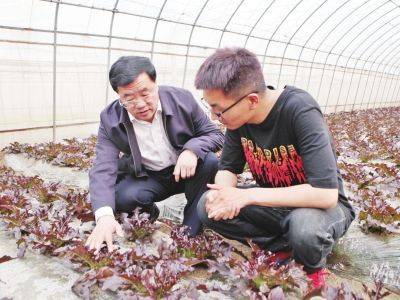
Fan biscuit (left) gives pupils an orientation on the growth of vegetable vegetables in the growing sheds。
Chart
Editor presses: you know, lettuce, a common home dish on a popular table, was not common in beijing more than a decade ago. The raw vegetables, which originate in europe and are not suitable for the four seasons of climate cultivation in beijing, have now jumped to the top of the growing area. How did this "smuggle" european dish arrive in beijing? How did you walk from the field to the table? Listen to the reporter who tells you the story behind a lettuce
At the beginning of the spring, the country's temperature was warmed up, and in the village of insein, the village of insein, the village of the town of tunzhou, beijing, there was a green-oiled vegetable field full of fresh and fresh vegetables. “a little over a decade ago, no one knew about this dish. We can grow lettuce four or five times a year. In the summer, the seeds are barely burned and the market is in great demand.” the base manager, li maofeng, who had grown vegetables for over a decade, told the journalist. In other areas, several heat-resistant varieties of vegetables have been planted by the chief expert of the beijing vegetable innovation team, fan biang。
The lettuce has always been a popular table meal, with fresh, nutritious and large amounts of food cellulose and micronutrients. It's getting hot, and a lot of people like to mix a cabbage salad. More than a decade ago, the beijingi people rarely saw lettuce on their table, which made it hard to see pang ying, who was working on vegetable breeding at the beijing agricultural institute。
In beijing, targeting the market's blank "small" european dish
In the 1990s, fan bi-hin carried out a study at the national level, which found that, a few years ago, “special vegetables” had been grown in beijing in small quantities, mainly for high-end restaurants, and that supply was far from keeping pace with demand. But lettuce originates on the euro-mediterranean coast and requires facilities and technical support to introduce foreign varieties into the country。
Finally, with the support of the national fund for study abroad, fan tsai was given the opportunity to study at the department of horticulture of chiba university in japan, “when he wanted to see how the raw vegetables were grown in other countries, he was determined to introduce state-of-the-art facilities and vegetable-planting techniques so that the raw vegetables could reach the table of ordinary people earlier”. Fan tsiao-hsi recalled what he had intended to do that year, and said with sympathy。
In the course of his study abroad, he found that in japan or in the countries of europe and the united states, from eutrophication, cultivation techniques to pest control, the cultivation of raw vegetables had been completely closed and industrialized on a full scale. The raw vegetables love cold environments, are neither cold nor hot, and control of temperature and light during planting is very strict, and the greenhouse sheds in the country could hardly reach that standard at that time. “neither the nature of the species nor the manner in which they are cultivated shall be adapted to the conditions under which they are grown in our country.” how is it possible to plant the veggies in the country
Fan tsai-hye has decided to solve this problem in the form of seed. “if we are to grow fresh vegetables in beijing, we must have good varieties that fit the characteristics of the climate in beijing.” in beijing, the summer cycle is high, and lettuce is not suitable for long-distance transport, and local cultivation is required to eat fresh lettuce. The most suitable temperature for the growth of lettuce is 15-20°c, while growth is poor over 30°c. Cultivation of high-quality heat-resistant varieties is key to achieving anniversary production. But it's not that easy to grow heat-resilient “discrete” by using the coolest “one-size-fits-all” players。
“teacher fan has been putting us and our students in the canopy for four quarters of the year, sowing, observing and recording hundreds of times, half a day and twenty years.” “we often enjoy this kind of `free sauna' and sometimes complain about it. Teacher fan often says that for breeders, no more sophisticated measuring devices can replace eye-to-eye observation, and that to understand the `personality' of the variety, we have to go into the fields and get into the greenhouses to solve the real problems.”
“the selection of varieties is a cyclical, repetitive and monotonous exercise.” liu jie said, since 1998, fan has led a team to collect 750 copies of raw vegetables from the main producers in the netherlands, italy and the united states of america, and to analyse the growth patterns and environmental adaptation。
After more than 20 years of persistence, the team has introduced new varieties of raw vegetables, filling the gap between the spring and summer hot seasons and the lack of hot vegetables in the country and abroad. It has seen the proliferation of chinese raw vegetables, ranging from heat-resistant to cold-resistant varieties, from achieving the goal of producing raw vegetables throughout the year to choosing a variety of violet-rich vegetables, which has produced 12 “new members” to enrich the chinese food basket。
Safe and high-quality production for the anniversary of good breeding practices
Precipitous leaves are juicy, unsatisfied to store browny, and consumers are increasingly in demand for their fresh quality, placing stringent demands on the technical aspects of the management of vegetable cultivation and after-harvest processing。
Good breeds need good combinations. With a view to providing people with fresh, high-quality and safe raw food, fan has led a team to optimize the technology associated with the selection of varieties, standardized planting techniques, green control of pests and diseases, and conservation of products, creating a comprehensive system of safe production technologies covering the entire industrial chain of raw vegetables。
“stretching of raw vegetables leads to serious pests and pests, which alone can cause a one-quarter loss in the production of raw vegetables.” juicy pests, scavengers, etc. Are common in protected vegetables, and there is a consensus on the subject. However, many chemical controls are limited by the short production cycles of lettuce and by pesticide residues. To that end, the team developed green prevention and control techniques for pests and diseases, such as biological control and beer booby traps, reducing the use of medicines by more than 70 per cent and fertilizer by 40 to 60 per cent. At the same time, new breakthroughs in four seasons of seamless and anniversary high-yield cultivation have been achieved through the innovative use of decorated bark as a matrix material, the improvement of foreign-owned cultivation models based on a series of automated greenhouses, and the innovative promotion of solar greenhouses, plastic sheds and open-field matching。
From the field to the table, it is a crucial step to preserve the raw vegetables. From product preparation, low pressure pre-colding, graded packaging, to refrigeration, transport and marketing, specialists in team vegetable processing have established a series of technical specifications for reprocessing. In response to short cutture periods and the vulnerability of fresh cutts to browning and physical ageing, the screening and development of active packaging materials suitable for fresh cutts and ablution, as well as the development of a unique composite method of digestion, impregnation, dehydration, packaging, refrigeration and storage of fresh cutture in a single package, while reducing the rate of loss of goods, the extension of the existing regular cutture period from 3 to 6 days to 6-10 days has effectively expanded the sales radius of fresh cutture products and increased product value by 50 per cent。
The dragon head is a special dish for sale
In 2012, fan tsai-hye was the lead expert in the beijing greens innovation team of the modern agricultural industrial technology system. Twenty-two vegetable specialists were organized at the chinese agricultural university, the chinese agricultural college, the beijing agricultural institute, the beijing agricultural institute and the beijing municipal agricultural authority。
“through integrated stations and farmer field schools, we have promoted results to villages, with specialist home-to-door guidance at key nodes and critical periods, hand-held training techniques.” fan tsai-hye described this “dumb” cultivation pattern. In 2013-2015 alone, 39 specialized training sessions were held, with 6873 technical cadres trained, focusing on diversity selection, plant management, plant protection techniques and product preservation。
“the variety and technology alone are not enough, and there is nothing to sell or sell.” supported by municipal and regional agricultural extension centres and service centres, the team has developed integrated technology models, supported leading enterprises, led micro-enterprises and led farmers, and established extension services。
At present, the area of raw vegetables grown in beijing city has grown from thousands of acres grown sporadically to more than 80,000 acres per year, with a total production of more than 200,000 tons, making it the largest vegetable growing area。
Not only in beijing, the team, in collaboration with the hebei and tianjin vegetable innovation teams, and using the “integrative research and development for integration” organization system, has radiationed the joint development of spinach growing in the kyinzu region. Hebei and tianjin have promoted four varieties of raw vegetables, no. 1 and no. 2, totalling 285,000 acres, with a cumulative increase of 11. 24 million tons and a net increase of 42,9375,000 yuan. (reporter jo zheng)