


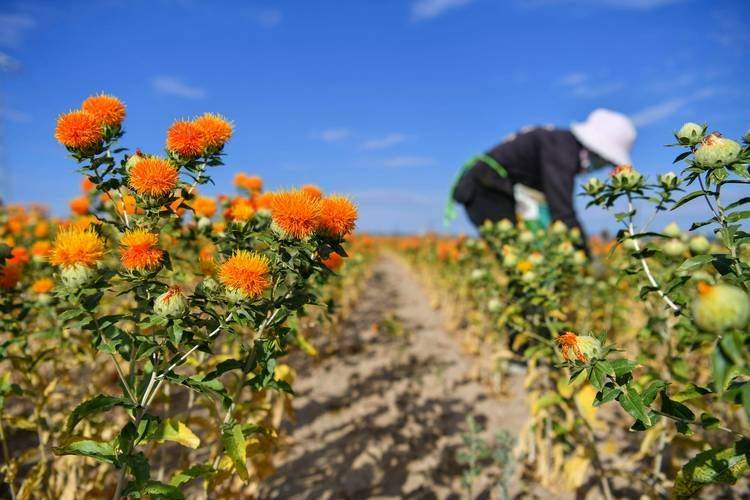
The first section of wi, which is a high-yielding red flower cultivation technology in yumin county, is prepared for 1 and 1. 1 arable land in the autumn, with a minimum depth of 25 cm or more, by wheeled force. 1. 2 to maximize soil nudity in order to enter winter to freeze most pest eggs. 2. The spring fertilizer, rake and ground. 2. 1 in the spring, the soil is unfrozen 3-4 cm and dredges in order to protect the warmth and warm the earth. Fix the drains according to the terrain. 2. 2 fertilizers: diammonium phosphate 15-20 kg per acre for base fertilizer, combined with 3,5 kg urea for increased phosphorus utilization. Before seeding, stripping, fertilizing at about 5-7 cm. 2. 3 before planting, the field shall be flattened and fined to meet the six-word criteria of flat, zilong, zilong, zilong, shredded, zilong, zilong, zilong, zilong, zilong, zilong, zilong, zilong, zilong, zilong, zilong, zilong, zilong, zilong, zilong, zilong, zilong, zilong, zilong, zilong, zi, zilong, zilong, zilong, zilong, zi, zi, zi, zi, zi, zi, zi, zi, zi, zi, zi, zi, zi, zi, zi, zi, zi, zi, zi, zi, zi, zi, the six-word standard is: flat: only flat as the ground can sow a shallow agreement requiring a high difference of ^2 cm in a broadcast (4-5 cm). Quite a lot of work is done. Pine: soil laxity, pine layer 5-8 cm. Fragmentation: scattered earth, requiring no more than three pieces of earth with a diameter greater than 2 cm within 1 m2. 墒: the soil complex meets the criterion of “destroyed and scattered”. Net: i. E. Ground free of membrane, roots, debris, etc. Section ii sowing1 and the seed standard is cloud red 2, and the seed quality is above the desirable seed level. 2. The planting time of 2. 1: the average temperature can sow at 5°c or 5°c at 5°c at the end of the season, aiming for early seeding, which can occur at the same time as spring wheat, normally in the middle of april. 2. 2 seeding volume: approximately 2. 0 〜2. 5 kg per acre; flatness of the lower species to avoid absence. 2. 3 seeding methods: 15 cm parallel strip. It's three and a half centimeters deep. It's all the same, it's all the same, it's all the same, it's all the same, it's all the same, it's all the same, it's all the same. Section iii, field management i, technical measures 1 for weeding in red flowers, 2-3 times for the entire reproductive period, in order to keep the fields loose and free of weeds. Weeding in china does not hurt roots, does not crush seedlings, does not hurt seedlings, does not miss times. 2. The first weeding begins when the red flower comes out of the whole seedling (4-5 times). The seedlings tend to be weeded and lightened in order to avoid root damage. 3. Red flowers extend for a long period of time to cover the second time with weeding, so that weeds are carefully treated so as not to cause injury to the seedlings, and weeds are to be uprooted. 4. Weeds should be completely cleared of agricultural land. Second, science has strong roots in the pursuit of red flowers, which absorb water from the depths of the soil, and where no water is poured, the maximum production of red flowers is obtained under irrigation. However, since the above-ground and underground parts of the red flowers are sensitive to moisture, irrigation should take into account the following: 2. If the weather forecasts rain within 2-3 days, it is advisable not to water the water. 3. The flowers were given water six times during their full reproductive life, the first at the beginning of their extension, on or about 25 may, with urea being sprayed in front of them, and the next 10 to 12 days at each break, the last at the final flower, on 2 august. In the case of red flowers, which are associated with soil, climate and seedlings, the amount and frequency of water recharge may be increased appropriately in the year in which the water is scarce, and in the year in which the precipitation is abundant and less water scarcity, the duration of the water recharge may be delayed or reduced. It's hot and pouring. Iii. Principles and requirements for the prevention and control of pests and grassland. 1 the principle of prevention and control is based primarily on agricultural control, supported by chemical control, which uses a combination of agricultural and chemical control measures and prohibits the use of highly toxic, highly toxic and highly residual pesticides. 2. Integrated management measures in agriculture are mainly aimed at combating pests and grass-breeding through deep fall shifts, selection of disease-resistant varieties, rotational run-downs, weeding in chinese tillage and breeding. Chemical control is mainly based on spray control measures, and the choice, application and timing of application are strictly carried out in accordance with the technical programmes developed by the technical staff of the corporation of limited responsibility for the development of red flower technology in yongmin county. Fourthly, mangrove pest control technologies should be based on prevention and integrated management. The symptoms of rust 1. 1 are long-lasting throughout the life of the red flower, with the first infection beginning with the seed, and the convulsions of the winter spores affecting the embryo and the leaves underground. First, round yellow spots were found at the point of contamination, and after the seedlings had been released, a small yellow spot appeared in the ground or near the base of the ground, and then turned to red and brown, with the roots partially or completely dead. 1. 2 prevention and treatment methods 1. 2. 1 are primarily preventive and drug control is a subsidiary principle. 1. 2. 2 in the early stages of the disease, the strains were removed and removed from the fields for destruction, with a small amount of lime spread around the strains and, if necessary, 23 sprays. • cleaning up the garden in time for treating the sick leaves. 1. 2. 3 the treatment of pharmaceutical agents can be treated with a 5% leaf sap 1000-1500 times liquid, or 30% first-class 3,000-4,000 times liquid, or 20% triazone 1000-2000 times liquid spray. At least 45 kg of acre water is used to achieve even spray. Failure to act on the above-mentioned technical points will not achieve the desired response. It is recommended that the application be made by 10 a. M. Or after 6 p. M.; the spraying control is combined with plant growth regulators and leaf-face fats to increase plant resistance and effectiveness. Alternative plant growth regulators: green wind 95 or plant dragons; leaves and fattening: 98 per cent of potassium phosphate; and recommended red flower fields with an interval of 7 to 10 days and a series of 2 to 3 times will have good effects. 2. Root causes of the disease 2. 1 are the main diseases occurring during the chromosomal period, with the bacteria infesting the roots of the plant and the roots of the truncheons, which have been turned into black and brown after infection and watering. The more ill plant is aging and dying. 2. 2 prevention and treatment method 2. 2. 1 and crop rotation 2. 2. 2 select well-drived plots, while during the rainy season attention is paid to drainage, avoiding the accumulation of water in the field and reducing the incidence of disease. 2. 2. 3 symptoms associated with 3 and 3. 1 cases of lignoma are mainly harmful to leaves. After a small green drop in the leaves at the beginning of the disease, the symptoms gradually spread, resulting in a round or near circle of yellow tan, with a yellow dizziness on the outer edge of the disease and deep in the centre. Before the harvest, there are times when there are large numbers of small black spots on the outskirts of the disease, which are bacterial nuclei. 3. 2 prevention and treatment method 3. 2. 1 removes the leaves from the strain, reduces the source of the disease by 3. 2. 2 strengthens field management, increases the application of organic fertilizers and increases the resistance to disease. At the beginning of the disease, 50% of the phenometha-propylene 1000-1500 times the fluid was sprayed again at intervals of 7-10 and 2-3 times. 4. The symptoms of the tiger 4. 1 are phosphorus fins, night moths. The larvae are fed by a group of three-year-olds on the heart or back of a young child, who eat the leaves into a nethole. After three years of age, red seedlings were cut off from the penis near the ground, resulting in the loss of seedlings. 4. 2. 1 agriculture 4. 2. 1. 1 manual capture: early in the morning, around the sprouts of red flowers, pick up the larvae. 4. 2. 1. 2 weeds: weeds are the place where tigers lay their eggs and the bridge between larvae and crops. As a result, some of the insects and eggs can be eliminated by precision tillage or weed eradication in the early larvae. 4. 2. 2 boot control: 80% trichlorfon soluble powder at 200 grams per acre mixed with 5 kg of oilseed cake or scavenger skin, 1 kg of water and seduction at night. 4. 2. 3 drug control: 40 ml/acre with 80% dichlorvos cream - 60 gills per acre. The larvae tend to operate in the evening, at which time the drug is most effective. Section iv deals with the management requirements for the processing of the first, the collection of red flowers, the drying of sun and the selection of devices. 1. Tools used for harvesting include pockets in the waist; tools used for drying, selection and packaging are plastic rags, bamboo sticks, rakes, gloves. All collection, drying and selection equipment shall not be contaminated. 2. Gloves, plastic knitting, etc., shall be used in order to shake repeatedly, to shake the residue and to hang ten. Upon completion of use, wash or wash with potable water, tan 10, and have a clean bag in place. When used, bamboo sticks and rakes are washed with potable water, tan and hanged in the dry cleaning area. Inspections are required before reuse to avoid contamination of products. 3. Tools and instruments used for harvesting, drying, selection and packaging shall not be used in other production operations or replaced. Ii. Processing site management requirements. 1. Processing sites should be located far from toilets and livestock rings. 2. The drying site shall be kept clean and ventilated and shall not be surrounded by sources of pollution. Other impurities, such as hair, insects, stains and shredding, should be prevented. The items of sunflowers shall not contain harmful substances and shall not adversely affect red flowers. Cleaning tools. During the season of collecting red roses and red flower seeds, no food shall be allowed for the processing site, and no other items shall be placed on the floor to protect against contamination. 3. Items and bags packed with flowers and seeds shall be of good aerobic quality, plastic weaves or sacks meeting sanitary requirements and shall not contain hazardous substances, and packagings shall be stored separately in dry and ventilated areas without mixing. 4. After each day's work, the packaging site for the flowers must be cleared, which requires the removal of miscellaneous items and the cleaning of the site。iii. In the case of velvet pick-up techniques, measure 1, method 1. 1, hand-picking shall be carried out in the case of a flower, with loose and tight hands, in the case of a flower, in the centre of the flower ball, with its fingers evenly rounded around the bouquet, and then rounded up to the top, too tight in the hand, and too tight in the case of red roses. When picking, do not mix the roots, leaves, shells and other impurities of plants into flowers. 1. 2. 1. 2 in order to mitigate the abuse of the plant, method 1. 2. 1 should be within the line and reach the right and left wiring. 1. 2. 2 for the purpose of ensuring the quality and quantity of bouquets, the number of workers may be determined according to the size of the bouquets and the production of bouquets for the whole field, and the fields may be divided into several blocks, which may be picked in rotation the following day. 1. 3 packagings that are picked to prevent filamental fever and imperviousness shall be made of well-literated plastic knitting bags. The efficiency of harvesting can be enhanced by placing bags between the waist and picking both hands. 2. During the pick-up period, 2. 1 red flowers are usually blooming in the morning and in a flower ball, small flowers on the edge are opened and then taken to the centre. When 10 per cent of the plant is open, the plant enters its prime stage. It usually starts in early july, lasts in mid-july and lasts in early august. 2. 2 during the reproductive period, when the flowers are grown up to the flower season, the pollination ends, the colour is red, and the length of the flowers is generally around 2 cm ~ 3 cm. The fragrances are open, the macaws start to fade, the flowers are red and the oil is taken best. If the extraction is premature, it has not yet been pollinated and the colour of the florist is yellow; it is too late and the colour is purple and black. Both affect the quality of flowers and reduce the value of medicines. 2. 3 the time taken during the day and throughout the day shall be taken in the morning and shall not be taken in the rain. At this point, the crowns are not easily broken, the blades are not stingy, the laces are straight, the bouquets around them are close to the centre, they are easy to pick and they are larger. 3. Caution 3. 1 roses shall not be squeezed so that they do not become moldy or heaty and affect their quality. 3. 2 red flowers are dry and their dried flowers cannot be mixed with flowers. 4. The processor must wear gloves before doing the operation. 2. The flowers extracted shall be collected in time for drying or drying in the shade, with no more than 2 cm of drying, and shall be tanned at regular intervals (usually not more than 2 hours) depending on the degree of drying of the flowers, and collected after drying to w12. 0 per cent (until they can be dispersed naturally after hand-held red flowers). 3. Scrambling, picking, packing sites are selected to be laid in the flat ground, with red flowers or seeds placed on plastic fabrics. Dry red flowers or seeds shall be selected before they are packed, except for medical parts, impurities, foreign objects, etc. Personnel in the selection process should wear gloves and sanitary caps in order to avoid contamination of red flowers. 5. Standard 1 for the processing of rheumatoid seed harvests, yellow leaves for red flowers, a shrinking braids, and harvests when a fruit ball breaks. Seeds should be cleaned before harvest and grain silos should be cleared, and the fruits of exotic crops should not be left behind. 3. When harvesting is done using a harvester, the recovered seed of a red flower shall be released in a timely manner and stored, sampled and packaged as the moisture meets the standards. Seeds of original, original and good species shall be harvested, dried and packaged separately。



