Rural and agriculture directorates by municipality, county (city, district):
In order to implement the requirements of the provincial council and the provincial government to secure production and supply, to accelerate the completion of the mechanized cultivation of rice in our province, to effectively enhance the capacity for rice production and to provide a strong support for the growth of food production and the reduction of productivity efficiency, the mechanized rice cultivation programme has been issued to you and will be carefully followed up。
Zhejiang province agricultural rural department
18 april 2022
Rice mechanization programme
The relevant deployments by the ministry of agriculture and rural affairs and the provincial and provincial governments are being implemented in order to create a pilot area for the extension of small agricultural machinery in hilly mountain areas as an opportunity to deepen the implementation of the agricultural “two-power” initiative, to strengthen the creation of prefectures for high-quality agricultural “machine-for-man” development, to accelerate the completion of mechanization panels in our province, to upgrade the level of mechanization of rice throughout our province, to ensure a sustained increase in food production and to keep farmers growing。
I. Overall objective
In 2022, the goal of focusing on 1. 6 billion hectares of early rice and 8 billion pounds of late rice throughout the year was to promote the application of rice plug-in techniques as a complement to the dominant and other mechanized planting methods, to increase policy safeguards, to promote the use of advanced and suitable tools, to improve socialization services, to implement the mechanization of agricultural land, to achieve an integrated mechanization rate of 85. 5 per cent for rice cultivation, of which more than 56 per cent was mechanized; and to achieve a comprehensive mechanization rate of 91 per cent of rice cultivation throughout the province by 2025, of which more than 70 per cent was mechanized to provide strong support for increased production of food。
Ii. Key initiatives
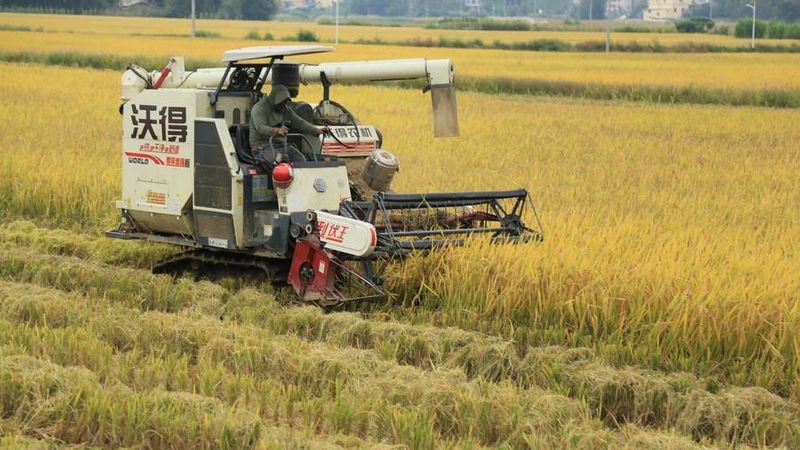
(i) efforts to expand rice cultivation. Actively directing “de-farming” “non-food” land management to develop food production, encouraging local drylands to change their fields, stopping and making full use of wasteland, guiding farmers to grow double-season rice, actively developing regenerative rice and working towards rice expansion and production. For households engaged in growing crops, such as rice, a direct subsidy of $120 per acre is granted to the actual area under cultivation, and a linkage between crop subsidies and cost measurement is explored. Strict implementation of the minimum purchase price policy for rice, with full coverage of early rice orders at $30 per pound, provincial late rice orders at $20 per pound and no more than $180 per acre, and municipal and county orders at no lower rates than the previous year. Seed enterprises are rewarded with a sum of 30 yuan per pound for conventional rice seeds and 100 yuan per pound for hybrid rice. (c) implement a policy on agricultural land for facilities, which is the main source of food production on a scale, and address the need for land for construction, such as planting, storage, farming, etc。
(ii) implementing an active rice mechanization enabling policy. Accelerate the development and implementation of the first set of agricultural machinery. To improve the policy of subsidies for the acquisition of agricultural machinery, further expand the scope of subsidies for agricultural machinery, improve standards of measurement, improve validation capabilities and highlight the mechanized short-board and high-end products of rice, in an effort to achieve equity and quality, and increase the total subsidy for plug-in machines at the central and provincial levels to 45 per cent. Increased support for the mechanization of rice and support to municipalities in the inclusion of rice machine fittings and equipment for breeding facilities. Implementation of the zhejiang province's programme to implement subsidies for the replacement of agricultural machinery at the end of its life, and rehabilitation of obsolete tractors, combine harvesters and rice plugs. (c) encourage the introduction of nursery insurance, subsidies for farm equipment, etc., where the conditions are ripe。
(iii) construction of high-standard reproductive centres. (b) conduct a basic fertility survey to map the family base. - improvement of the “three bases in one district” programme, optimization of the distribution of child-rearing centres, and planning for the construction of high standard child-rearing centres. Implementation of the requirements for the deployment of food and oil production, support for socialization services such as integrated rice breeding, encouragement of village collective economic service organizations, agricultural champions, etc. To set up breeding centres, exploration of the “1+n” two-part birthing model (“1” is a plant chemical breeding centre, “n” is a local breeding site) and promotion of mechanized rice production among small farmers. (c) strengthen the concept of cynicism and promote “two-strength” cultivation, so as to make the plant fit and foster a suitable plant. Promotion of martial arts and temperate practices, increased rice production inputs and subsidies for rice-scale producers who procure seedlings from breeding centres。
(iv) promotion of new varieties of rice machines. New varieties testing demonstration and dominant species promotion initiatives have been implemented, with over 98 per cent coverage of good rice species. Zhejiang agricultural master push varieties and main push techniques were published in 2022, in particular those suitable for machine placements, of which five were of high quality, eight were of conventional late rice varieties and 11 were of mixed late rice varieties. A 2022 technical guide on mechanization of rice in zhejiang province was issued, focusing on the promotion of techniques such as seeding from rice stacks, precision seedlings, simultaneous bathymetric fertilization and mechanization of seedlings. A major provincial technology synergy project, an agro-industrial technical team project and the establishment of a rice high-quality technology application base were launched. (c) the launching of the 10,000 senior agricultural technology specialists ' union forced science and technology initiative, with 2,200 science and technology commissioners at all levels appointed every two years to the grass-roots level. - establishment of a departmental team for agricultural and agro-based synergy innovation and industrial services, and establishment of a one-to-one network of bases and specialists. The creation of the “three bases in one county” was further developed, and in 2022, 30 new “machine-for-manufacturing” high-quality development pioneer districts were created, of which several were fully mechanized districts, and a full-scale mechanized application base and innovative testing base for the integration of agro-machines was established。
(v) improving systems for the socialization of rice varieties. Significant efforts have been made to develop socialized service providers, such as farmers, farmers ' cooperatives and family farms, to support them in the development of integrated services throughout the chain and to further expand the area and percentage of hosting services. Create agricultural service centres based on agro-machinery and issue guidelines for the construction of agricultural service centres to guide the development of multi-business integration across the chain. 60 high-standard agricultural service centres were built throughout the year。
(vi) to vigorously promote the mechanization of water fields. (b) to issue recommendations for the implementation of the development of the motivation of the hills and hills and to develop guidelines and evaluation guidelines for the improvement of the mechanization of agricultural land. Implementation of the motivation and rehabilitation of the hills, with priority given to the placement of sites within the 26 districts of the mountains. In conjunction with the construction of modern agricultural parks and the reform of agricultural standards, 972,000 acres of high standard agricultural land have been built (to be replenished), 400,000 acres have been upgraded and 10,000 acres of water-efficient irrigation developed simultaneously. By 2025, 50,000 acres of land will have been built throughout the province to adapt the hilly mountains in a manner that will allow land connectivity, land levelling to be optimized, canal layouts to be rationalized and flood control capacity to be improved。
(vii) accelerate the development of mechanized rice talent. Technical training courses on the management, driving and maintenance of agro-machine cooperatives, with a focus on rice machine varieties, are planned to train 500 highly skilled agricultural machine operators and to guide the province to train 30,000 people in various types of agro-machinery. The agricultural machinery professional cooperative, which is based mainly on agricultural machinery, plays a full role as a first-line “earth expert” in the use of agricultural machinery, conducts training in the application of new technologies, new machinery and equipment, enhances the capability of the machine-work service through technical workshops on agro-machinery projects and practical training in field operations. A group of rice machines has been identified as a practical training base, field classrooms and training modules that are flexible and close to production requirements。
Iii. Organizational safeguards
(i) implementing responsibility. Fully recognize the importance of promoting mechanized rice cultivation in order to ensure the sustainability of production and supply, improve the mechanisms of agricultural “two-power” workshops and promote priority tasks in the form of checklists, implement a package of directors of rural agricultural sectors to guide food production efforts, and provide timely and accurate information on progress in mechanized rice cultivation。
(ii) enhanced coordination. (c) strengthen communication and coordination with relevant agencies to implement preferential policies on land, electricity, oil, water and credit for mechanized rice cultivation. Use of a platform for the monitoring of agricultural machinery operations, issuance of inter-district certificates of operation for plug-in machines and movement of operational capacity。
(iii) summary advocacy. The policy of subsidizing the acquisition of agricultural machinery has been widely disseminated, allowing good policies to reach thousands of households. Promotion of the benefits and advantages of mechanized rice cultivation and promotion of a series of model models have been promoted to create a favourable climate for the upgrading of mechanized rice production。
Annex: technical description of rice staplers in zhejiang province, 2022
Annex
Zhejiang province, 2022
I. Pyrotechnic techniques: the main solution is to address the low rate of seed production of low-temperature seeds in conventional rice breeding, which is controlled at about 32°c by temperature and above 90% wetness at 48-72 hours, to reach full and robust seedlings. In 2021, the technology was introduced in our province with 1. 8485 million acres, representing an increase of 33. 44 kg per acre and a net gain of about $100, with significant efficiency gains。
Ii. Whole-matrix dryland breeding: subsoil using rice-specific matrices, seeded, stacked and placed on hard ground (cement land, etc.). This technology has produced saplings that are uniform, free of weeds and saplings, with an increase of 20 to 30 per cent in the rate of sapling, a better cumulation of the roots, a lighter mass of tatters, and collageable transport. There has been no visible return to youth, strong growth and rapid spread of seedlings, which has helped to increase production at an early age。
Iii. Precision seeder interpolation techniques: this technology can address the problems of high-sowning, poor-quality seedlings and uneven seedlings in traditional rice machines, with significant productivity gains through quantitative positioning, precision seedlings, low seed usage, low leakage rates, even seedlings, and rapid back-planting. Compared with traditional machine plug-in technologies, this technology reduces seeding per acre by 25-40 per cent and increases production by 5-10 per cent。
4. Rice seedling planting techniques: this technology, which uses seedlings, can produce seedlings of older ages, enhance their resistance to low temperatures, and lead to early planting. Accompanying with late rice can also lead to the generation of old seedlings and the resolution of bottlenecks associated with late rice emitters, with a demonstration of 17,000 acres in 2021, with an 11 per cent increase in production, in such areas as the hot spring, the sea and so on。
V. Direct broadcasting technology for rice precisions: this technology uses flat machines (e. G., power dredging) to flatten water fields, seeding of rice by a sprouts machine, precision seeding operations in daejeon using a rice precision dens, with an optional, adjustable and controlled range. Peaks, ventilated light, root systems developed after seeding can be effective in reducing inverts, pests and pests and significantly reducing labour intensity and production costs。
Vi. One-time mechanical fertilization technology: through slow and rational fertilization, one-time fertilization of rice production has been achieved, and the high cost and difficulty of working in rice-scale cultivation has been addressed, which has been replicated in zhebei's single-season rice area. Using this technology, nitrogen fertilization was reduced by 8-10 per cent, rice was reduced by 2-3 times, and rice production was no lower than conventional fertilization。
Vii. Paddy plug-in technology for deep fertilization: this technology enables the precise delivery of fertilizers to the root of the rice, through the application of fertilisers for integrated equipment, slow decomposition of fertilizers, and deep application of fertilizer locomotives, which will facilitate the construction of high-yielding deep roots of rice and increase productivity. Based on local comparisons in recent years, the use of the technology could result in an increase of 37. 74 kg per acre and 5. 83 per cent and an increase of 8 per cent in fat。
Viii. Mechanized integrated technology of rice breeding centres: this technology supports rice-scale production and socialization services using mechanized, automated, intelligent integrated technology and the “1+n” two-part breeding model. Compared to traditional breeding techniques, the growth rate has increased by 15-20 per cent and production by 5-10 per cent, with good prospects for replication。