


Strawberries, which are one of the major destructive diseases in strawberry production, are widely distributed in strawberry-growing areas and can frown the whole reproductive period, causing serious harm to organs such as leaves, tubers, fruit handles and florist, resulting in a weakening of the plant and a sharp decline in its yield and, in severe cases, the death of the whole plant, causing significant economic loss to the grower. Regularity is an important measure of effective prevention and control and is of great relevance for ensuring sustainable development of the strawberry industry。
I. Symptoms of harm
The symptoms of strawberry carbide hazards are of an obvious stage and organ-specific nature, with variations in the behaviour of different invasive areas, depending on the onset of the disease, as follows:
(i) symptoms of folate victimization
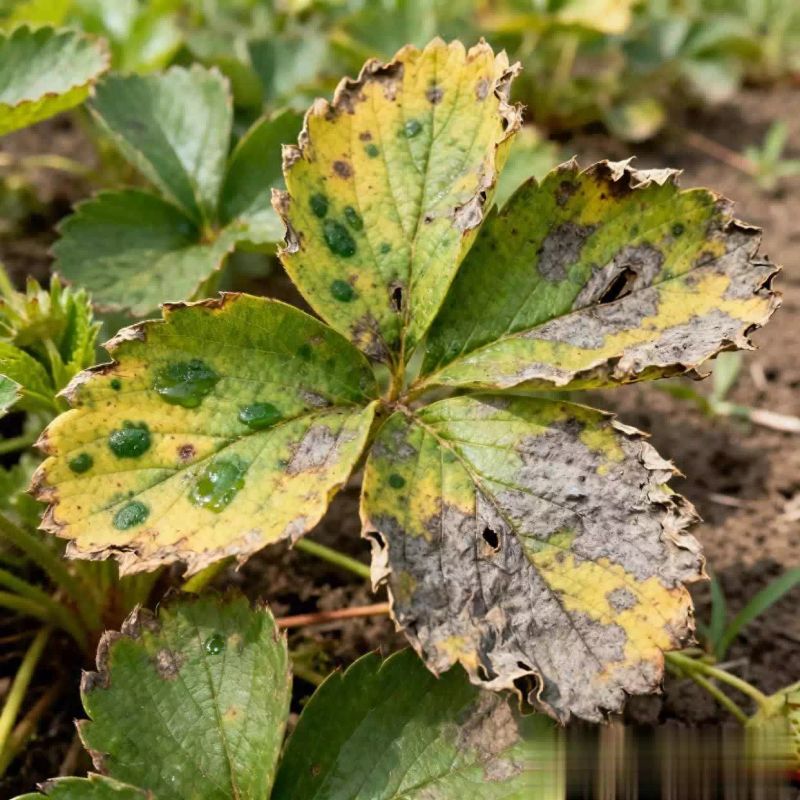
During the initial infestation phase, most of the disease begins to appear on the lower face of the leaf, with the appearance of water immersion in the red and brown in an irregular spot, at which point the symptoms are more hidden and can be ignored during the early stages of strawberry seeding. As a result of the development of the disease, the disease is gradually widening in an agular form, with light observations in a translucent form and reflections in a dark green form, which is one of the most typical features of the disease. In the medium term, multiple angular spots can be integrated into one another, creating large irregular spots, with the edges of the leaves gradually showing water loss and drying up internally, and from the front of the leaves there is a tendency for the disease to spread internally along the veins. When the humidity is greater, there is a white or light yellow fungus in the back of the leaf, which, when dry, condenses into amber-colored gel particles or forms a white spectrometer, which is an important basis for judging bacterial diseases. In the post-incident period, the foliage color deepens to grey brown, the edge is darker, and some of the foliages appear to be wheeled, leading to loss of function and loss of function。
(ii) symptoms of injury to the penis and its base
When the disease is transmitted to the root of the tuber, through the veins and handles, it causes browning in the tremors, which are clearly immersed in water, and when the marrow tissue is seriously damaged to form an dissolved cavity, i. E., an “alcoholic disease”. Squeezing the diseased truncheon with a small hand would give rise to white puss from the emptiness; the base of the diseased strain would be scalded with water and moist, fragile in the form of a small touch that could break, and thus be known as “head hysteria”. When the disease is infested, it spreads further upward to leaf handles and leaf blades, resulting in the burning of the leaves, loss of light on the leaves, slight yellowing of the new leaves, and some of the plants display abnormal foliage, which can be confused with yellow atrophy and which needs to be distinguished by detection of the pathogens。
(iii) symptoms of victimization of other organs
In addition to the leaves and tubers, the fungus can also infest fruit handles and flowers, resulting in water immersion in brown spots in the fruit handles, which are brownened and withered, affecting pollination. The affected fruit, although not directly visible, suffers from stunting, deterioration in quality and, in serious cases, loss or decay as a result of the disruption of the transport of plant nutrients。
Ii. Patterns of occurrence
Strawberry creases occur with marked seasonal and regional patterns influenced by a combination of factors such as the survival of pathogens, transmission pathways, environmental conditions and cultivation management。
(i) infestation of pathogens in winter and early infections
The winter sites of pathogens are mainly soil, field diseases (including leaves, roots, etc.) and some of the pathogens can survive in unconsumed organic fertilizers. In the cold regions of the north, pathogen bacteria are resistant to low temperatures in the deep soil or in the tissues of the sick, and recover activity in the next year when the environmental conditions are appropriate; in the warm areas of the south, the pathogen bacteria survive on an anniversary without visible winter break. Every spring, when temperatures return to above 10°c and soil moisture rises to over 60%, the pathogen bacteria begin to be active, completing the first infestation process through leaf and tubing, which is contaminated with strawberry seedlings, such as rain spattering and the spread of irrigation water。
(ii) means of dissemination
Strawberry creases are transmitted mainly through water transmission, irrigation water (especially flooding) being the main vector for the long-range transmission of pathogens, which spread in the field with the flow of water and infestation of adjacent strains; air flow, where wind can blow the dust and rain drops carrying the fungus to the surface of a healthy plant to achieve field diffusion; and agricultural tools, hand-carried pathogens, which can be transmitted directly between strains, during exposure to transmission (e. G. Whole branching, leaf-cutting, harvesting, etc.); and disease-dispersion, where the fungus of disease are corrupted in a timely manner, where the fungi re-enters into the soil and creates new sources of infection。
(iii) conditions of morbidity
Temperature conditions: strawberry horny disease is a moderate-temperature disease with a temperature range of 15-25°c during the day, and cold night and day temperatures are more conducive to the occurrence and development of the disease. When temperatures are below 10°c or above 30°c, pathogen activity is inhibited and the disease is slowly developing; the temperatures in spring (march-may) and autumn (september-november) are appropriate and represent two peak periods for disease。
2. Humidity conditions: high humidity is a key factor in disease epidemics, with a relative humidity of more than 85 per cent in the air and more than 70 per cent in the soil of the field, increasing the rate of growth of pathogens and contributing to the spill and spread of the disease, which is prone to outbreaks. Continual rainfall, mist weather, or high-humid environments caused by poor ventilation and inappropriate drip irrigation in facilities can significantly increase the risk of disease; just after the membranes have been sequestered, soil moisture accumulates and is also a critical period for high disease。
3. Cultivation management: over-density of cultivation and poor ventilation in the field can lead to higher local humidity and create favourable conditions for the growth of pathogens; the application of nitrogen fertilizers leads to strong planting, low cell walls, reduced resistance to disease and vulnerability to disease; the accumulation of pathogens associated with field soils has a significantly higher probability of disease occurrence than rotation; and the use of bacterial strawberry seedlings can lead directly to the introduction of new fields as an important source of first infection。
4. Procreational factors: strawberry horny diseases can occur throughout the gestation period, but during periods of strong nutrient demand, such as budding, outcome periods, strain metabolic activity has increased, wounds have increased, disease resistance is relatively weak, and pathogen infections are more prevalent。
(iv) period of onset
Strawberry bushes can occur in cycles ranging from first-time infestation, boom and recession. The initial infestation period is usually in march-april (spring) or september-october (autumn), when the incidence rate is low, mostly single; in april-may or 10-november, when the temperature and humidity conditions are appropriate, with the rapid spread of pathogens, an exponential increase in the number of strains and a series of episodes of disease in the field; and with the arrival of high temperatures (above 30°c) or low temperatures (below 10°c) in the summer, the disease enters into recession, slowing down the rate of morbidity, but the disease remains alive in the soil or in the pathogen, awaiting the next cycle。
Control measures
Strawberry bushes should be controlled in accordance with the “preventive, integrated” approach to plant protection, which combines agricultural, physical, chemical and biological control measures to build a full-cycle, multi-layered system of control and control from the source to control the transmission of pathogens and reduce the risk of disease。
(i) agricultural control
Agricultural control is a fundamental measure for the prevention and control of strawberry bush disease, improving the growth environment by optimizing cultivation management, increasing resistance to strains and reducing the growth and spread of pathogens。
1. Selection of resistant varieties and healthy seedlings: priority is given to detoxified strawberry varieties such as scarlet, zhang jie and others (selected according to local climatic and planting conditions) to reduce the probability of disease from source. The seedlings are carefully examined before planting, the seedlings showing signs of bruising or decay in the leaves, and the seedlings are treated to ensure that they are healthy and healthy; detection of suspected seedlings is carried out before they are certified。
2. Rational rotation and soil improvement: introduction of a three- to five-year rotation system that avoids association with strawberries or other eggplant and thallium crops, which can rotate with herbal crops (e. G. Wheat, maize) to reduce the accumulation of pathogens in the soil. The soil has been improved before planting, with the application of decomposed biological organic fertilizers of 2,000 to 3,000 kg per acre, potassium phosphorus of 50 to 80 kg and micronutrient fertilizers of 20 to 30 kg (e. G. Calcium, magnesium, boron) to improve soil structure, increase soil fertility and increase plant resistance。
3. Optimizing cultivation patterns: increasing drainage in the field and avoiding soil accumulation by using high-strength cultivation methods; rationally sequestered to control the range of the strains at 25 to 30 cm x 30 to 40 cm, depending on the characteristics of the species and the conditions of cultivation, ensuring ventilation in the field and reducing local humidity. The use of drip irrigation or micro-jet techniques in plant cultivation avoids high soil wetness and the spread of pathogens resulting from flooding; and provides timely ventilation and control of air in the sheds below 80 per cent relative humidity, especially in the aftermath of the rainy weather。
4. Strengthening field management: the timely removal of field leaves, rods, fruit and weeds, the removal of the sick and the sick from the field for deep burial (50 cm depth) or incineration to avoid the spread of pathogens. Rationally regulate the strength of the plant, avoid the application of nitrogen fertilizer, increase the application of phosphorus potassium and bio-organic fertilizers during the chromatization and outcome periods, supplement the micronutrients, promote the growth and growth of the plant and increase its resistance to disease. In the case of farming operations (e. G. Twigs, harvests), a healthy plant should be treated before the strain is treated, and after the operation has been completed, alcohol-sterilized farming tools and hands should be used in a timely manner to prevent exposure to transmission。
(ii) physical control
Physical control is mainly used to prevent the transmission or extinction of pathogens by physical means and to reduce primary sources of infection。
1. Sterilization of seedlings: strawberry seedlings are sterilized before planting, with 1 per cent hydrochloride tetracyclic solution impregnated with seedlings for 10 to 15 minutes, or 3 per cent intermediate fungist water agent 500 times impregnated for 20 to 30 minutes, after extraction and drying up, to kill pathogens attached to the surface of seedlings。
Soil disinfection: 1 to 2 weeks before planting, the soil can be sterilized by solar means, i. E. By covering transparent membranes, closed rooms for 15 to 20 days, using high temperature to kill soil surface pathogens, or 50 per cent of the acre with more than 2 to 3 kg of filamentary powder, rinsing of the soil after tilling, fumigation for 7 to 10 days, after which ventilation can be established。
3. Protection of facilities: installation of an anti-verbicide net at the facility's vents, at the entrance (aerometry 40) to reduce the amount of dust and insects outside carrying pathogens into the sheds; closure of the vents in the sheds on a rainy day to avoid rain-spraying of pathogens。
(iii) chemical control
Chemical control is a key measure to control the outbreak of strawberry horny diseases, and the principles of “proper use of drugs, substitution of drugs, safe use of medicines” need to be followed in order to avoid pathogen resistance。
Pre-plant soil treatment: 40 per cent chlorine bromine per acre before planting combined with soil conversion utility powder 2-3 kg of urea acid, or 50% of copper humid powder 1. 5-2 kg of bacillus, is equally distributed and tilled into the soil, killing pathogens in the soil。
Plantation seedling root treatment: 800 times more liquid than 30% zinc suspension, or 600 times more liquid than 20% microbacterium wettable powder, or 77% more than 1,000 times liquid powder with copper hydroxide (which can kill 3,000) root treatment, immersion in 10-15 minutes, drying and planting, preventing root infestation。
3. Prevention of initial spraying: timely spraying of the agent at the beginning of the onset of the disease (water immersion small spots in the blades, no fungus abs), with the option of a 20% copper suspension agent of 500 - 700 times liquid, 30% zinc suspension of 800 - 1,000 times liquid, 20% bacterial wettable powder of 600 - 800 times liquid, 77% copper hydroxide humid powder of 800 - 1,000 times liquid, 40% chlorbromoocyana substitute sprays, such as urea-wettable powder 1000-1500 times more, are sprayed once every 7 to 10 days and twice to three times continuously. When the humidity is greater, the frequency of spraying can be increased by reducing the interval between drug use to 5 and 7 days, with a focus on the back of the blade and the root of the tuber。
4. Mid-term root and spray combinations: medium-term disease (breeding of leaves, slightly browning of the tubers), with the exception of leaf spray, which needs to be treated in conjunction with the root, with 40% chlorine bromine utility powders of urea acid, 800 times the fluid, 30 per cent copper suspension, 600 times the fluid, apply 200 - 300 ml each, root every 10 days, refill every two consecutive times, kill pathogens in the soil and cut off transmission routes。
5. Treatment of post-mortem strains: in the post-mortem period (e. G., pyrocyte, dysentery, dysentery, infection with tremors), the strain is largely incurable and requires the timely removal of the strain and a healthy plant of 1 square metre around it, the bringing out of the field for deep burial or burning, the spreading of lime or 40 per cent of the chlorine cyanocyanate humid powder in the diseased den, local soil disinfection and prevention of the spread of the fungi。
6. Post-harvest clean-up of the garden: the timely removal and central destruction of all infirmity in the field following the completion of the strawberry harvest; the application of a 40 per cent chlorine cyanocyanide humid powder to the whole plant plant and the soil, 800 times more or 50 per cent more, and the elimination of residual pathogens and the reduction of winter bacterial sources。
(iv) biological control
Biocontrol is an important component of green control, protecting the ecological environment through the use of beneficial micro-organisms to inhibit the growth and reproduction of pathogens, reduce the use of chemical pesticides。
1. Biobacterium fertilizer: before or for a long period of time, 100 - 150 kg of bacillus bacterium fattening per acre, or 80 - 100 kg of bacillus fluorescent fluorescent fungi fattening, combined with watering into the soil, to benefit micro-organisms in the formation of dominant strains in the soil, to inhibit the growth of pathogens and to promote the growth of plant roots and increase resistance。
Biopharmaceutical control: biopharmaceutical spray control, with the option to replace the chemical agent with one application every 7 to 10 days, three to four continuous sprayings, with a combination of chemical agents, may be used at the initial stage of the disease, with the option of using a biopharmaceutical powder (10 billion cfu/g) 500 to 800 times the liquid, a spring reperoxin water agent (2%) 600 to 800 times the fluid。

Miracle mu officially authorizes 1. 03 h, 100 times the experience



