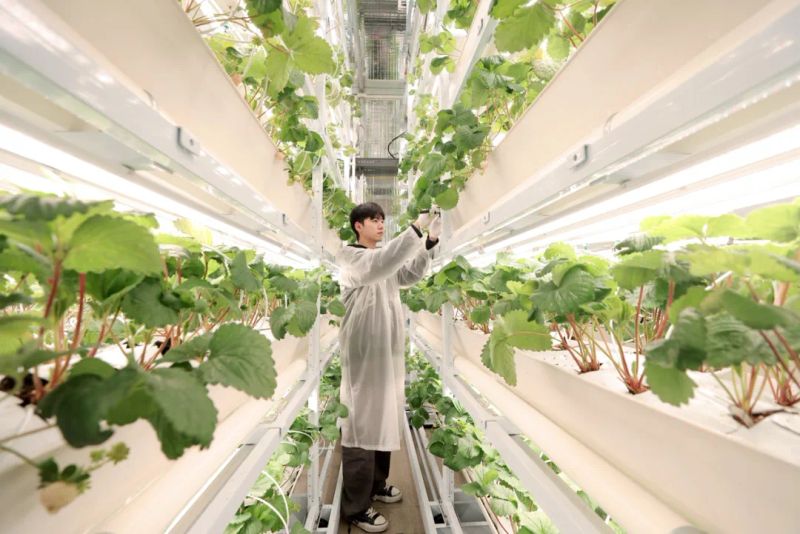
Shanghai in april, bong-hyun, grass and onions. In shanghai, four small white “small houses” of 50 square metres in short shape stand in parallel in the squares of led light matrix, multi-layer stereo-planting racks, and live-time data displays, each of which is a mini “plant plant”。
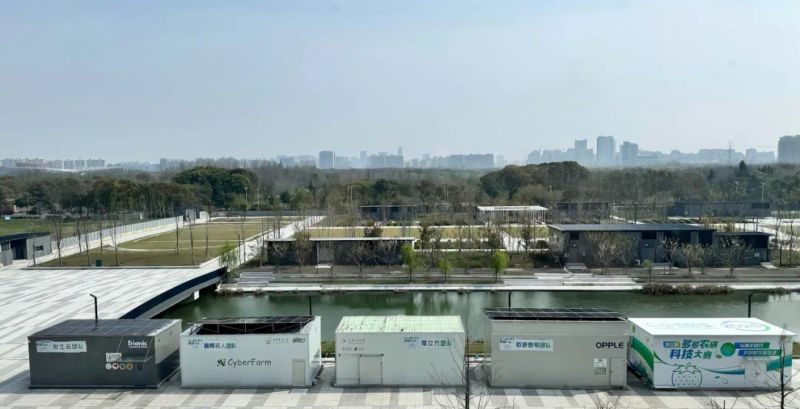
Each of the four final teams designed and constructed 50 square metres of strawberry plants. Land cloud waves
This is the upcoming finals of the fifth multi-agricultural science and technology competition. The four teams that have broken out from the 22 initial teams will, over the next six months, match the home-grown strawberries in their own plants。
Since the inaugural competition in 2020, six springs and autumns have passed through the multi-agricultural science and technology contest, which was spearheaded by many. From strawberry cultivation in greenhouses in yunnan highlands to the challenge of vegetable growing in containers, to the present-day plant strawberry cultivation, each of the trajectories of the competition is stepping on the pulse of agricultural technology development。
Today, a new group of “new farmers” are challenging the multiple challenges of domestic strawberry plant cultivation and are working together across borders to explore the best solutions to frontier agricultural production patterns。
It's a big technical challenge
"the growing of strawberries and the growing of lettuce are not the same thing." according to chen min hui, a doctorate student at the agricultural university of china. Her team was the “year-old” team for five consecutive rounds, and she herself was in the game for the second time。
Chen min hui has a specific sense of the difficulty of the competition: while the first two competitions involved only the stage of nutrient growth, strawberries had to be precise in adjusting the balance between nutritional growth and reproductive growth. “ strawberry is a plant with a continuous flowering effect, with long-term cultivation demanding the sustainability of the ring system.”
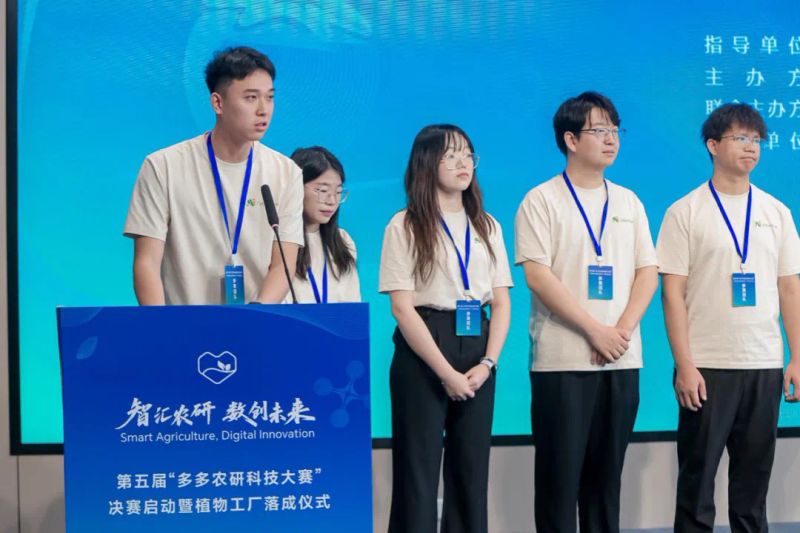
For five consecutive years, the team of "old generals" sabon farmers. Land cloud waves
The teams have come up with great ideas in the face of the escalation of technological difficulties. The sabon farmers' team, with its philosophy of “dialogue with plants”, has designed an intelligent ring-control system driven by plant demand: seven rows of six-story stereoponics expand the area under cultivation to 126 square metres, combining machine visualization with multi-target optimization algorithms, incorporating internal plant-sourced biological clocks to adjust light, and water-composed systems to precision irrigation according to nutrient demand。
Three “technical plates” were drawn by the berries cube team led by shanghai university of transport: 110 windways were installed, each of which had two ventilated pipes, each of which was equipped with an exclusive “respiratory channel”, accompanied by a customized spectrum of leds and reflectors, to achieve an even supply of light-temperature fattening; self-study prediction control models were dynamically improved every half-hour; and the avi system, which measured the nitrogen potassium content through mobile phone mapping, ai analysis, reached 90 per cent accuracy during the trial phase。
The ecological team from zhejiang has chosen a more unique path — shallow flow (nft) cultivation — and has incorporated the self-inflicted concept of “ecoology” into the competition. Captain ho xuanyang indicated that “preparatory ecology” refers to the simulation of natural circulation metabolisms, the construction of symbiotic systems in soilless water-free environments using microbacterial agents, and the realization of closed loops from the input of elements to the output of fruit and the return of debris。
As the only team in the four teams that have adopted the alkaline hydroponic model, they adhere to the “preventive priority” planting strategy and wish to build a pure and manageable hydroponic environment without chemical pesticides throughout the process. In space use, the team planned to plant 4,600 strawberries within 50 square metres, with a density of four。
The operchberry plant program shows unique highlights such as plant lighting smart centralization systems. Captain wang wanhai shared the road, and during the plant plant construction, he often went on site to follow the project, interacted with other finalists, and the teams were open and open. “there are now different options for each team, with the result of thinking on its own about design。
Four teams, four programmes, are directed towards the same goal: high-yield, high-quality, low-cost, low-energy, home-grown strawberries are grown in 50 square metres of maximum space。
How far is the commercialization of plant plants from the arena to the market
When technology is so cool, you have to answer the simple question: can strawberries from plant plants reach the market, industrialize and commercialize
According to one of the competition's expert reviews, professor of hydrology and civil engineering of the chinese university of agriculture, and dr. Ha dong xian, the answer lies in the irreplaceable value of plant factories. She noted that for very short-lived agricultural products, such as strawberries, plant plants were able to achieve near-supply, stable output throughout the year and meet the rigid demand for good-quality fruit and vegetables from specific populations。
“this method of production will not replace all agriculture, but it must target the population.” in addition to strawberries, such items as high-value-added chinese medicine are being industrialized through plant plants, according to he dong xian。
Qin qing, a member of the berry cube team and managing director of shanghai technology (shanghai) ltd., which is responsible for industrial assessment, observed from an industry perspective: chinese strawberry production is now the highest in the world, and perhaps plant plants are not the best option for large-scale development of home-grown strawberries in the short term, but the greater significance of the competition is to explore the path of integration of productive research - “to transform what is in the field into what is on the farm, to connect people and money with technology and industry, and to make more young people willing to stay”
With regard to the difficulties faced by plant plant strawberries in moving out of the plant to the market, the competitors and experts mentioned, infrequently, that there was also a need to address the high energy intensity of plant plants. In terms of cost control, plant plant energy consumption can account for 50-60 per cent of operating costs, so how to make plant plant plant operations efficient is a priority issue for each team。
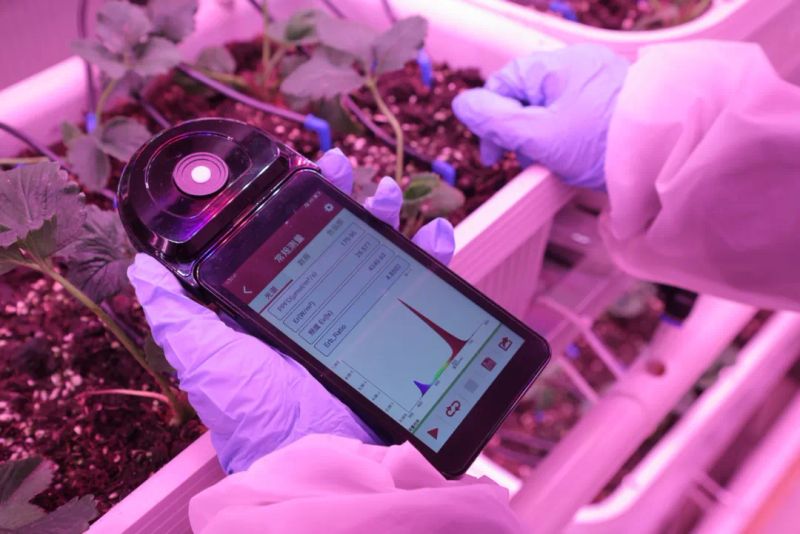
The members of the oprah team collect key data from plant plants using plant photoanalysis. Land cloud waves
Each team also offers its own energy-saving solutions. Among other things, the opple grinchberry team has a full article on “lights”: the four-channel spectral lamps can adjust the light formulations according to the dynamics of the seeding, flowering and fruit periods, while the high-pressure direct flow centralized power system integrates more than 400 lights into the outdoors with water cooling lamps, which alone saves 10 per cent of energy compared with conventional programmes. In addition, the team installed 24 photovolts on the top and south sides of the plant plant plant to supplement electricity with solar energy。
Other teams have focused on reducing air conditioning energy consumption by using out-of-house cold sources and secondary winds; and on the exclusive and accurate start-up of equipment such as air conditioning, wind machines and wet-deficit machines by the strawberry cube team to avoid waste ..
“we see that more efficient light technology, more intelligent ring control and closed ring management of water fertilizers are actually reducing core costs.” at the opening of the finals, the deputy researcher of the institute of information of the shanghai academy of agricultural sciences commented, “commercialization cannot take place at once, as long as it does not deplete and add value, plant strawberries must move from demonstration to inclusion and to thousands of homes, and i am sure that the event is driving.”
For its part, the he dong feng pointed out that the plant plant had a more commercialized break point, or “breeding”. She said that one of the greatest advances of the competition was that "breeding specialists finally came in." zhejiang's ecological team brought in strawberry breeders from the agricultural institute of zhejiang province, who were also included in the evaluation。
“none of the world's species has been cultivated specifically for strawberry plants. The competition is likely to attract more breeders. If a suitable plant plant breed can be developed, it will certainly follow the technology model and move out of a completely new business path.”
Who is rebuilding the future of agriculture across borders and integration
Of the four finalists, one trend is particularly striking: cross-border integration. Students, experts and practitioners from various disciplines such as breeding, horticulture, lighting, building energy conservation, automated control, ai algorithms, commercial operations, etc. Have joined the contest. Agriculture is no longer a “face to the ground”, and the industry is calling for talent in the fields of plants, mechanics, algorithms and commerce。
At the end of the trials, the team leader of the berry cube team, he shihi, records the strawberry fruit trail in order to optimize the formal planting phase of the finals. Land cloud waves
As a model of a combination of production studies, the berries cube team, which was formed jointly by shanghai and two enterprises, developed a complete closed ring from laboratory algorithms to plant hardware landings. As a student, hershey, who was the leader of the team, said that he had previously “only grown lilies” and that growing strawberries was “the first time”, and that today the master of the facility's horticulture profession not only has developed an insight into strawberry cultivation, but has also learned to pool budgets, coordinate specialists, manage progress and become a long-term classroom。
In the team of he shiwei, there are students in the e-information profession, senior engineers in smart agriculture, and “masters” in companies that integrate agricultural technology and industry. He said, “it's time to learn how to do fine work without having previously spent so much money; it's time to be social and to come here and deal with all kinds of people with hard skin.”
As a corporate-led team of representatives, members of the oop jigerberry team came from all walks of life: light formula specialists at the university of vahaningen in the netherlands, zero carbon construction engineers, and ai big model experts ... Engineers from the oop lighting team found that simply selling plant lighting lamps to growers, lighting programmes and the next strawberries in person, felt quite differently, “it was easy to make lights, it was difficult to grow strawberries, and it was absolutely necessary to have love to do it.”
At the same time, the team has experienced a shift from “empirism” to “data thinking”. Some of our farmers used to go around the field every day, judging by feeling, "almost." but the team asked me to turn the experience into accurate data: the moisture can't say "almost," but 65 percent or 70 percent." by translating vague experiences into computer-recognised commands, then using ai algorithms to connect, the team is saying that in the summer, the team is making strawberry truly “comfortably happy”。
The concept of intelligent agriculture is taking root in different areas through technical collaboration and complementarity of experience. “during the last few years, five `multi-agricultural science and technology' competitions have not only attracted more attention, but also, and more importantly, truly promoted cross-disciplinary cooperation.” he dong xian said。
This is also the purpose of the campaign. “we want to encourage more young scientists to become involved in agriculture, break barriers to industry, take advantage of technical know-how, cross-border empowerment, and breathe new life into agriculture through the competition.” many of the leaders concerned have expressed their desire to do so. In 2025, a multi-billion-dollar support programme was launched to increase creative investment in agricultural science and research, to explore new models and technologies and to equip farmers with skills and talent “two engines” by leading high-level events such as the fifth multi-agricultural science and technology competition。
The team in ho dong xian sent words to learn from each other in a more open-minded manner in the course of future events, “when there is progress, we win. Progress is not perfect or more than anyone else, but rather through training, interdisciplinary cooperation, thinking about the path of industrialization and closer to the goal of commercialization.”
The game continues. In the next six months, four teams will complete a final round of production, quality, energy consumption and cost in 50 square metres of “small houses”. Regardless of the outcome, this contest bodes well for the desired future — the future of modern agriculture that crosses borders, where technology can be empowered and industry can make money。