Reading notes
It's a technical piece that suits readers who want to understand。
Title: "understand-anything: transform code into a searchable knowledge map with multiple proxy conduits"
Https://github. Com/lum1104/understand-anything"stars:3999tags:
"knowledge-graph", "multi-agent", "codeb""claude-code," "tree-sitter", "cursor"
Core proposition
The code understands this, it used to be read by people, it now depends on searching. But what would happen if you could see the code structure directly — the file, the function, the class, the dependencies all turned into clickable nodes, forming an interactive map? Underwood-anything turned this idea into a reality: a claude code plugin, using a pipeline of five professional agents to turn any code library into a searchable knowledge map。
"stop reading code blind
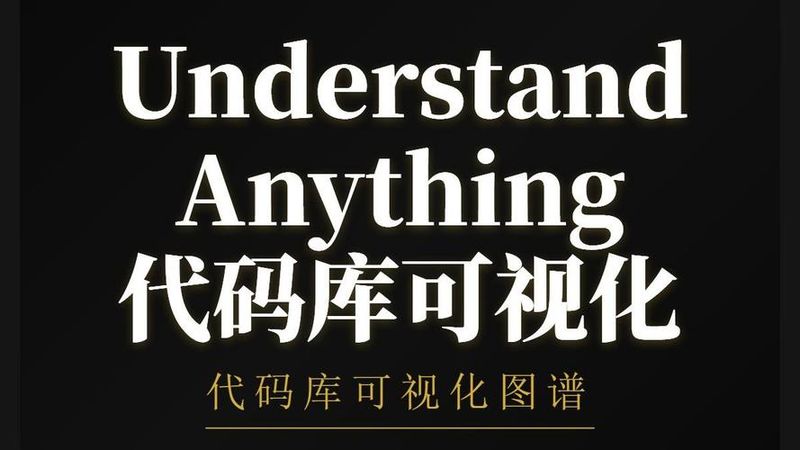
The author argues that the core value of the project is not in the form of a "knowledge map" but in the form of an engineering commons -- that the bottlenecks in code understanding are never about whether llm is smart enough, but about the fact that nobody turns the code structure into a form that llm can access efficiently. Knowledge mapping is only a form, essentially a form of visualization and mapping of hidden code structures。
Technical architecture: 5 conduits for professional agents
/understand command
zenium
project-scanner ← found files, tested languages and frames
zenium
file-anallyzer ← extract function, class, iOther organiser
zenium
architecture-analyzer ←
zenium
tour-builder ← generates a guiding learning path in the order of dependence
zenium
grap-reviewer ← validation map integrity and reference integrity (default inlink running)
Optional 6 agent domain-analyzer: extraction of business domain, flow and process steps。
Key technology i: positive resolution + llm enhanced
The project uses a tree-setter (confirmant solver) to extract the definition of the position of the function/category, the call relationship, the structure of the inheritance - these are structured hard information that does not rely on llm. At the same time, llm is responsible for supplementing the plain-english interpretation, labels, floor allocation and business domain mapping - these are flexible parts of the semantic layer。
"the deterministic parser examples story that llm alone can't: fight solutions, call sites, inheritance -Llm adds what the parent canIt's like, "oh, my god
Key distinction: many people try to understand using llm only as a code, but quickly encounter hallucinations and omissions. Understand-anything is based on the idea that the structural layer uses a certainty tool (tree-setter) and the semantic layer uses llm, both of which function。
Key technology ii: interactive mapping dashboard
It's not static output, it's stored
... Understand-anything/knowledge-graph. Json, then open an interactive web dashboard:
Key technology three: lead
Tour-builder agents automatically generate learning paths based on dependency - not in file order, but in "the correct order of understanding code". This addresses the core issue facing the new members of the large code library: where to begin and in what order
Link to subject-mode
In round 97, we recommended mksglu/context-mode (15,600 stars), which addresses the question of "how to manage information efficiently in context windows". Underwood-anything solves another dimension of the same problem: how do you get agent to use code structures efficiently when the context is long enough
The answer is: mcp four levels optimize to reduce token consumption. The answer to underwood-anything is to translate the structure of the code into a graphic, so that agent can scan as needed, not as linear。
Complementarity - context-mode allows limited co-Ntext is enough, underwood-anything allows structured code knowledge in coNtext is efficiently accessed。
The author's engineering judgment
The most interesting design decision: the hybrid structure of the three-setter + llm. The common problems understood by pure llm codes are inaccuracies in structure, possible omissions, and the need for extensive token in-depth analysis. This project uses the tree-setter to ensure structural accuracy and llm to supplement semantic layers - neither of which are isolated, but reinforce each other。
The most valuable feature: diff impact analysis. When a team makes changes in the code library, the greatest risk is not knowing which modules the change will affect. This function allows you to see the extent of the ripple effect -- it's very valuable for the re-engineering of a large code library。
Application scenario: - new member onboarding (directive tour + spectroscopy exploration) - structural understanding of large code libraries (not read code, "travel" code) - pre-restructuring impact analysis (diff) - cross-team code sharing (persona-adaptive ui)
Not applicable: - small scripts or single file items (not required) - scenes requiring precise type extrapolation (tree-setter provides structure but does not provide type syntax) - hf change codes requiring real-time updates (spectrum generation is cost-effective and not suitable for high frequency rebuild)
Next-period advance
Next issue: anthropic 2026 activation communications report
If this article helps you, please leave a message and tell me what you want to hear