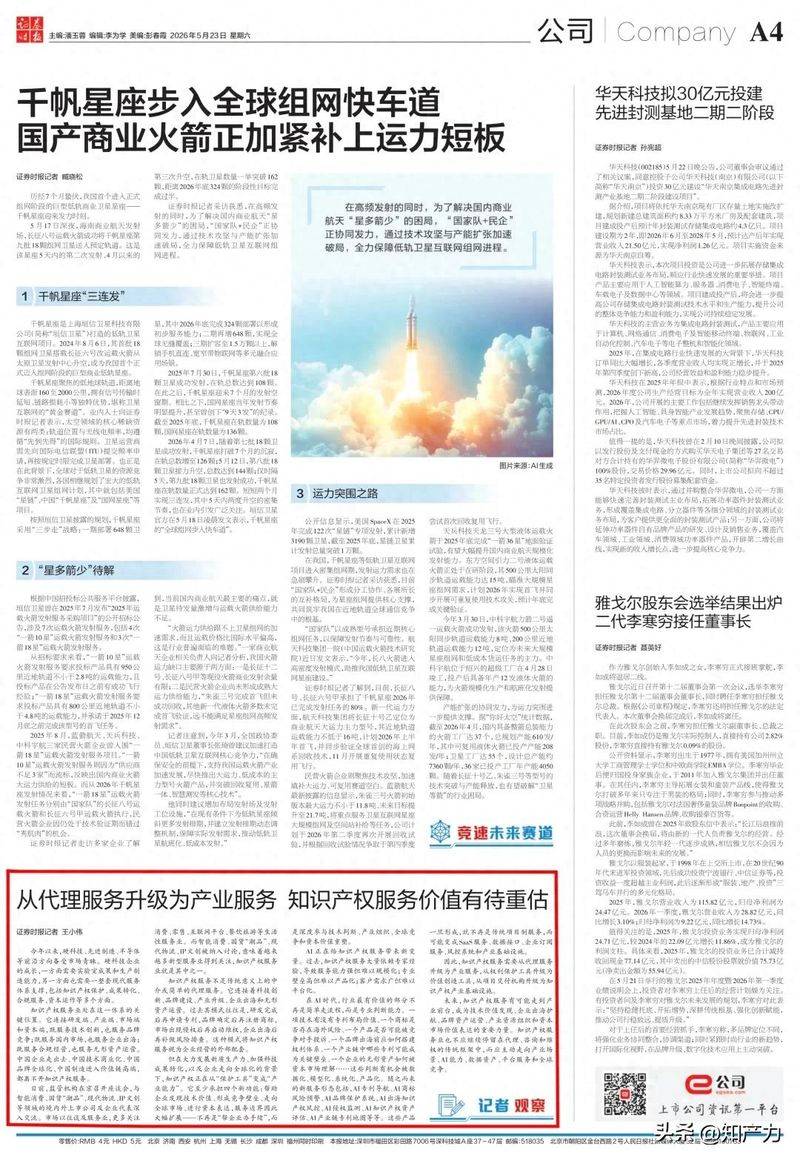
Since this year, the front lines of hard technology, advanced manufacturing, semiconductors, etc. Have been favoured by the market. The growth of hard-tech enterprises requires, on the one hand, laboratory results and manufacturing capacity and, on the other hand, a modern system of services, including intellectual property protection, conversion of results, compliance services and capital operations。
Intellectual property services are at the heart of the system. It links the research and development end, the industry end, the market end and the capital end. It serves both technological innovation and brand competition; serves both the domestic market and the enterprise; and serves both compliance and intangible asset operations. The exit of chinese enterprises, the commercialization of chinese technology, the globalization of chinese brand names, and the entry of chinese manufacturing into the higher end of the value chain are all essential to intellectual property services。
Recently, regulators held a symposium in kyoto to interact in depth with representatives of domestic and foreign listed companies and enterprises in areas such as intelligent consumption, domestic goods “tide”, modern logistics, ip creation, etc. Markets have spoken of services in the past, with greater attention being paid to services such as consumption, retailing, internet platforms and catering tourism. The inclusion of smart consumption, domestic “tide”, modern logistics and ip innovation in the discussion meant that attention was increasingly being paid to new types of services, among them intellectual property services。
Intellectual property services are not traditional intermediaries or simple agency services. It links science, technology and innovation, branding, industrial upgrading, business travel and intangible asset operations. In the past, the pattern was often one of patenting after the completion of research and development, registration of trademarks after branding, initiation of advocacy after market infringement, and re-entry of enterprises into the sea for risk screening. This model views intellectual property services as an external complement to business operations。
However, in the context of strong efforts to develop new qualitative productivity, enhance the transformation of science and technology and the globalization of enterprises, intellectual property rights are shifting from “protective tools” to “industrial capabilities”. It has at least four new functions: helping enterprises to discover technological value, create barriers to competition, move to global markets, and make capital representations, which has led to a substantial expansion of the service boundary — no longer “business facilitation”, but rather a deep participation in technical judgement, industrial organization, global competition and recapitalization。
Ai is bringing new variables to intellectual property services. In the past, intellectual property services had relied heavily on expert experience, leading to strong but difficult scale of services; high professional barriers but difficult to produce; and widespread customer demand but difficult to platform。
In the ai era, the most valuable part of the industry is no longer simple process but professional judgement. Whether a technology has patented value, whether a trademark has an offshore risk, whether a product can be complained to by a competitor, how a brand should build a system of rights before going out to sea, which patents in an industrial chain can be a key barrier, and how an enterprise's intangible assets are understood by the capital market ... These judgements have the opportunity to be digitalized, modelled, systematized and productized. The resulting new service patterns include ai patent navigation, ai mark risk alert, ai brand protection system, ai offshore intellectual property wind control, ai tort monitor, ai intellectual property asset assessment, ai industrial chain patent map, etc. Once these products are formed, they are no longer traditional project-based services but may become saas services, data interfaces, corporate subscription services, wind control systems and industrial infrastructure。
Thus, intellectual property services need to be upgraded from agency services to industry, from rights protection tools to value creation tools and from project delivery agencies to intellectual property industry infrastructure。
In the future, intellectual property services have the potential to move to the front of industry and become an important force for technology value discovery, business escorts, brand asset operations, industrial resource organizations and the expression of capital market values. Iprs services should also not remain within the traditional framework of agency, advice and rights protection, but should move proactively towards industry landscapes, ai capabilities, data assets, platform services and global competition。