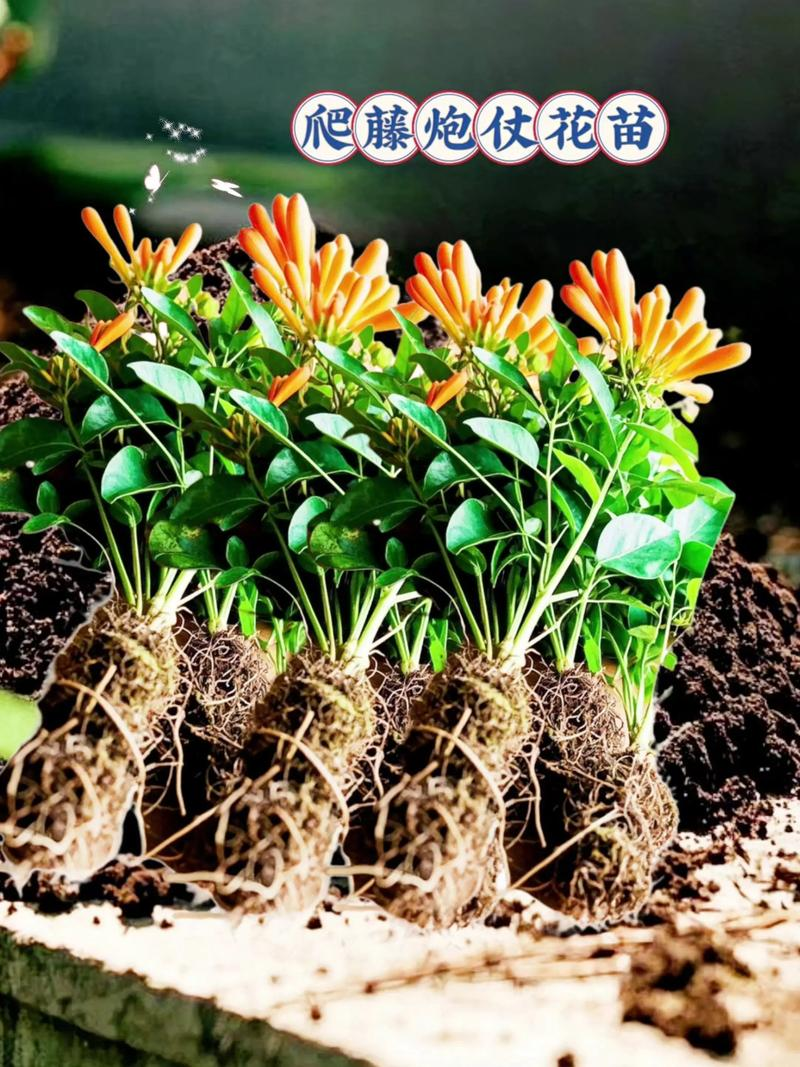
The fireworks are violet, hormonal and vegetable, and are called yellow vegetable, firecrackers, gold corals, sparkling flowers, membranes and flame vines. Artillery flowers are planted in courtyards, as well as fences, flower racks or for vertical greening. A string of flowers, like firecrackers, is a very good view of flowers, which usually open every january — june — sometimes for more than six months. The flowers are beautiful, the orange and red flowers are very rich. During the flowering season of the battle, it's a beautiful view of the sea. Gunfire is an important climber in south china. In the northern region, the choice can be made for dwarfed varieties, corroded in the form of pellets. In hainan, yunnan, guangdong, guangxi, etc., it has been widely used as a garden watcher for plant cultivation。
Artillery flowers are originally produced in brazil, south america, and have a three-kilogram twirl requirement. Leaves to life; male and female born in the middle of a flower coronary, in the form of a filament, with flowers fork open. The cylindrical form of the sub-house, which is thick and thin, which is thin, flat in its tongue, and which stretches out its crown drums. Vegetables, canoes, with seeds in them, with wings, thin membranes. It takes a long time to survive, to grow and to grow more easily. It likes to grow in a sun-rich environment and requires ventilation. High temperatures and high humidity are preferred for soil with a very acidic sandy soil. (c) prosperous environments and fertile, wet, acidic soils. Rapidly growing, in the south china region, it keeps the leaves green, and the open winter. As many of the rolls were born in the upper part of the penis, the whole stock was solidified on him。
First, the method of reproduction of the gunpowder: it is mainly reproduction by barbs or pegs。

1- reproduction: low pressure and high pressure are usually used to reproduce, and low pressure reproduction is the choice of a branch near the ground at the beginning of spring, with a small knife to strip one centimetre of the incision, which happens to be buried in the soil when it is pushed down by a branch, and part of the incision is buried in the soil with stones, the branch is pressed upwards and the branch is not swinged. When the planting season, the ground pressure is cut open, the already long-stretched pressure is cut from one end of the mother's strain and separated from the mother's。
In addition, it is high-pressure reproduction, with a small selection of branches close to the ground, which must be grown using high-pressure branches, which are called air-crushed strips, 2-4-year-old vines selected for growth on the tree crown, 20-30 centimetres from the tree crown, which are skinned in circular strips, then pegged around the wound in a plume form, then constricted externally with plastic sheeting, usually in spring 2-march, until the white roots are seen in august-september, when they are cut down by 3-5 centimetres below the ball, they must be fabricated immediately。
Ii. Plug-in breeding methods: pre-emergence pre-emergence in early spring incubation, selection of vine strips with large size and no pests, approximately one centimetre in diameter, cutting into 8-15 centimetres long plugs, embroiled in prepared bed, lined 15-20 centimetres in bed, and perm every 3-5 centimetres with a wooden stick. It is then inserted in the hole by one half to two thirds of the length of the piping, and the soil is pressed down and water is poured once. You're gonna have to cover up and get wet. Vegetable growth hormones can be used to treat jade slots, with a clear contribution to the promotion of roots. Commonly used growth hormones, such as thioxybutyric acid, thioxyacetic acid, 2,4-d, root powder and so on, have a good effect on rooting。
Second, planting, which is practised in the south, can be carried out where the climate is cold。
Ground planting: the site of cultivation is to be selected as a well-soiled, coolly ventilated site in the courtyard. Artillery flowers are less demanding to the soil, but grow stronger in rich, organic, well-watered and deep, fertile soil. Artillery plows are duly larger and deeper, generally requiring the cultivation of caves about 30 cm in diameter and 30 cm in depth, the application of base fat, and the use of corroded compost and appropriate pie fat or bone powder. When temperatures return in april-may each year, saplings or seedlings are planted into the flower basin, before planting the broken roots, broken roots, damaged roots and excessively long roots. It is then filled into the earth, then placed in the center of the flower pot, and the roots are stretched up to half of the ground, and it is swayed with the earth, so that it is not too deep to plant, so that the roots and the ground are even. The shallow effects are alive, affecting the growth after transplantation of the cannons and planting and pouring water once。
B. Plantation: the pellets are very limited in their capacity to grow cannons, which are a special small environment and which, regardless of the single soil, cannot meet the needs of the pellets for all aspects of the soil. As a result, pelvis cultivation must be artificially prepared to produce the soil in place of the pellets, which fixes the flowers in the pelvis and has a certain level of water conservation and drainage, laxation, fertility, well-ventilated drainage, rich decomposition and low soil alkalineity. In general, 40 per cent of the earth, 40 per cent of the yellow sand, 20 per cent of the land used for the cultivation of cannons or for the production of household garbage are produced。
Small amounts of base fat were applied at the bottom of the basin. When temperatures return in april-may of each year, small seedlings that are incubated or grown under pressure are planted into the flower basin, and the roots, broken roots, damaged roots and excessively long roots are cut off before entering the pot. First, the fermented fermentation, bones, fish stings, etc., are to be put in the base of the flower basin, then the fermentation plant is to be placed in the center of the bouquet, the roots are to be stretched, the pelvis are to be filled up to half the bouquet, the bouquet is to be strewn, the earth is to be bred, the planting is not to be too deep, and the root and the mouth are to be flat. The shallow effects are alive, affecting the growth after transplantation of the cannons and planting and pouring water once. Cultivation is followed by conservation in a shaded environment for about a week, while root systems are restored and moved to sunlight-rich local conservation。

Day-to-day management: there is a need for fatty plants on the pyrotechnics, which are fast growing, multi-fruit and long-lived, and therefore fatty and water. A per-month fertilisation is required. The pursuit of fatty is accompanied by corroded and thin pies or co-fertilized fats, which cause their branches to grow and bloom. In order to keep the soil wet, the frequency of water recharge should be determined by the state of the soil moist, and water is sprayed on the leaves two to three times a day during hot summers and on the surrounding ground to increase air moisture. In the autumn, the guillotine guillotine period has entered, the water should be reduced and the application of fertilizers should instead be dominated by phosphorus. Nitrophosphorus is usually combined with thin liquid fertilizers about two weeks in the growing season. During pregnancy, the pregnancy buds are followed up with liquid fertilizers, mainly nitrogen fertilizer, to open flowers and grow plants. The water must be dry and wet, and the water must accumulate in the basin. During the summer, the temperature is high and the water is sufficient, while water is spilled on the ground near the flower basin to increase air moisture. In the autumn, the guillotine period began, at which time water would need to be properly less so as to control the growth of nutrients and encourage the guillotine。
In winter, the southern region can still be cultivated outdoors, and in the cold north it is necessary to move cannons into indoors or sheds. Artillery flowers moved into the interior need to be placed in a well-soiled area, with room temperature above 10°c。
Gunfire flower trimmed. A flowered horde does not bloom again, and when the flower is lost in daily management it is necessary to trim it in time to promote the emergence of more branches and ensure the sustainability of the flower. When the branches grow to a certain height, they have to hit the top, prompting them to grow, so that they can bloom. Some old branches, weak branches, etc. Should be cut off in a timely manner so as not to consume nutrients and affect flowering. Special attention is paid to the cutting, trimming and cortexing of the pyrotechnic pyrotechnics, which reduce the pyrotechnics. During the winter, artillery flowers are moved into indoors or sheds, which need to be placed in areas with sufficient sunlight to keep room temperature above 10°c and to control the watering。