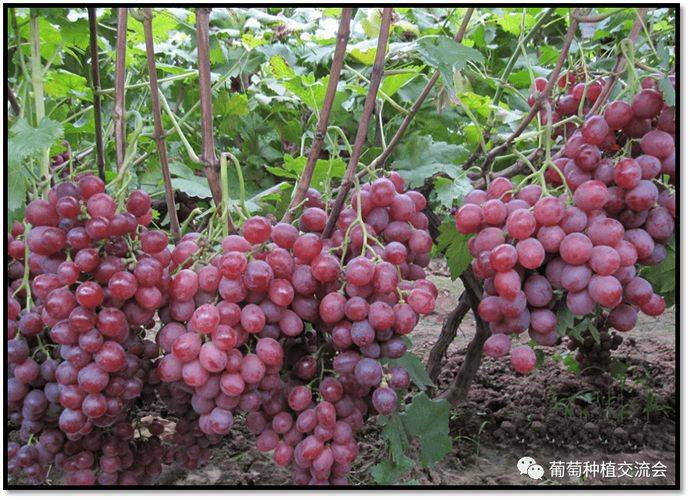
What is the method of planting rubies without nuclear grapes
The rubies have no nuclear raisins, have a high symmetric rate, have even grains, are easily coloured, and are hard
Cracky, windy, early and productive, adaptable and high planting prospects. Here's my recommendation
The way rubies grow without nuclear grapes, hopefully, will help you。
Cultivation of rubies without nuclear grapes
I. General information
Plantation pilot site at the grain pond village vineyard in my district, with a period of 232 days and an annual rainfall of 650
Millimetres, average annual temperature of 13. 1°c, flat ground, slightly alkaline soil and deep, fertile soil. Year 2000
In the spring, the plant is built directly from a single metre range。
Ii. Greenhouse shed structure
The greenhouse is 50 meters long, 7. 5 metres wide, the ridge is 3. 3 metres high, the front foot is 1 metre tall, the front and bottom corner
It digs 50 cm wide cold-proof ditches and lays straw or straw. The walls of the east, west and back are 50 cm empty walls
It contains pearl rock. It contains a line of cement pillars, 2. 4 metres high. Take the iron arch and use it green
Drill cover, with the moisturizing curtains. The shed is equipped with an improvised pipe coal furnace。
Cultivation techniques
1. Cultivation and fertilizer management. 30 to 40 centimetres of established caves, 5,000 kg of organic fertilizer
50 kg of ammonium phosphate and 10 kg of potassium sulphate, mixed with soil, filled into a stable den, then planted a seedling, planted and poured
Aqueous membrane. 50 grams of compound fertilizer before the bud starts to bloom, and then it's followed up when it's up to 40 centimeters. It's back
100 grams of fertilizer, 400 times more oxen at a height of 1 metre, and mid-july when the berries are colored
Potassium dihydrates 0. 3% phosphate sprayed and 5,000 kg of organic decomposition chicken dung continued to be applied after fruit extraction. In early october
Foot water, heating and sprouts in late november。
2. Integrative trim. After the seedlings were planted, they were trimmed in a single dragon dry form, each with a main chicken, which was left above
4-6 result branches, no more outcome groups. When it is as long as 30 cm, the frame is drawn and the armpit is removed。
The main chicken sprays multi-acting accelerants at a new length up to 1 metre, up to 2. 5 metres, and leaves two or three subs at its top
Twist, two to three leaves on each side to get your heart ready. 60-80 cm short in front of the shack. It's new
Five are retained each and the rest are erased. When the new steps rise up to 20 centimeters, they're sprained
1/4
Growing is done after 10-15 days, when the postmortem is 20 cm. Up to 30-40 cm time
With a rope to pull strong new grains into smaller parts of the chicken, so that the branches are evenly distributed. For forthcoming sub-issues
Only one or two leaves at the top and two or four leaves at each。
3. Temperature control. 19-20 october buttoned up, covered with grass during the day to keep the room out of light, evening
The vent is ventilated, which reduces the temperature to 30 days cold outside. Use lime nitrogen to wipe the branches
Their early hibernation. In mid-november, the heat rose during the day, and it was 18°c until the blooming night
Days 25-28°c, flowering night control at 15-18°c and not more than 30°c during the day. The temperature is 25-28°c
At 20°c in the middle of the larvae and then at 18-20°c, 25-28°c in the daytime, 25°c in the daytime in the coloring period
28°c, 16-18°c at night. Keep an eye on the temperature in the shed, turn on the heating equipment when it's too low, and keep it inside
Temperature. Premature humidity can be larger, relative humidity can be 85-90%, pre-flower control can be 60-70%
60 per cent, 50-60 per cent during expansion and 60-70 per cent during coloring. It's gonna be a long time. It's gonna be a long time
In the snow, light is used to fill the light, and a reflection screen is mounted inside. Dust and impurities on the shrouds are removed at all times to add light. Two
When carbon oxide is reduced, solid carbon dioxide fertilization is increased。
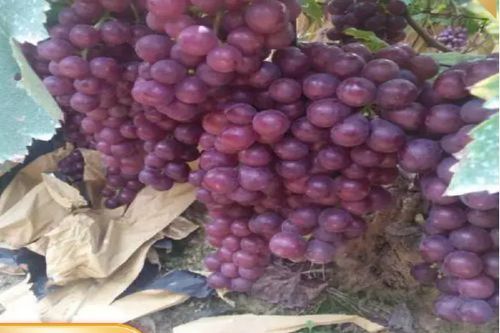
4. Flower fruit management. Weak branches, strong branches with a single ear, weeds their ears out, chokes their ears, leaves five for each
Goe, draw the small, the dense. The berries sprayed 0. 3 per cent of potassium phosphate in colour。
5. Disease control. Spraying 5 degrees of thiomer in front of the shack, pre-growth period at year-round temperature
Lowest periods, prone to ash and frost, managed by eco-temperature, depending on the temperature of the period
Seek good control. Drug control is carried out through smoke and dust rotation, once a week. Watch out for the white ticks
25% emulsifiable concentrate. The fruit grows from frost and powder
The shed is highly susceptible to disease and can be smoked with bacillus, 16 per cent anti-frost dust and 1 in 7-10 days。
Forty-six per cent of aluminium triethylphosphate can also be used with 15 per cent rusty 2000-fold fluid. Post-cut fruit multiplication bordeaux 200
Double, 1 month, protect the leaves。
The way grapes fertilize in the summer
One is the foliage. The grapes are fertilized, mainly on the back of the leaves
Proper spraying. Spraying is available for all growth after summer. To make it more effective, you can use medicine to fatten. Fuck
Spraying, with the exception of calcium phosphate, the usual nutrients can be sprayed with guacamole tiline, without wind or rain
The twilight application is the most effective and can also take place from 8 a. M. To 10 a. M. Usually 10 to 15 days apart
One and two to four extensions。
The second is to rejuvenate. 10 days after the flower bloom or green bean grains in the fruit are fertilized in large hours, each
2/4
The ditches were used to remix the fat 500 grams and then watered the soil in time. I'll spray the guacamole on the leaves
It's a key fertilizer that boosts the growth of young fruit and branches
Real expansion, with increased output。
Third, when grapes are harvested, nitrogen fertilizer should be applied in a timely manner to enhance the function of the leaf and to extend the lifetime of the leaf
Growing the nutrient storage of the tree body, with both spraying and root application of nitrogen after extraction, if combined
Better. The application of 0. 4 per cent of the urea solution is appropriate for root application of 4 kg of urea per acre。
Garden management after grape harvest
1. The restoration of the tree, as much as possible to protect the leaves from premature fallout. Get it together
Reduce nutrient consumption, regulate the flow of tree nutrients, and promote the budding
Full old. For thin, infertile orchards, noodles are sprayed in time。
2. Cleaning of gardens to reduce the density of disease in the field. When the grape harvest is over, the garden shall be internal
Cutting the branches, removing the dead leaves, the sick leaves, the leftover fruit, the rolls, and picking
Remove broken bags and weeds from the gardens, remove the gardens and bury them or burn them. This way
This will help to reduce the intensity of infestation and the incidence of pests in the park next year。
3. Combining deep-tilled pine pine pine pine pine tune。
Autumn fat is dominated by decomposed organic fertilizer (usually 2-3 tons of manure per acre or 1 ton of refined organic fertilizer)
2 - 3 or 1 - 2 packages of compound fat, pellets, zinc and magnesium. Time spent on fertilizing in autumn
"better than later". Early fertilization, high external temperatures, active soil microorganisms, favourable to fertilizers
And root systems to produce more organic nutrients for the safe passage of grapes over the winter and next year's growth
It's a good start。
4. Combating pests and diseases
Post-harvest pest control is dominated by frosting, powdery and shellworms, borer-drilling and pharmaceutical agents
With mainly bordeaux, 80% sulfur and 80% protection agents such as dyson manganese zinc (several cases can also be used once or twice)
After microbicides are used) with insecticide。
5. Water management, irrigation combinations, timely drainage in the event of heavy rainfall, and in the event of drought in the autumn and winter
Water is pumped to maintain a soil content of not less than 60%。