


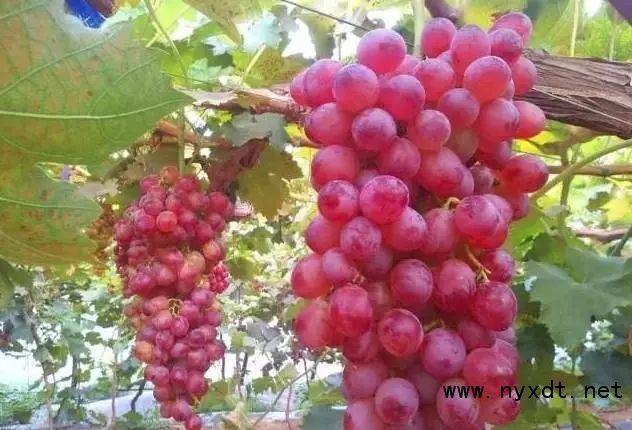
The rubies have high levels of non-nuclear raisins, even size of fruit, easy to colour, hard meat, good taste, early ripe production and adaptability. The plant matured at the beginning of may and was launched two months earlier than the field, yielding 3,000 kg per acre, with good economic performance。
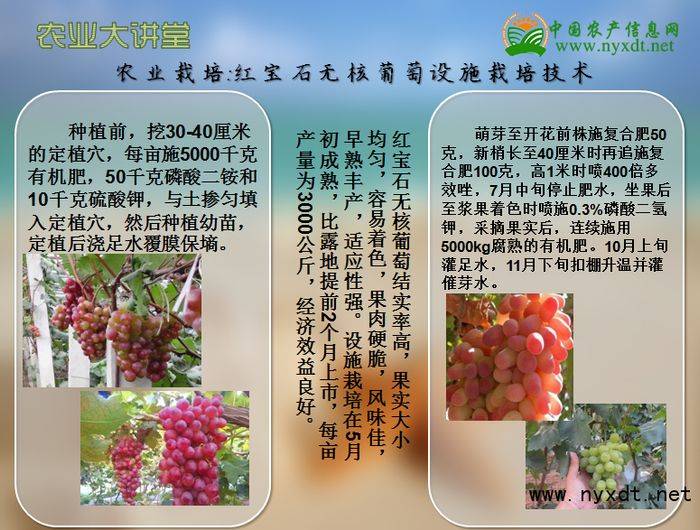
Preplantation: before planting, 30 to 40 centimetres of sedentary caves are dug, 5,000 kg of organic fertilizer per acre, 50 kg of ammonium phosphate and 10 kg of potassium sulphate are applied, mixed with soil, and then planted with seedlings, which are then filled with water membranes。
2 fertilizer water management: 50 grams of compound fertilisation in the bud until the flower starts, 100 grams of compound fertilizer in the new roll up to 40 centimetres, 400 times more fertilizing at a height of 1 metre, cessation of fattening in mid-july, application of 0. 3 per cent of potassium phosphate in the back of the fruit to the berries colour, continuous application of 5,000 kg of rotive organic fertilizer after harvesting of the fruit. During the first half of october, sufficient water was poured, and in late november the shacks warmed and sprung。
3 orthopaedic shears: once the seedlings are planted, they are trimmed in a single dry form. Each plant has one main chicken, with 4-6 result branches on it and no more branches. When it is as long as 30 cm, the frame is drawn and the armpit is removed. The main chicken sprays multi-acting accelerants when it is new to 1 metre, takes a heart when the length is 2. 5 metres, leaves two or three stabbings at the top, and leaves two or three leaves and three leaves at the top. 60-80 cm short in front of the shack. The temperature rises and leaves five in each of the new surges, with the rest wiped out. When new branches grow up to 20 centimetres to sprain and control growth. 10-15 days later, when he was born up to 20 centimetres later, he had to take care of his heart. When the length is 30-40 cm, the string pulls a strong new sprawl to fewer parts of the chicken, so that the branches are evenly distributed. Only one or two tops and two or four leaves for each of the forthcoming stubs。
4. Temperature and humidity control: 19-20 october, membranes were buttoned up during the day, grass-grasses were covered to keep the room out of light, ventilation was opened at night, temperature was reduced to outdoor temperatures and cooled for 30 days. The parent branch is wiped with a lime nitrogen solution so that it is released from hibernation earlier. In mid-november, the temperature rose during the daytime and remained at 18°c until the budding, at 25-28°c during the daytime, at 15-18°c during the night and not more than 30°c during the day. The appropriate temperature is 25-28 °c, 20 °c for larvae and then at 18-20 °c, 25-28 °c for the day, 25-28 °c for the day and 16-18 °c for the night. Attention is paid to the humidity in the shed and the wetting equipment is activated at low times to maintain the humidity in the shed. Premium humidity can be greater, with relative humidity ranging from 85 to 90 per cent. Pre-flower control ranged from 60 to 70 per cent, with a peak of 60 per cent, fruit expansion of 50 to 60 per cent and coloring of 60 to 70 per cent. The morning and evening must be covered with grass, increased light time, snow and light, and indoor reflections. Dust and impurities on the shrouds are removed at all times to add light. When co2 content is reduced, solid co2 fertilization is increased。
5 and the fruit management: weak branches are not left behind, and the strong branches leave a small ear, and they remove their ears from them, and they choke away their ears, each of them leaves five ears, and they draw away small and dense. When berries are coloured, 0. 3 per cent of potassium phosphate is sprayed。
6 insect control: 5 degrees of thioperate sprayed in front of shacks, pre-breeding period, at a minimum temperature throughout the year, prone to ash and frosty disease, managed by eco-temperature management, controlled according to temperature and humidity requirements for various periods, and fumes used for drug control; application is rotated once a week by dust. Attention should be paid to the control of white powdered lice, with 25 per cent of cyanide cream sprayed. There is a need to prevent frost and powder disease during fruit growth. This is an extremely prone disease in the shed, which can be smoked with bacillus, 16 per cent of which is smoked every 7-10 days. 46% triethylphosphate plus 15% of a 2000-fold stainless lactation can also be used. Multiple bordeaux after picking fruit 200 times, one half month, to protect the leaves。
Agricultural farming: high-yield patterns of fish farming



