


"technology plus"
In late july, in the village of baoyang, the city of luangyang, a bag of mango trees, visible everywhere, became a beautiful view of the roadside and the mountains。
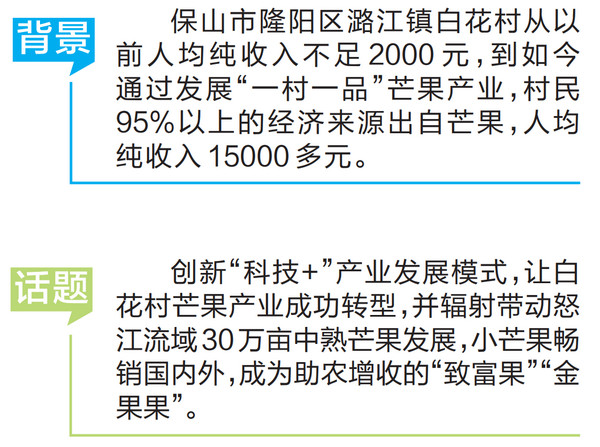
“before 2006, villagers were mainly growing sugar cane and maize, with a net income of less than 2,000 yuan per person. Today, the village's mango growers have a high income of 2. 3 million yuan and, in general, more than 100,000 yuan. The villagers have built houses and cars, and more than 60 of the more than 80 villagers in the village's five and six groups have built new buildings on the income of mango.” the new changes in the village of whiteflower have been a source of great relief to the deputy director of the institute of tropical subtropical crops of the yunnan academy of agricultural sciences, which has continuously served the development of the mango industry in the village of whiteflower for many years。
“the village of white flower used to be `rich to work', now `rich to grow mangoes', with frequent visits to study, and we hope that more and more places will follow the path of wealth through the development of niche industries in science and technology.” the general secretary of the white flower village party, li ling, told journalists。
In the past, mango, the village of white flowers, was cultivated only sporadically, with a total area of no more than 200 acres. Today, 95 per cent of the village's land is grown in mangoes, with an area of over 17,000 acres and an acre production value of between $7,000 and $10,000. The villagers were deeply impressed by the fact that the mango industry in white flower village had been developed by the technology plus。
In 2006, the yunnan agricultural institute used the village of white flower as a pilot village for technology to support the development of the mango industry, focusing on the promotion of mango varieties and supporting technologies, and exploring the model of “technology+” industrial development for the village。
“the high temperatures, high temperatures, low rainfall and low humidity in white flower village are ideal conditions for mango cultivation, with local products having such advantages as a good colour, affluence and a good taste, but the `three-year-old' commodities, which were the most grown in the past, are low, of poor quality and unsustainable and can only be sold in the surrounding areas at a price of between $0. 2 and $0. 8 per kilogram.” the mango expert at the yunnan agricultural institute believes that the development of the mango industry in white flower villages requires the selection of varieties of high quality products, high market demand and high national advantage。
Through research, the team identified the choice of drought-resilient, well-resilient, productively productive mango “palarenda” from myanmar as the village's dominant species through the ingenious project, combined with the application of techniques such as “breed selection, ooze packs, drought resistance, dwarfation, preservation of fruit products and integrated pest and pest control” to make the mango “natural growth, natural flowering results, natural maturity” in white flower village green production, making the advantages of “palarenda” extremely popular with a wide range of consumers throughout the country. Support has also been given to the establishment of the white flower mango professional cooperative, which effectively organizes the mango growers and connects them to the market, effectively breaking the contradiction between “small farmers facing the big market”。
Accelerate the integration of the rich and the rich
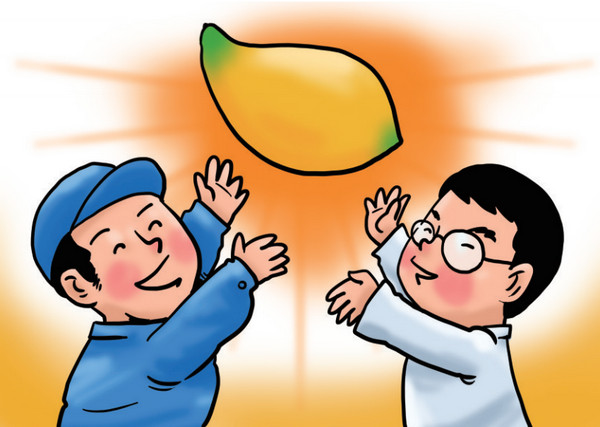
The continuous “landing” of mango technology has contributed to the transformation of the mango industry in white flower village, which has led to the integration of industries i, ii and iii, the mutual reinforcement of services before, during and after childbirth, and a fundamental change in the habitat, the face and mindset of the village。
There are currently 10 farmers, pesticides and fertilizers sellers, 40 mango sellers, 7 restaurants, 7 hotels, 1 mango material processing plant and 5 electric power companies. In 2020, the village-wide professional service for the cultivation of knapsacks, shearing and fruit production reached 500 5,200 persons, the sale of agricultural resources, pesticides and fertilizers increased by 30 persons, the marketing of mango sales increased by 40 persons, post-mango packaging increased by 100 persons, catering increased by 30 persons, hotel services increased by 12 persons, mango packaging plants increased by 7 persons, mango electricists increased by 5 persons, and cumulatively increased by 3. 35 million dollars through the integration of mangos in one or two industries。
The brightest changes are common in white flower village。
In terms of economic income, before 2005 villagers ' income was mainly based on the cultivation of maize, sugar cane and coffee, with a net per capita income of less than 2,000 yuan. Today, more than 95 per cent of villagers ' income is derived from mangoes, with a net per capita income of more than 15,000 yuan。
On the basis of employment, the white flower village has an average mango area of 30 acres, which is managed for a period not exceeding six months. In the other six months, villagers can work as part-time workers in large growers and sellers in such areas as fertilization, medicine, bags, shearing, harvesting, packaging, etc., and work outside the country has become a mango。
In the village, 568 farming families have built 400 new houses through mango cultivation, the mud huts have been converted into cement houses and 300 have purchased cars; farmers have gradually moved from firewood to biogas and electricity for cooking; 50 per cent of households have built new latrines, which have effectively improved the “dirty, disorder and disparity” prevalent in rural areas。
After years of technological support from the yunnan agricultural institute, villagers developed the concept of “good mango-based technology” and the quantity of white mango rose from traditional to modern agriculture。
"technology+" industry development model, which stimulates internal dynamics and helps the village to move into "technology, innovation and applications" agricultural efficiency - rural development - farmer development - environmental protection - scientific progress - more efficient agriculture - better rural - more modern farmers - better environment。
The radiation is wide, and the anger basin is bearing fruit
The “technology+” industry development model, which has achieved the beauty of the white flower village's ecological mango, has contributed to the growth of local farmers' income from poverty and has become a typical example of how technology supports rural renewal. Over the years, the technical staff of the agricultural institute of the province of yunnan have been exploring and carrying out the mission of writing papers in the clouds and leaving the results to the farmers and the countryside, with a view to replicating the model and benefiting more regions。
In the village of inshou, suyang town, yongping county, dalit autonomous state, it is gratifying to see that the “technology+” industrial development model introduced in the white flower village has taken root and that the slopes of the old sandy hills have become productive orchards。
“the villagers, who were reluctant to grow mangoes in the past, now see that the mangoes are working well, then take the initiative to fill the pond and wait for the technicians to guide them. This year, more than 2,000 acres of mango were newly planted throughout the village, and there are also operators willing to plant mango on nearly 10,000 acres of land.” dhuwen biao, general manager of the limited liability company dali yongping, which specializes in pro-poor agricultural development, has full confidence in the development of the mango industry。
“there is a high altitude and a high temperature differential, and `palainda' is ripe because of the long reproductive period, sufficient sugar accumulation and better quality, and when the mango here matures in late august, the mango elsewhere is at its end and prices are higher.”。
Over the past three years, the yunnan agricultural institute has developed an upgraded version of the “white flower model” in which experts are in charge of industrial technology, set up standard demonstration bases in enterprises, organize technical training and guidance on a regular basis, train poor people in the construction of the card as mango growers and indigenous experts, and develop enterprises as model science and technology enterprises. In 2019, 200 acres of mango demonstration base in inshou village were hung fruit in the first year, producing 45 tons of mango, yielding 450,000 yuan, with an average acre production of 2250 yuan, with an average expected production of 1. 5 to 2 tons and an average of 15,000 to 20,000 yuan after the production period (year 5). In addition, through this model, farmers are able to achieve a “five-fold” income split between red, food forage, land rental, employment and equity。
Not only in inshou village, but also in maung ying village, yujiang river autonomous state, where the “white flower model” was successfully applied, the area of mango growing in the village was over 7,000 acres. Driven by the “white flower model” radiation, mango industries have flourished in hot areas of the angry river basins, such as yuyang district and lungyung district, in ruijiang county, and the climate has evolved in the 300,000-acre medium-clement mango industries of the angry river basin。
Over the years, thanks to international cooperation to promote mango scientific and technological innovation, the yunnan agricultural institute has systematically dug and collected more than 800 resources for the preservation of national and international mango varieties, selected 14 excellent mango varieties adapted to the different ecological types of production in yunnan and distributed them on a large scale, regulated the cultivation of mango in yunnan, built a technology support system for yunnan mango-oriented industries, and explored a replicable model of “technology+” industrial development. These results have begun to flourish in the clouds, making the vision of industrial power, rich villagers and rural beauty a reality。



