


It is the spring season for the production of farming and the year-long farming season for rice sowing. In order to improve the efficiency of rice production in guangdong province, to promote industrial development and to upgrade its transformation, the institute of rice of the guangdong academy of agricultural sciences recently organized a technical training session for the modern rice industry in guangdong。

The problems of the guangdong rice industry are mainly efficiency issues, which need to be addressed both in terms of cost-effectiveness and quality. “the economy and the economy of machine-regenerating rice technology are truly efficiency gains for farmers.” dr. Hu shanyu of the rice institute of the guangdong academy of agricultural sciences made a presentation. Today, the minister of agriculture and finance will give you an opportunity to focus on the technology used to regenerate and produce rice。
Portant; width: 677px;"/>
Guangdong agricultural science01
Reproduction is a form of cultivation
Guangdong is rich in light heat, with a long period of frost and a high degree of resilience in regenerative rice. Reproduction of rice is not a termed rice species, nor is it a type of species. It is a method of planting once, using a breech that survives after the first season of rice harvesting and is properly cultivated to manage growth and growth into ears。
At present, there are more than 12 million acres of regenerative rice under cultivation in the entire country, with the largest amounts of regenerative rice being collected in lake north and south. Hu xianyu said that around 2010, my country had entered the application phase of regenerative rice research. While machine-generated rice technology can reduce significant labour costs during the regenerative season, acre production generally ranges from 250 to 300 kg. Although regenerative rice research started late in guangdong, significant progress has been made in the selection of varieties and supporting technologies.” in 2018, the average acre production of the himinogenated rice demonstration field reached 410 kg.” presentation by zhong xuhua, deputy director, rice research institute, guangdong provincial academy of agricultural sciences, and head of the regeneration rice research team. The model field is grown in a variety of species with a maximum acreage of 430 kg。
/ /
Comparison of revenue from regenerative rice
Hu xianyu left a check on the growers, as shown above. The cumulative savings of regenerative rice items amount to nearly $700. Although lower yields affect the total price of food per acre, they add more than 400 per acre of regenerative rice per acre than late rice。
Portant; width: 677px;"/>
The regenerative rice regenerative competition
02
Selecting the right species is the key
“not all varieties of rice can be grown as regenerative rice, and the regenerative capacity of different varieties varies considerably.” hu xianyu reminds farmers. What kind of rice can be developed into organic regenerative rice
In guangdong province, there are three main conditions for the high production of regenerative rice varieties:
One is the choice of varieties with a high degree of resistance to the disease and rice lice
(b) second, the selection of varieties with high first-season rice production and strong regenerative capacity, and the selection of low stakes to make full use of guangdong's light and heat resources to extend the reproductive period and increase production
The third is the strict management of water, the tanning of the field at the end of the first season, the maintenance of the humid field during the regeneration season, and the absence of a layer of water in order to prevent “cooking seedlings”。
After several seed screening tests, hu hshangyu recommended that farmers grow huang hsing and mei hsing 2 varieties, which may also be tried on the basis of different areas of cultivation, such as tsing tsing, nan jing, hsing hsing, hsing hsing, hsing hsing hsing, hsing hsing hsui, etc。
Portant; width: 677px;"/>
It's good to have a proper water supply
Liao wei, the head of the cooperative for rice cultivation in xinning city, has many years of experience in replanting rice. He believes that the most important thing about regenerating rice is that it should be ready for running water at the end of the early season, and that it must open trenches, ensure timely drainage and drainage, and fear “cooking seeding”. At the same time, there will be a “fall-down valley” in the early harvest of rice, and liaowei moved to the fields and dropped hundreds of ducks, eating them clean and resolving the problem。
How can we keep the water
Hu xianyu points out that the first season of rice begins to tan when the number of seedlings in the field reaches 80% of the target ears, goes to water at the tip of the second leaf and is followed by dry and wet irrigation. It is then expected to start draining the fields 10-15 days before the harvest, at a level of “hard soil before the harvest but no large cracks”, and if the soil is too dry, it can be pumped out once five days before the harvest。
I'm sorryI'm sorry
The regenerative rice must be properly managed
During re-emergence and seedlings, the fields are kept wet but without water. Following the harvest of the first-season rice machine, on the same day or in the evening of the following day, the water of the horse was drained, and the following morning only the water was found in the nest. If there is still a water layer in the field the following morning, the water will be drained to prevent the “high temperature boil”. After regenerating rice seedlings (80 per cent of rice strains grow 5-10 cm long), shallow layers are built. Dry and wet alternate irrigation is then carried out throughout the entire process, mainly wet, until the harvest matures。
03
Most growers now invest too much in the return of green and stimuli, with high inefficiency and low oscillation rates, with increased pests and pests and increased pesticide use, affecting production. How can we achieve "consummation gain"? Zhong xuhua described the focus of fertilizing technology in conjunction with green control techniques for pests and diseases。
Portant; width: 677px;"/>
"3c" technology enhancement savings
“the key to `triple-control' fertilization techniques is the control of fertilizers, seedlings and pests. Use non-use of chromosomes and promotion of fertilizers, together with enhanced end-of-life composts, can control the fractions of rice, reduce the ineffectiveness of the fractions, control the height of rice, and allow control of pests and pests to achieve the goal of boosting production and yield by reducing fertility. Distinguished from traditional fertilization practices, “triple-controlled” fertilization is primarily about controlling the total amount of fertilizer used and later transferring nitrogen fertilization time. If the leaf is coloury before the regenerative season, the acre urea can be applied to 3kg or the face of the leaf can be followed. Pesticides are generally not used because there are fewer regenerative seasons。
Reproduction of rice generally waits for the beginning of the first season to begin when the grain in the rice base is yellow, with semi-feeding harvesters commonly used. Guangdong is suitable for low stakes, so they are generally kept at a height of 5-10 cm. The rice fields in guangdong vary in size, and before the harvester goes down, the route is planned to reduce the number of turnovers and rollbacks and avoid repeated crushing; the crushing and destruction of the plume are reduced and the straws are all cut back to the field。
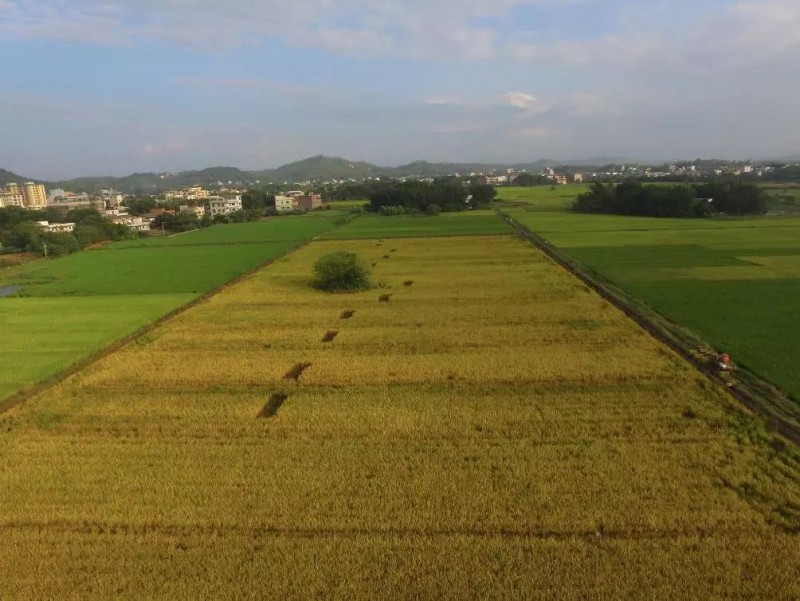
The harvest begins when the grains of the rice rice base are yellow
Zhong xue looks forward to the potential for regeneration of rice in guangdong, which can be developed across the province in light-hot resource conditions, but with the possibility of developing 2 to 3 million acres of regenerative rice, which would yield between $800 million and $1. 2 billion。



