On april 18th, xinhua beijing, xinhua daily telegraph published a story entitled "the crusade chief" in flowerfield: "the pillards" led a team to produce more than 80 oilseed varieties, cumulatively promoting over 300 million acres。
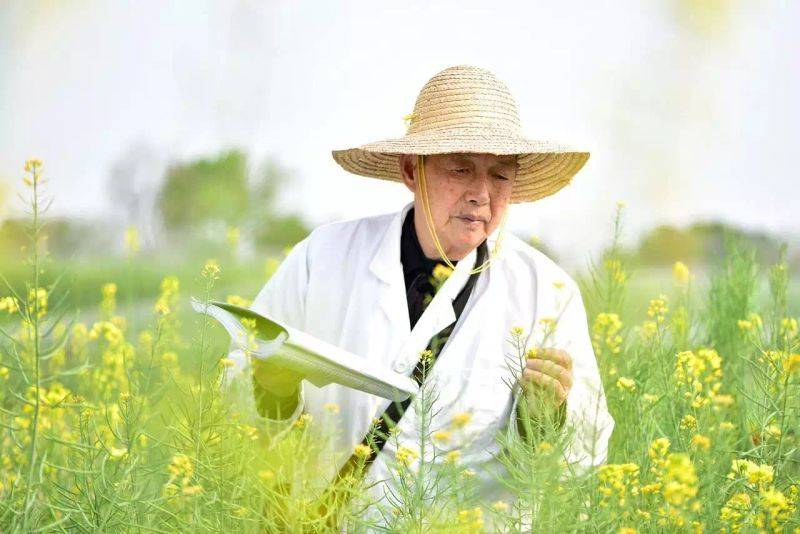
In march, the chinese university of agriculture experimented with oil and vegetables in a golden patch of 85-year-old futing dynasty, which appeared every day in the bouquet。
“once i was old, they all advised me not to go to the field, and now i only go to the field four or five hours a day.” a strong cantonese accent, and futien laughs。
Straw hats, buns, deep boots, canteens, work clothes, notebooks, “four's six packages”, inserted into the fields, were more like a tunnel farmer. For more than 60 years, he's been swimming like a hard-working bee in the kingdom of vegetables
A lifetime, a flower, one thing。
A team led by futin dynasty has developed more than 80 varieties of oil and vegetables, promoting more than 300 million acres. As the main pioneer of international hybrids, futin dynasty discovered the first useful type of male sterility in the world, and since then, in the first 10 years of the world's use of hybrids for production, about 80 per cent of the hybrid species have been produced by porima sterility first discovered in futin dynasty. More than 50 per cent of the three hybrid varieties currently grown in the country are still bred by male sterility in poriema, with far-reaching consequences。
German scientists have commented: “his findings paved the way for the operationalization of international hybrids ... Europeans have attributed this unreservedly to the chinese”
Growing seed. From chase to collar
From the window of futin dynasty, by the wild lake, by the breeze, the golden bouquet of flowers and the bright sun, full of life。
The oily bouquets are full of yellow, and the futting tower team is busy. They are looking at the strength and resilience of different varieties of oilseeds, recording thousands of data sets, and choosing “honorables”, which is a busy and happy time for breeders。

Retrospective 176, the call of a 30-year-old player
Futin dynasty's watching the oil and vegetables in the fields
The fine number of chinese oil and vegetable plantations has increased from less than 30 million acres to 100 million acres, with a threefold increase in acre production, for which fortien is proud。
Oilseeds have been growing in our country for over 2000 years. In 1965, futin dynasty graduated as the first new china in the field of genetic breeding. Today, he still remembers clearly that our oilseeds averaged only about 500 kilograms per hectare, less than one third of the average production of advanced countries。
Fu tingdong, who had just left school at the time, realized that to catch up with the world's advanced standards, the best way to do so was to make use of the advantage of the oil-crop bastards。
In fact, scientists from around the world are also exploring ways to exploit the advantages of the oil-cruising bastard. Various types of cytological male infertility have been detected in oilseeds abroad, but these types of infertility are difficult to locate either resuscitation or infertility instability and therefore cannot be used directly for production。
In the common interpretation of futtin, the cabbage is a home-grown pollinator, and in order to have a hybrid, it is necessary to first find a normal and degenerative type of oil, the “mother's oil”. At the time, scientists from around the world were struggling to find the male infertile “shells” that had nothing to do with them。
New male infertility must be found and run with time and with foreign counterparts。
On 20 march 1972, it was a day that fortien would never forget。
On that day, futing dynasty was in the field early in the morning, and when he arrived at a resource park with a porima variety, it was clear that there was a herd that was normal and that six flowers were shrinking. He's going to use his hands to squeeze herbs. There's no pollen. That's what he's been looking for。
Several searches took place, and he found a total of 19 of the above-mentioned forms and, through careful research, confirmed that it was a typical natural mutation male infertility. This discovery opened the way for an international study of the sterility of porima cells. This is the “thousand treasure” obtained by futting dynasty with a “fully six package” in the field tested at school, in the countryside for two years, excluding hundreds of thousands of samples。
It's famous. Since then, in the first 10 years of the world's hybrid vegetable use, about 80 per cent of the hybrid species have been made of male sterility in poriema, first discovered in futindu. More than 50 per cent of the three hybrid varieties of oilseeds currently grown in the country are still made from the male sterility of the polima。
Today, we have achieved 70 per cent monizenization of our oil and vegetable varieties, and the national average is above the world average for single production. The sterility of the porimas has also been transferred from home and abroad to crucible vegetables such as cabbage, cabbage and red cabbage, making an important contribution to the exploitation of the bastard advantage of these vegetables。
In 1991, the international council for the study of oil and vegetables awarded futin dynasty the highest honour of the world's oil and vegetable science community, the medal and certificate of “excellent scientist”, the second most distinguished scientist in the world and the only scientist to date in asia。
In the face of the honour of the “father of the world's hybrids”, fortien does not like the title and wants to remain the “chief” of crossflowers forever。
It's popular
Swollen disease is an infectious disease of the world's soil that endangers cross-flower crops and causes the death of small seedlings, leading to reduced or even no crop yields, which is described as “cancer” in cross-flower crops. At one time in the country, sichuan province alone had more than 3 million acres。
“i had just returned to my country and began a study of the swollen disease, which mr. Fu suggested was closer to the vegetable industry.” zhang shuang, professor at the faculty of plant science and technology of the university of agriculture of china and director of the centre for genetic cultivation of the ministry of agriculture and rural development, recalled the original purpose of the study on the prevention and control of the swollen roots of oil and vegetables。
Semasis can be combated in agriculture through rotation, delayed planting periods, clean seedlings and chemical control of crops, but these methods increase production costs or pollute soil and water, with limited effect. By contrast, the development of new anti-swollen varieties is undoubtedly the most fundamental, economical and effective way to combat it。
In response to the threat of bulge in the country's main oil and vegetable-producing areas, foutin dynasty led specialists, such as zhang shuang rain, to begin in 2010 with the best anti-infection resources, such as sauerkraut, cabbage and so forth, and first to produce new anti-infection varieties in the country. The results have been evident from the testing of seeds in areas such as sichuan, where, to date, 8 million acres of resistant oil and vegetable varieties have been distributed throughout the country。
Good breeding is key. Fourteen varieties have been cultivated by individuals, leading teams to produce more than 80 varieties, with a cumulative increase of over 300 million acres. Today, 100 million acres of oil are grown throughout the country each year, and more than a million acres are cultivated by the futton team。
“the original oilseed varieties were of high mustard acid, high sulfur and poor quality ofseed oil. Now `two low'seed oil has grown to the third generation, with high yields, good returns, and near olive oil."。
In addition to being widely planted in the yangtze river basin, a variety of oilseeds selected by the futting dynasty team were “drive northwards” and then spread to the heilong river, westwards to altai in xinjiang, and even sown the saline beach off the coast of zhejiang win state, the wider the “map of oilseed” ..
However, fortien has always believed that the results achieved are not enough。
Previously, during a north-west study, futin dynasty found that the local wheat harvest in july had two to three months to spare before the onset of the harsh winter, without vegetation and with severe water, wind and sand erosion. He saw first-hand the shortage of feed and the deterioration of the environment in the agricultural areas of the yellow-turkish highlands and wondered if he could do something about the oil。
As a result, futin dynasty went deep into the north-west countryside and, in cooperation with the gansu agricultural sector, carried out a “back-to-back seeding” experiment. The successful test of the wai-1 crop, which grew 60-75 days of oil and vegetables from wheat harvest until the onset of the winter, produced 34 tons of acre feed and supplied three or four lambs with a combined economic benefit of over $1,000。
“it is possible to develop 10 million acres of fodder oil in the north, with 20 million acres of autumn land and 40 and 50 million acres of winter land in the south, without competing with food.” fortin dynasty looks forward to the development of fodder oil. Previously, based on previous studies, it had been found that green fertilizing by growing saline-resistant oilseeds over a period of about five years would make it possible to improve the saline wasteland (ph10-11, with a salt concentration of 0. 3-0. 5 per cent) to good fields of medium quality。
At present, the replanted feed (green fertilizers) that was studied and promoted by futing dynasty and his team has been used as a driving technique by the agricultural authorities for large-scale demonstration in the north-west, north-east and yangtze basins。
Ueda, get closer to the line
The agricultural university of china is the country's largest producer of oil and vegetable talent, and the only trick for the training of students in fortien is “with me everywhere”。
Fortien told journalists that practical problems had to be felt in practice, and that there was no point in moving away from actual research in production, especially in agricultural schools。
There were some students who thought it was too hard to go to the field, and the coach said to him, "go to see if fu is there?" when you see the presence of the masters of tanaka, the students will no longer be able to mention their hard work。
On one occasion, a student from a foreign school came to report to a graduate student in fortington. After learning that the master was not in the field, the girl found a large circle in the field and did not find any sign of the master, but asked an “old farmer” in the field:
"do you know where the master is?"
"what do you want with him?"
"i want to take his graduate degree!"
"i'm my graduate student. You've got to prepare yourself for this."
The girl was astonished when it was confirmed that the “old farmer” in front of her was a monk。
There's a lot of stories about the masters love to go down. "mr. Fu isn't in the lab, he's in the field." according to his students, this affected them so much that “the oil can bloom in rain. Wearing mud-stained, five or six-pound rubber shoes, it's only a day's work, and we young people can't eat and old people don't complain.”
In 1999, futin dynasty again discovered a new sterility strain from mustard oil. A foreign colleague who visited the school was surprised to ask fortien: "why are you again?" futin dynasty smiled and said, "the farmers have to go to the fields more than they can actually find."
The 85-year-old futin dynasty, who had just finished the test field and arrived at the opening ceremony of the vegetable festival in ximensang, guided the three products of the local vegetable oil. Referring to this year's “minor target”, futin dynasty plans to proceed to the north-west summer complex after the harvest in the yangtze river basin, and to continue to produce a “map of oil and vegetables” throughout the country this year。
“scientific research has to go around farmers!” fortien has always been committed to the idea of adapting to the needs of production, gaining the approval of farmers and making a difference in their lives。
After 16 years of attack, the members of the futin dynasty and the research team have been selected to produce cold-resistant, edible oil and vegetables, which can be harvested about 50 days after planting. The harvest period lasts for three months and is about 30 per cent higher than that of the same species, with 1,000 kilograms per acre, which is not only good-looking, delicious and good, but also of nutritional value and economic benefit。
“the flower is the most beautiful flower in my heart, and the vegetable is a treasure, and it is a ‘rich flower’ for rural renewal.” fortin laughed。
"i feel like i'm not old, though i'm kind of after 85!" it is the love and dedication of oilseeds that has kept this love from the “mr. Fu” of hanata from studying。