


The benefits of scientific and technological progress have permeated all aspects of working life, and the emergence of chatgpt has created a new wave of intellectualization that has led to the emergence of more intelligent applications. A simple logic behind this is the collection, governance, modelling, analysis and application of data, which is the focus of data science on the realization of data value chains. This process involves key data science techniques such as data storage computing, data governance, structured data analysis and data visualization。
With the development of intelligent applications, the importance of text analysis and knowledge mapping techniques has become a key driver of progress in the data sciences, laying the limitless possibilities for a multi-clave-like smart future. So, how do they work in the continuing expansion of the application scene?
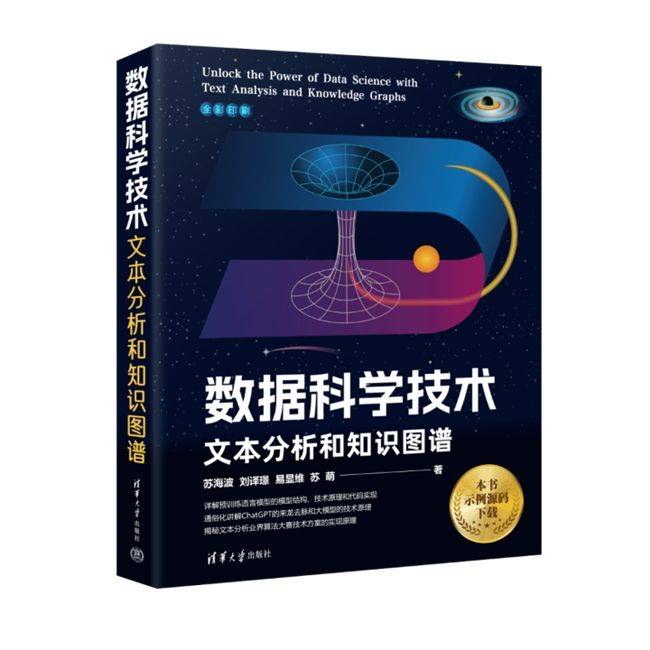
As the new year approaches, the percentage science and technology and the hard work of the university of qinghua press, data science and technology: text analysis and knowledge mapping, have been put on the market at the highest level. The book has revealed to readers the intrinsic mechanisms of text analysis and knowledge mapping, and, through practical cases, the practical appeal of data science from an engineering perspective。
In the real world, data scientists must not only master algorithms and technologies, but also have the capacity to manage projects, to break complex issues into operational modules and to design efficient and reliable data processing processes. Thus, not only is the theoretical basis for text analysis and knowledge mapping detailed, but more importantly, based on the application practices of percentage-point technology and the deposition of industry knowledge, it describes cases of real landfall in different scenarios, and it teaches readers how to set up a complete framework for the implementation of data science projects and apply them in practice。
Smart emergency practice case:
My country is one of the most serious natural disasters in the world, with a large variety of disasters, their geographical spread and their frequency, causing heavy losses. As a result of the evolution of the chain of events, the hazards and impacts are much greater and far-reaching than those caused by a single disaster event. Thus, research on disaster risk from the perspective of the disaster chain can make pre-disaster preparedness and disaster management more effective in order to reduce losses from the effects of the disaster chain。
The emergency disaster chain analysis and early warning applications system serves as a knowledge mapping service for industry areas, through natural language analysis processing capabilities, the development of a framework of intelligence analysis models and semantic analysis models, the structured processing of disaster incident news data accessed by the system and the construction of disaster incident chains. The historical data relationships of disaster incidents are presented in spectroscopy form, the knowledge system of the disaster accident chain is constructed, and early warning information on developments in the occurrence and development of forecast-type information is provided through data analysis and knowledge deposition of the disaster incident chain. Early warning, supported by a disaster chain map, helps sectors in all regions to keep abreast of the evolution of disaster incidents at the time of their occurrence, and to adopt a “linking” approach to dealing with early disruption of disaster evolution and loss control is of great value in the emergency industry。
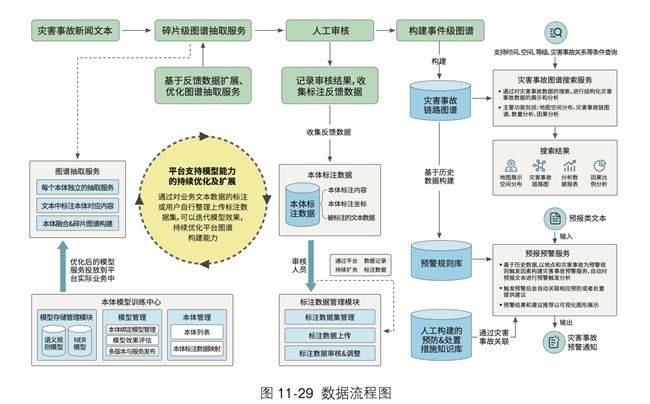
These are taken from data science and technology: text analysis and knowledge mapping, which provides detailed information on how text analysis and knowledge mapping techniques can be combined with applications in the emergency industry to better create value for society, from the case context, solutions, system architecture and realization, and case-taking。
The book is an in-depth guide to data science and technology that is suitable for students of higher education institutions, text analysis (or natural language processing) and studies in the field of knowledge mapping, and for researchers in the field of data science and artificial intelligence。
The book provides readers with a comprehensive understanding of the technical thrusts and frontier dynamics of data science, insight into key technologies such as text analysis and knowledge mapping, and professional technical knowledge and practical guidance. It is hoped that this book will help data science practitioners and lovers to better face the challenges and opportunities of the wave of intellectualization。



