Photovoltaic microreformers are used mainly for distributed photovoltaic power systems
Photovoltaic microreverser means a device with a power grade of less than or equal to 1 kw, capable of conversion and grid integration of photovoltaic components. Photovoltaic microreversers have advantages such as ease of expansion, high safety reliability and small size, and are more used in distributed photovoltaic power generation。
In order to regulate market development, a number of industry and group standards have been introduced, including, inter alia, t/ciet 935-2024 pv cluster control system functional requirements, t/ciet 898-2024 pv microreverse technology requirements, t/ciet 897-2024 pv generic technical specifications, t/ciet 280-2023 green low-carbon product evaluation norms, and pvm microreformers. The market share of high-performance photovoltaic microretroverts is expected to increase in the future as industry standards continue to improve。

Depending on the circuit structure, photovoltaic microretroverts can be divided into multistage microretroverts, two-stage microretroverts and one-stage microretroverts. Two-stage microreverses can be broken down into current source mini-reverses and voltage source microreverses. In the future, as the demand for the subdivision of product applications grows, the landscape of our optical microretroverts will be further enhanced。
According to the study on monitoring of market performance and prospects for future development of china's light-volt microreversers, 2026-2030, published by the new thought industrial research centre
It shows that photovoltaic microretroverts are mainly applied in the area of distributed photovoltaic power generation and can be directly converted from photovoltaic components to direct current power exchange. In recent years, with the support of national policies and technological progress, the development of our photovoltaic sector has accelerated. According to the statistics of the national energy agency, in 2025, our new light-voltage machine was 317 million kilowatts, an increase of 14 per cent over the same period, with an increase of 153 million kilowatts for distributed photovoltaics. In this context, the market space for optical microretroverts will be further expanded。
There are many companies that produce optical microretroverts in the country, including, inter alia, radiant technology, the acquisition of intellectual energy, the use of grains, the use of energy technology, the use of stimulant intelligence, the use of electronics for the time, the use of medium- and long-distance communications, and the use of industrial goods. In the first half of 2025, technology focused on the development, production and sale of component-level electrical and electrical equipment in distributed photovoltaic systems, and according to its biannual reports, the company received $360 million in revenues from photovoltaic mini-reversors and energy communications products, accounting for 55 per cent of its total business。
New thinking industry analysts have indicated that there is a wide range of prospects for the application of optical microreversers as important components of distributed photovoltaic power systems. In the future, the development space for the optical microretroverts sector will be further expanded as market demand is gradually released. After many years of development, our technology for optical microretroverts has continued to improve, and many enterprises have developed their own research and development and production capabilities, and their markets will become increasingly competitive in the future。
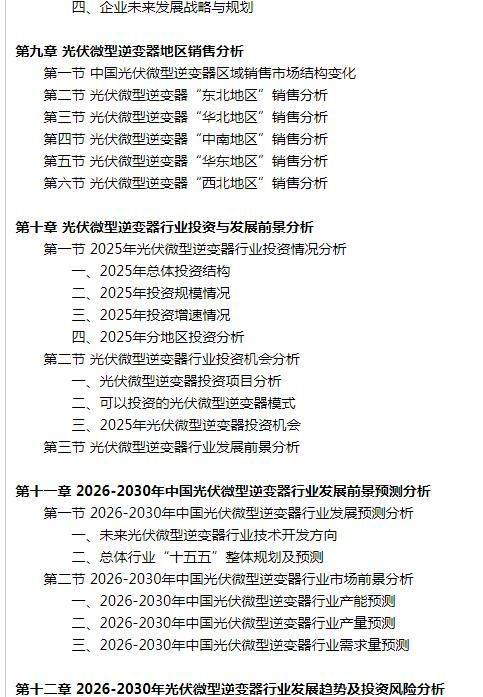
2026-2030 report on monitoring of market conditions and prospects for future development in china's light-volt microreversers
New thinker directory
Chapter iii
Market performance in china's light-volt mini-retrovert industry
Section i. Overall industry size
Section ii. Overview of industry production
Analysis of capacity, 2022-2025
Analysis of production, 2022-2025
Survey of the configuration and utilization of capacity
Section iii. Overview of industry needs
Statistics on demand, 2022-2025
Analysis of factors affecting product demand
Section iv. Analysis of imports and exports by industry
Section v. Product technology analysis
I. Characteristics of changes in technology in photovoltaic microreverser products in 2025
Ii. New technology in the competition of photographical millennium company in 2025
Chapter iv analysis of price trends and factors affecting domestic products of optical microretroverts
Section i. Price review of domestic products, 2022-2025
Section ii current market prices for domestic products and comments
Section iii analysis of factors affecting domestic product prices
Projected future price trends for domestic products, 2026-2030
Chapter v analysis and reflection of china's light-volt microreverse market
I. The market characteristics of optical microretroverts
Ii. Problems in china's holding minorially returners
Iii. New ideas for the development of china's light-voltaic microretroverts industry
Chapter vi analysis of competition strategies in the market for optical microretroverts
Section i. Analysis of the structure of competition in industry
I. Competition between existing business
Analysis of potential entrants
Iii. Alternative threat analysis
Vendor bargaining capacity
V. Customer bargaining power
Section ii. Analysis of competition strategies in photovoltaic microretroverts markets
I. Analysis of the growth potential of optical microreversers
Ii. Analysis of competition strategies for photovoltaic microreverse products
Analysis of competition strategies for typical enterprise products
Section iii. Outlook of competition patterns in the pv microreverse industry, 2026-2030
Chapter vii: analysis of the upstream and downstream industries of the optical microretroverts industry
Section i. Upstream industry analysis
I. State of development
Ii. Projections of trends
Iii. New developments in the industrial and its impact on the physical minoriary returns
Iv. The situation of competitition in the industrial and its implications for the physical medium instrument
Section ii. Downstream industry analysis
I. State of development
Ii. Projections of trends
Iii. New developments in the industrial and its impact on the physical minoriary returns
Iv. The situation of competitition in the industrial and its implications for the physical medium instrument
I don't know.