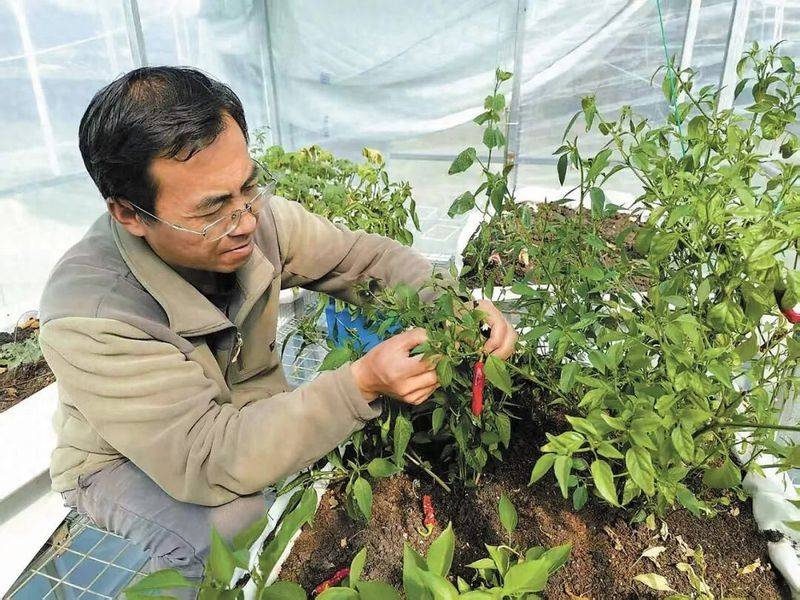
“you see, the top layer of light is the strongest and the highest temperature, and it is the most radiant, high-temperature-resistant watermelon, eggplant, pepper; the middle layer is weaker and the temperature is lower; the bottom layer of light is the weakest and lowest temperature, with spinach, lettuce and pickles ...”
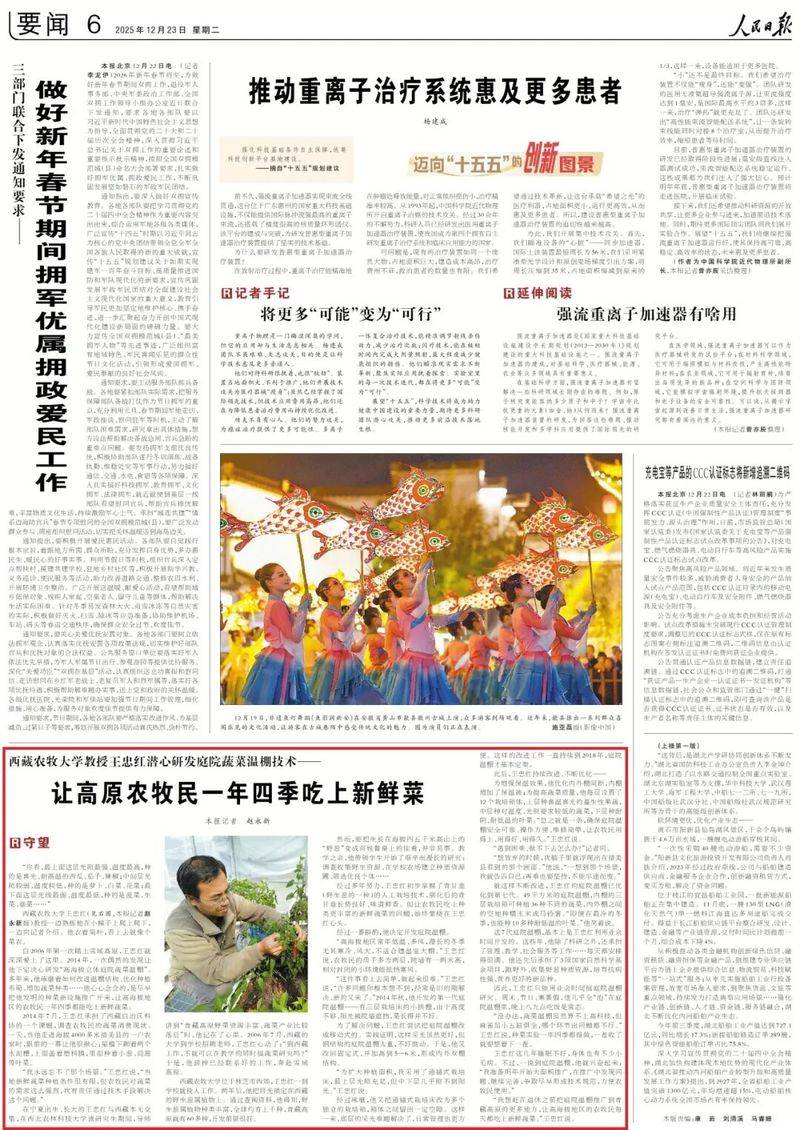
Professor wang zhonghonghong of the tibetan agricultural university (see figure below, zhao yongxiang of the people's daily newspaper) was skilled in climbing up and down the little ladder while introducing them to journalists. He looks like a vegetable。
Wang zhonghonghong has been deeply in love with the snow plateau for the first time since 2006. In 2014, an accidental discovery led to his determination to develop a “high-altitude garden vegetable greenhouse”. Over the years, he has wondered how to improve the greenhouse structure, optimize the layout of the plant and increase the variety of vegetables ... He was thinking of extending the new facilities he had invented for growing vegetables as soon as possible, so that farmers and pastoralists in high altitudes could eat fresh vegetables for four seasons a year。
In july 2014, wang zhonghong took up a subject of the tar association to investigate the current situation of vegetable consumption by farmers and pastoralists. One day, as he walked into a farm in the county of toome, at more than 4,000 metres above sea level, he was troubled by the scene: there were two cement tanks under the roof, covered with plastic membranes, which planted onions, artemisinin, etc。
"i will never forget that scene." wang zhonghonghong said that “the local conditions for fresh vegetables are very limited, but the demand for vegetables by farmers and pastoralists is so strong that it is my responsibility to resolve this problem by technical means”
When wang zhonghonghong, born and raised in ningxia, did not interact with tibet, and during his postgraduate studies at the north-west university of agro-forest technology, the mentors spoke of “the resource-rich and less developed vegetable industry in the tibetan highlands”. In july 2006, the university in tibet recruited a teacher, and wang was moved: “can't you work in tibet and study vegetables while teaching?” so he quit his connected work and went to the snow plateau。
The tibetan agricultural university is located on the western outskirts of the city of lynch, and wang zhonghonghong has been at work since his arrival. Two years later, he locked his eyes on the wild onions of tibetan plants. Through his review, he had learned that wild onions were rich in plant varieties, that there were some thousands of species globally and that there were more than 60 tibetan plateaus with good development prospects。
It is not easy, however, to turn the wild onions that grow on the mountains four or five kilometres above sea level into a good meal table for the people. In addition to teaching, he led the students to a difficult and long study: surveying the collection of wild resources, establishing seedlings on school farms, screening good individuals..
After many years of effort, wang zhonghonghong has first mastered the technique of artificial cultivation of green glycerine (a form of wild onions), which is well grown and tastes good after being tamed. However, the problem of feeding farmers and pastoralists with a much richer variety of fresh vegetables has been surrounded by the king's heart。
After some thought, he decided to develop a courtyard greenhouse。
“alternatively low temperatures, high winds and long winters are particularly cold and windy and unsuitable for greenhouse sheds.” wang zhonghonghong said that the houses of farmers and herdsmen were more than two floors, and that the walls of the compound were one or two metres high and the relatively closed environment could withstand the cold wind。
"this thing looks simple, it's hard." wang zhonghonghong said, “there are many problems you can't imagine, often old ones, new ones”. In autumn 2014, he developed his first generation courtyard greenhouses, small arch sheds with three-storey planting beds, which did not grow well because of insufficient heights and the sun was covered by the walls of the compound。
To solve the problem, wang zhonghonghong tried to change the courtyard greenhouse to a mobile one. This lighting has proven to be better, but the stench of steel structures is too heavy to push. As a result, he reverted to the fixed pattern and was raised to 5-6 metres, forming the internal and external double-barrel structure。
“in order to expand the area under cultivation, i have adopted a ploughed-up bed, with enough light at the top, but almost no sunlight at the lower middle。
After reflection, he changed the groceries to separate incubators, leaving a gap between them. As a result, the problem of lighting at the bottom has been resolved and daily management has been made easier. Such improvements continued until 2018, when the courtyards were largely stereotyped。
Since then, wang zhonghong has been improving and optimizing -
In order to improve the temperature-preservation effect, he optimizes the distance between the inner and inner sheds and increases the temperature-preservation regime; in order to improve the quality of vegetables, he has set up 12 incubators on each floor, with a variety of hot and glamorous chicken fruit and vegetables on the upper floor, medium-level vegetables requiring lower temperatures and light, and lower- and low-temperature vegetables. “in short, one thing is to ensure that the greenhouses in the yard are safe, reliable, operational and simple, so that the farmers and pastoralists can use them well and for long。
“what if you can't?” journalist asks。
"when i want to give up, i can see in my head the picture i saw in the county of tommy." he said, “when i think of that scene, i tell myself that it's hard to stick with it, not to lose it.”
As such, the courtyard of wang zhonghonghong has been improved to the seventh generation. 49 square metres of courtyard greenhouses, three-storey incubators in the interior sheds can grow 36 different types of vegetables, with corn or potatoes growing in the open areas between the inner and outdoor sheds. “even in the coldest winters, more than a dozen low-temperature vegetables can be grown.” he laughed。
The seven courtyard greenhouses were essentially developed by wang zhonghonghong using his spare time. Over the years, in addition to scientific research, he has taken on management, teaching, social services and so on... Every day is fully organized. He has also undertaken three projects of the national natural science fund, running in the field, collecting onion seed resources and developing new varieties that are disease-resistant and better nourished。
As a result, wang zhonghonghong was only able to conduct research in the courtyards during his leisure time. On weekends, holidays and summer holidays, he was almost entirely “beeped” in the courtyard greenhouse, and eating at 8 or 9 p. M. Was normal。
“no, the vegetable greenhouses are not high-tech, but the sparrows are so small that they can't have any problems.” wang zhonghong-hong said she had to do the gardening experiment for four seasons a year, and she wanted to do the next one。
Wang zhonghong has had a bad sleep these past few years and has a lot of physical problems. However, as soon as he spoke of the courtyard greenhouse, he was excited: “i intend to start a large-scale extension next year to identify problems and continue to refine it, with a view to developing technical norms as soon as possible to facilitate its use by farmers and pastoralists.”
“i want to spread the garden greenhouses to more places in the tibetan plateau before i retire, so that farmers and pastoralists in the high-altitude areas can eat fresh vegetables every day.” wang zhong hong said。