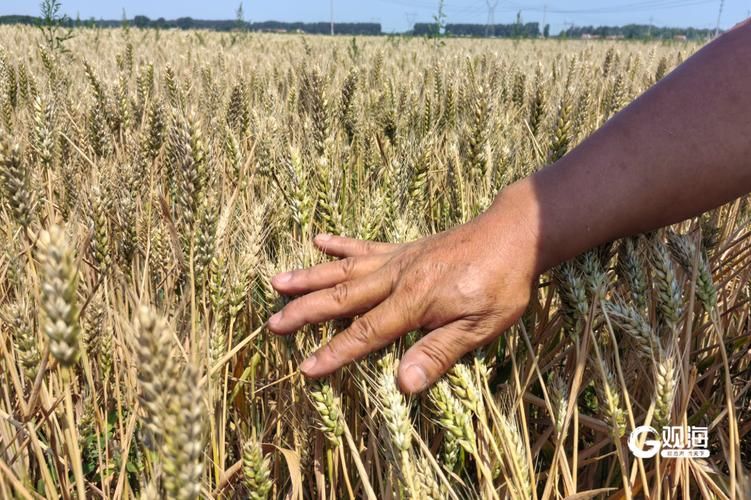
In june, 500 acres of wheat were waiting for harvest in the wheat fields of qingdao, the mok district. At first glance, they are no different from ordinary wheat fields, and the yellow waves rise and fall in the sun. But when the head of the farm, sun, bends over to open a grain of wheat, the palm of his hand comes out of a penetrating blue and green grain, with a microlight in the sun. Not far away, the other wheat field is darker and close to purple. These wheat with their own "pretty filter" are not a conceptual sample from the lab, but a successful functional species tested in the field after more than a decade of breeding at the aoshima agricultural college - ** blue wheat in youth ** and ** purple in youth **. (blockview://markdown-image-tos-cn-i-t/358e68a4864f44cb9e2c0dab247d4ce6)# # a production reversal about “colour”: “many people react so well first, the output must not be good?” sun shutao remembers the questions of the outside world. The reality has given a complete reversal: last year's test field collected more than 1,300 pounds of blue wheat acre production and more than 1,400 pounds of purple wheat, on a par with the usual high-yield wheat. This year, from the test to the 500 acres, the production of blue wheat has stabilized between 1,300 and 1,500 pounds, and that of purple between 1,400 and 1,500 pounds. This means that the single production of these coloured wheat is not reduced by “functionality”, but is 25 to 50 per cent higher than the average of 1,000 to 1,200 pounds per acre of ordinary wheat on qingdao. High-yielding secrets are hidden in the oak structure. A verb of purple wheat is pulled from hand and can easily exceed 40 grains per ear, while ordinary wheat is usually only 35 to 40. In combination with higher grain weights, as long as the management of water fertilizers is kept up to date, the stability is fully demonstrated in the case of large-scale cultivation. # from blueberries to the ears of wheat, if the “cross-the-border” journey of nymphs is said to give the grower a break, then nutrition is the true “nuclear weapon” of these coloured wheat. Flour made from blue wheat and purple wheat, with natural light blue or purple grey, which is not added, but the mark of natural pheasant. Plumbing, which can be understood as a natural antioxidant widely found in blueberries, purple radon, is now “moved” into wheat as a daily staple. According to gaimme,** the luminous content of blue wheat 1 is 10 to 15 times greater than that of ordinary wheat** and the levels of iron, zinc and selenium are 22. 3 per cent, 17. 1 per cent and 31. 8 per cent, respectively, equivalent to the construction of a “micronutrient bank” in the staple diet. Purple, on the other hand, has a unique advantage in addition to plume -** with chromium content.** chromium is a trace ingredient necessary for humans and has potential benefits for maintaining blood sugar stability. This has enabled yriyo-2 to match the needs of the elderly and the healthy diets with a focus on blood sugar management. More critical is the process performance breakthrough. ** blue wheat one meets the barley barley standard**, which means that it can be used in the production of bread, high-quality noodles and dumpling powder, either alone or with powder, as a special powder for the production of advanced bread. In sun's words, the “skin is particularly elastic and tastes very convoluted” dumplings that are wrapped in blue wheat flour are a complete break with the old idea that “colour wheat can only make ordinary pasta”. # an acre earns an extra $400, and once the whole chain from farm to workshop is linked to “making money”, the promotion becomes self-propelled. Sun has calculated an economic account: the average wheat purchase price this year is about $1. 2 per pound, while the yck-series wheat purchase price is 30 per cent higher with a nutrition premium of about $1. 56. Based on an acre production of between 1,300 and 1,500 kg, gross revenue per acre easily exceeded $2,000, with net profits after cost exceeding normal wheat by more than 40 per cent, equivalent to ** earning about 400 more per acre.** as planned in aoshima city, functional wheat cultivation will expand from the current 500 acre to more than ** 3,000 acres in 2027, which will create a state of fire. Field harvests are only the first step, and the extension of the industrial chain is key to the release of value. At present, companies such as the shandong ultra-intelligence biotechnologies have launched in-depth cooperation with the agricultural institute, and the flour mills are ready to launch a series of deep-processed products ** of wheat-coloured bread, nutritional pasta, dumpling powder** to move these coloured staples from the ground to supermarket shelves. In shibuya, a similar plume-rich wheat industry has paved the way for a full chain of harvests — from the whole wheat-mounted to the purple sakima — deep processing has allowed a single grain to add multiple value, boosting more than 3,000 farmers around it. The youth studies series is based on the experience of previous generations and the chain from breeding to the table is clearly visible. # colored wheat, redefining the meaning of “main foods” when wheat is no longer just a source of carbohydrates, but rather a vehicle for functional nutrition, and the chinese content of the “job” is changing qualitatively. From “eating well” to “eating well”, to “eating well”, the success of the test of blue wheat 1 and purple 2 means that we have three meals a day with buns, noodles and bread, and that in the future it is possible to make up for the universally lacking trace elements without changing our diet. Recognizing this, when you see light blue-packed flour or purple gray wheat bread on the supermarket shelf, at least you can judge: this is not a concept, but a new option for a grain to grow solid in the field。