Rice is one of the most important food crops in the world. More than half of the world's population is provided with a source of staple food. Rice is also the most important food crop in my country, with a very long history of cultivation。
Rice is described in the episode more than 2,000 years ago. For example, in windy july, it was written that “october is the month of rice, for which spring wine is given, in order to give a fresh life”. In zhou song fong's year, it was said: “for more than a million years, there are hundreds of millions and hundreds of millions. For the sake of wine, zhu zou zou zou zou zou zou zou zou zou zou zou zou zou zou zou zou zou zou zou zou zou zou zou zou zou zou zou zou zou zou zou zou zou zou zou zou zou zou zou zou zou zou zou zou zou zou zou zou zou zou zou 这 这 这 这 这。
In addition to this, there is the expression “eatmeat, clothes, women?” in the mandarin. All this reflects the importance of rice in ancient chinese society。
Of course, humans have a long history of domesticating rice. Humans had begun to domesticate rice long before the words had appeared, so there had been a long period of controversy as to where rice was first cultivated。
Layers of evidence to open the source of rice cultivation
In the 1930s, plant scientists and geneticists of the soviet union, nikola vavilov, argued that the domestication of plants worldwide was not random and that there must have been some areas that had begun to domesticate first, known as “centres of origin”。
However, vavilov believed at the time that rice might have originated in india and that chinese rice was also imported from india。
The study later found that rice included two sub-species, paddy and paddy, and named them “indian” and “japanese” respectively。
Later, however, with the emergence of archaeological evidence, china became the first proven place to domesticate rice。
In 1973, archaeologists discovered a cultural site — the hemover site — more than 7,000 years ago in the yuya region, downstream of the yangtze river, china. Here, scientists have discovered large quantities of rice and agricultural tools for harvesting. This evidence has led many scholars to change the perception of rice origin。
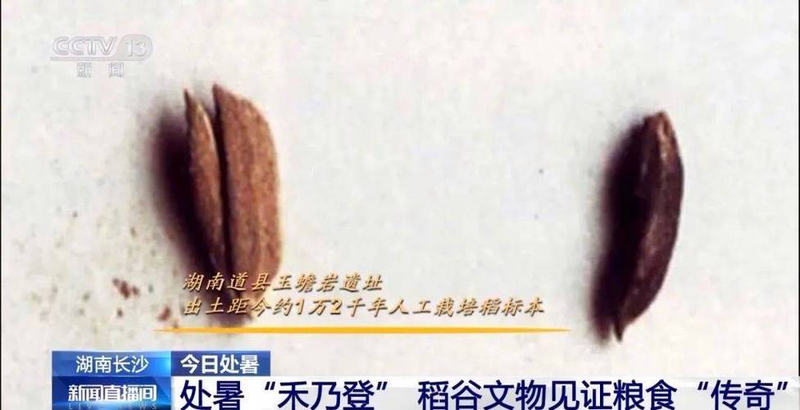
In 1985, the site of mount peng-head was discovered in the city of changde, hunan province. The peng-head culture is between 8,200 and 9,400 years old. In the culture of pumbaa hills, rice remains are similarly discovered. This, in turn, has pushed forward the history of our national domestication of rice for a thousand years。
And in some archaeological excavations from the 1990s to the beginning of the twenty-first century, scientists also discovered some “million-year rice”。
In jiangxi province, for example, paddy grains have been excavated for thousands of years now from the sites of the fairy cave and the canal ring in jiangxi province, and from the upper mountains in zhejiang province。
In 2004, scientists discovered five carbonated rice grains, special rice species with wild, pyrotechnic, combined characteristics, which retained the primitive form of the early evolution of common wild rice to plant rice, which is about 14,000 to 18,000 years old, the first artificial rice to be discovered in the world to date。
There are also scientists who use molecular biology to find the source of rice。
For example, in 2012, the team led by han bin, a geneticist at the shanghai institute of life sciences of the chinese academy of sciences, compared over 1,000 domesticated rice varieties with over 400 wild varieties. It was found that both paddy and paddy are most closely associated with wild varieties growing in the pearl river basin. So it is assumed that the pearl river basin of our country is probably the first area to domesticate rice. Unfortunately, no relevant archaeological evidence has been found in the pearl river basin, and this claim remains to be verified。
But it can be said that, based on current archaeological and genomic evidence, our country is most likely to be the first to domesticate rice。
Improved planting techniques for the benefit of neighbouring countries
As a long-standing rice-growing country, our hard-working people are also constantly exploring and improving rice-growing techniques in long-term practice。
As mentioned earlier, the term for rice in the mandarin the sun is, "the eater rice, the clothes, the woman?" in fact, it was confucius who criticized his disciples for eating rice and wearing coats during mourning. This suggests that in spring and autumn, rice was also a “high-end food”。
However, at the end of the day, song resung mentioned in the "attraction of the skyworks" that: “today, the people who bear the people live in rice, in rice, in rice, in rice, in rice, in rice, in rice, in rice, in rice, in rice, in rice, in rice, in rice, in rice, in rice, in rice, in rice, in rice, and in rice.” this indicates that rice has become a major food crop in ming dynasty, with a significant increase in prevalence。
The ancient chinese people have not only improved rice cultivation techniques, but also disseminated them to neighbouring countries and regions。
In south-east asia, for example, viet nam, there is also a very long history of rice cultivation. The handai renjeng period, during which he was in office, spread to the region advanced technologies and irons, which have contributed to the development of local agriculture。
In addition, china's agricultural production tools, the dragon bone water truck (turkage) and the cricket, were introduced into viet nam and surrounding areas. These technologies play an important role in improving the efficiency of local agricultural production。
Moreover, some 3,000 years ago, chinese rice also passed into japan, and while japanese scholars still dispute the route of rice to japan, whether it is uncertain to enter japan through the north-east, the korean peninsula, or directly from china’s south-east coast, there is no doubt that both acknowledge the fact that rice is imported from china。
“the rice giant” to address global food issues
As the oldest rice-producing “paddy country” in the world, china’s rice technology not only achieves food self-sufficiency at home, but also plays an important role in global food security。
China's extensive experience and advanced technologies in rice cultivation continue to provide valuable support for agricultural development worldwide。
Yuan long park, who is known as the “father of hybrid rice”, has successfully developed and promoted hybrid rice technology. This pioneering technology has significantly increased rice production and effectively addressed food security in china. More importantly, this technology has been hailed by the food and agriculture organization of the united nations as “the preferred strategic measure to address food shortages in developing countries”。
The contributions of the yuan pilgrim are not only scientific, but also remarkable contributions to the well-being of all humankind。
Today, with advances in science and technology and increased international cooperation, china's rice cultivation technology will continue to provide solid guarantees for global food security. China's efforts to promote scientific, technological and technological innovation in agriculture and international cooperation have highlighted the responsibility of a responsible power and its far-reaching implications for the common future of humankind。
References:
1
Http://www. Zys. Moa. Gov. Cn/mhsh/20104/t20210422 6366373. Htm
2
Http://www. Xinhuanet. Com/policys-2020-12/08/c 1126834755. Htm
3
Http://www. Sky. Yn. Gov. Cn/xsyj/zgsd/2096919733444455652
4. Public tintin. Research on rice origin, domestication and communication in china. Central national university, 2017.
5
Https://www. Cas. Cn/zt/kjzt/zykjfmz/201609/t20160901 4573458. SHTML