


Shenzhen business news
How does social capital work
Pay up, you got more money
Is monopoly equal to maximizing benefits
Gold and silver, who is the winner of the crisis
In the book " this is the economics: 16 masters of the economics " , the economist zhong wei wei wei wei virtualizes 16 mysterious classes, each of which is organized around a theme and is taught by a suitable economist。
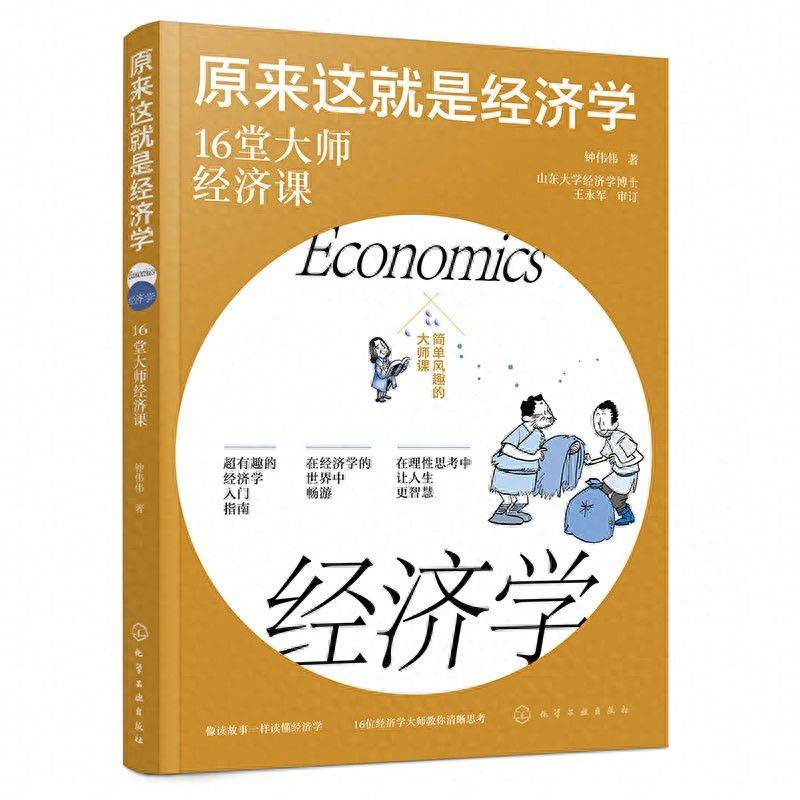
This is economics: 16 masters of economics
Zhong weiwei by
The wang young army, finalised
Chemical industry press
September 2024
It was described as covering 16 economics topics, such as land, agriculture, freedom, values, demand, marginality, dualism, protection, state, metrology, cycle, crisis, capital, production, recovery and game, and 16 economists, including d, queenie, licato, muller, marshall, keynes, samuelson and others, presenting themselves as cartoons, interacting with readers at zero distance and teaching the essence of life-long theory. During the course, the listeners interacted and interacted with economists。
Zhong wei wei wei, who described economics as a science of wealth generation and distribution, has many branches, the most influential of which is macroeconomics, but they appear to have little to do with our daily lives. And books that specialize in economic operations, such as personal finance or equity investments, are always fragmented and difficult to look at. The book attempts to address the disconnect between economics theory and real life. “upon reading this book, you can clearly know how to be a rational economic man, how to find the truth in the `expert' prophecy, how to apply the common sense of economics learned to your work, and how to look for economics in past economics consciousness.”
Zhong wei wei wei said that, unlike other economic writings, the book did not clearly inform readers about what and why, but rather needed readers to understand the essence of economics and to find the right economic answers from the many economic phenomena and events。
It is understood that the book was validated by wang yong jun, doctor of economics, shandong university。



