The anti-intuitive sense that debt is added to the civil code when there is room for application is precisely a key to understanding the evolution of chinese debt law. The answer is not “legislators did not think” but four forces pulled together for 30 years, until the civil code was codified in order to become a culture。
First, to break the misunderstanding that the era of contract law is not “without such a system”, it is “not written in law”
Many consider that section 84 of the contract act deals only with exoneration transfers. In fact, the legislature's own interpretation of the term “partial transfer” has been interpreted as a prototype of debt participation:
Whether the debtor transfers all or some of its obligations, the consent of creditors is required ... In another case, there is a partial transfer of contractual obligations, i. E. A new debtor joins the original debt and performs with the original debtor to the creditors。
In other words, the official interpretation of the nlrc in 2000 has interpreted “partial transfer” as an “accession plus” structure. But the problem is that there is no consensus in the academic world:
Narrowness (mainist doctrine): article 84 “part” refers to the debtor's release of part of the debt from liability and transfer to a third person, while the remainder of the original debtor remains on its own, and does not involve a concurrent structure of “third person enters or replaces” - article 84 is purely exonerated。
The “part” can be read together - article 84 is sufficient。
This is the core contradiction that shaw joon pointed out: the agreement itself does not establish that the status of the remaining 5 thousand remains unchanged, so that the equation of “partial transfer = burden-taking” is not valid。
When there is confusion in the teachings, the legislation does not hesitate to add provisions — this is the first tier of delay。
Second tier of delay: early demand for commercial credit has not broken out and the “cases + local records” will take 20 years
The real big customers of debt entry are corporate finance, construction, supply chain factoring, and gambling. From the 1990s to the early 2010s:
A. Market owners rely primarily on assurances (supported by the guarantee act)。
B. A small number of “third-party promise” disputes, resolved by supreme law cases — e. G. No. 153 (2010) establishing that “a creditor is deemed to be bound by it without objection”。
(c) local high councils themselves: jiangsu 2005, beijing 2013 housing lease, shenzhen 2014 private loan, zhejiang 2018 marital debt - four local reports have all defined, defined and defined the type of debt and the form of responsibility。
These fragmented norms are largely adequate at the regional, case level and do not constitute a “national legislative imperative”. The former section 419 of the german civil code was even repealed in 1999, and taiwan civil code is only a “general acceptance/business merger” with cultural acceptance (art. 305), generally combined with a long-standing doctrine - it is not a rule of law to suggest that the system is inherently suited to the growth of jurisprudence。
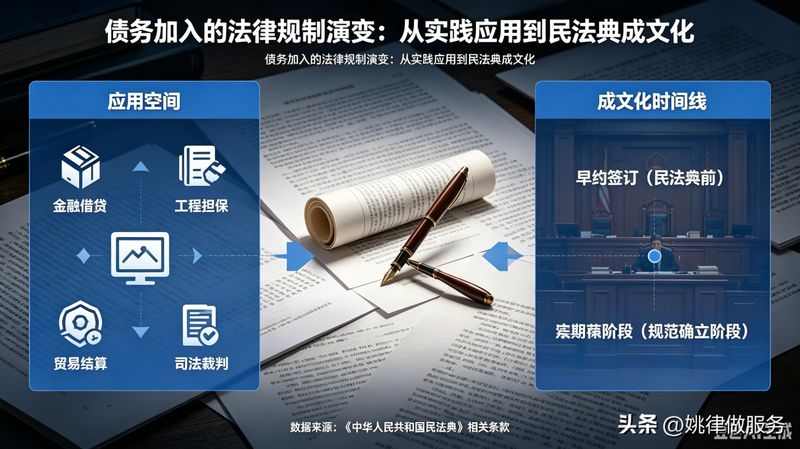
Third floor delay (most critical): the nine people's summary exposed the three mines of "no can't do it"
In the late 2010s, three events detonated simultaneously, pushing the case law plus summary to the limit:
Ray i: what is the validity of the company's legal representatives signing up for the debt
The company's external debt is more onerous than the guarantee (unguaranteed period, no prior defence, independent new debt), but article 15 of the companies act only contains a “foreign guarantee” resolution and no debt is added. Can creditors obtain them in good faith when legal representatives exceed their authority to sign an accession letter? Is the company responsible
Article 23 of the n9p is forced to give an interim answer: “refer to the relevant rules of the company providing security for others”. However, the n9p is not a judicial interpretation and has limited effectiveness and the word “reference” speaks for itself — the absence of law in the main battlefield。

Ray ii: discrepancies in the characterization of additional measures
Bonds, management, trusts, “compensation/liquidation support/repurchase commitments”, various court characterizations:
A. Guarantees of acceptance, acceptance of obligations and recognition of independent contracts
(b) the high level of debt recognition prior to the n9p and the preference for assurances following the n9p
C. Statistics from the beijing chamber of deputies: almost 77 per cent of cases are classified, but a large number are still difficult to identify。
There is no law, not to mention the right of recourse, the right of defence and the relationship with the period of the guarantee。
Ray iii: right to recover vacuum
After the third person joined, the money was returned. Could you ask the original debtor for it? The contract law does not state that the doctrine is divided (agreement/inappropriate gain/with the debtor's internal share) and that there is no uniformity in supreme law jurisprudence. This directly affects the willingness of commercial subjects to add letters。
The common denominator of these three mines is that local records do not control cross-regional transactions, that judicial interpretations do not create new systems and that only the civil code can pronounce itself。

Iv. Fourth floor: comparative maturity + civil code codification window, water to canals
By the time the general civil code was codified in 2017 and the civil code in 2020, conditions had been met:
A. The german, japanese and chinese doctrine has been in operation for 100 years and the teaching toolbox is complete
B. Twenty years of chinese jurisprudence + four local summaries + nine population summaries, with sufficient empirical evidence
C. The “dual debt-incurring structure” (exemption/accumulation) is to be completed in the contract set-up, which was to be rewritten in article 551 (exemption transfer)
D. The judicial interpretation of the guarantee system, which parallels article 12 (approval guarantee resolution for the accession of corporate debts) and article 36 (assure that the vs debt is added to the credibility + doubts assurance), closes the web of the nine remaining issues。
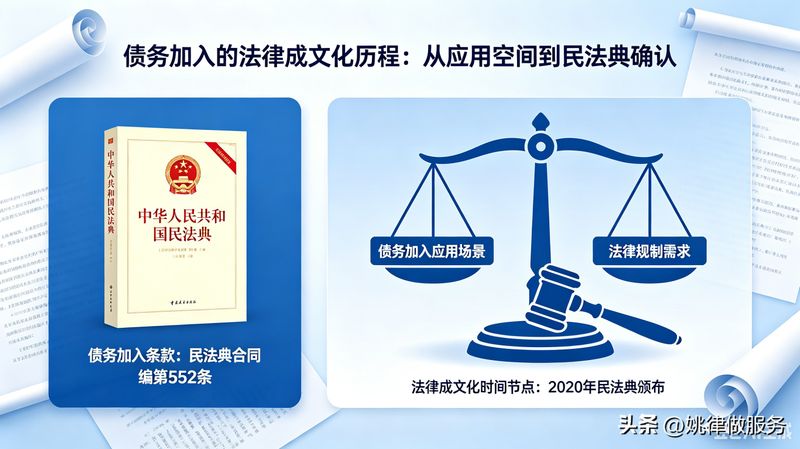
So article 552 is not “a useful regime”, but a one-off solution:
1. Co-payment of a statutory title (no longer doctrine/local record)
2. Adding a test of validity to a company's debt (a guarantee resolution)
3. Qualitative anchorages for additional confidence measures (as distinct from guarantees, surrogate performance, liquidity support)
4. Rules on the basis of the right of recourse and the right of defence (subsequently supplemented by article 51 in the cl)
In summary, the late entry of debt into the civil code was not a lag in legislation, but rather a cultural premise (conceptual consensus + commercial demand explosion + corporate ultra vires problem exposed + qualitative confusion) that was not available until late 2010. For the previous two decades, it had operated barely on the basis of “article 84 of the contract law explaining differences + local records + supreme law case + nine-person rules of reference”; what had really forced it to become law was the black hole in the effectiveness of the company's legal representative's false letters of accession, the qualitative war of credit enhancement measures, and the right-to-recover vacuum — these are hard bones that cannot be solved by “soft case law” and must be determined by “coder law”。