Ginger time
Ginger seeding usually lasts from late april to early may。
You have to pick the ginger before you sow it, remove the mold, rot, and dry, weak ginger. It is good to choose 50-100 grams with one or two sprouts of ginger, but it is also too big to sow, but in large quantities and at high cost, it can be cut open with a knife or hand, but the wound should be disinfected with straw ash or lime。
Preferably impregnated seed sprouts with a medicinal agent, which is used to dry the acreage for one to two days and then impregnate the acreage for 10 minutes with:1:120 bordeaux and then extract the acreage from the acreage, which is covered by thin membranes with a tidal sand of about 30 - 40 centimetres thick, keeping the temperature at 20 - 30 degrees centigrade, and can sow in 8 - 10 days, according to the size and strength of the sprouts. 300-500 kilograms per acre。
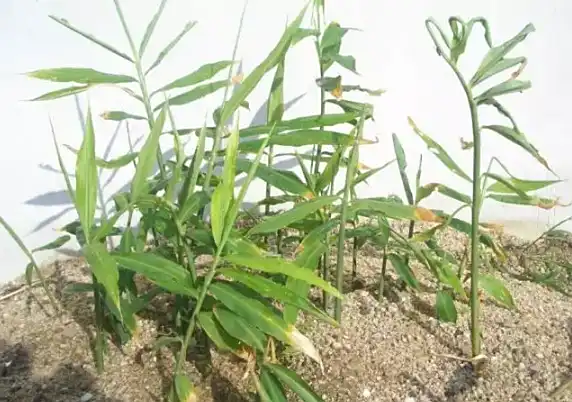
Outreach
I. Ginger conditions
Temperature: ginger is born in the tropics of our country and in east india, with a warm sex and a high temperature for the growth of the root (ginger clot). The acupuncture occurs at above 16 to 18 degrees centigrade, the ginger clots develop rapidly at 20 to 27 degrees celsius, the average temperature of 24 to 29 degrees celsius per month is the most suitable for the root branch, the growth of which ceases at below 15 degrees celsius and the growth of the acreage at 40 degrees celsius remains intact. But under 10 degrees centigrade, ginger clots are perishable。
2. Light: kang ning-hyun does not tolerate strong sunlight, which is not strictly required for its duration. Cultivation should therefore be carried out in shades or with appropriate shades of the crop to avoid strong sunlight。
Water: the root of ginger is underdeveloped, drought-resistant and flood-resistant, so water requirements are particularly acute. The drying or wetness of the soil during growing up is detrimental to the growth of the ginger clot and can cause disease and decay。
4 soil nutrition: ginger likes fertile, estranged or sandy soil, is poorly grown in the moist, low-lying areas, and poorly grown on poorly protected land. Chon needs the most potassium fat, followed by nitrogen and the least phosphorus。
Ii. Ginger production techniques
1. Cultivation
Take the ginger out 20-30 days before planting, clean up the soil on its surface and lay it on clean ground or grass. For 1 to 2 days, be careful not to be exposed and be moderate. The ginger species choose the strong, insect-free, non-dry, large, hard, unfrozen, non-decompressed, coloured and bright, and are reluctant to choose the soft, brown, dry and thin。
Drumbs can be effective in promoting ginger growth and, whatever method is chosen, the temperature can be kept at 22-25°c for another 20-25 days, and it is important to ensure that the buds are thick and full. It is important to keep the ginger seed wet while ensuring air intake; the seedling criteria are 0. 5 to 1. 0 cm thick and 0. 5 to 2. 0 cm long。
2. Ground-based application
Soils should be micro-acid, lax, deep, drainable, water-conserving, and organically rich fertile land. The application of base fats to calcium perphosphate 750 - 1125 kg/hm2+ organic fertilizer (fully decomposed) 75t/hm2, smoothing of dredges, high-precipitation。
3. Field management
1) shade
Due to its insatiability for high temperature weather and strong light exposure, the membranes are covered in a timely fashion, with a more appropriate shade range of 60 per cent; if the shade is insufficient or too large, the production and quality of the ginger is reduced。
There are three kinds of shades
One is to cover the sunnet over the ginger, and then fix it with a rope
The second is the placement of bamboo poles on both sides of the pole (two to three centimetres in length) and the laminate poles are bound from 1. 7 to 2. 0 m on both sides
Thirdly, there is a stocking of melons or the placement of a high pole in a row。
2) fertilizer management
Before seeding, it is important to water the bottom water, with ginger seeding periods, which can be draught with small water, and to keep soil moisture between 65% and 70%. Water can be poured early and late in the summer; the frequency of water can be controlled from four to six days after the fall, ensuring that the relative humidity of the soil is between 75 and 80 per cent。
If the ginger is in the gestation, the fat is not required. The number of branches to be divided is 2 to 3 and 30 cm tall, followed by the first fertilisation, with the application of 300 kg/hm2 ammonium phosphate or 300 kg/hm2 ammonium phosphate, or 150 kg/hm2+urea 150 kg/hm2+ human and animal dung 22. 5t/hm2
The number of branches to be divided is from 4 to 5 hours for the second pursuit of manure, with a high-quality dry dung of 30 t/hm2 + potassium sulphate of 450 ~ 600 kg/hm2 + urea of 150 kg/hm2 + human urea of 30 / hm2 + human urea of 30 t/ hm2; the third pursuit of manurea, before and after the summer, is primarily aimed at further promoting the expansion of the root and human urea of 30 ~ 37. 5 t/ hm2 + urea of 225 kg/hm2。
Integrated pest management
(1) chontamine
In the production of ginger, ginger plague is the main disease, both on the frontal side of the ginger and on the root stem of the ginger, mainly manifested in the rapid atrophy of the ginger leaf within a short period of time, showing a more visible atrophy, with the final side of the leaf curling back, yellow, and even dying; the pressure on the disease results in the flow of white juice and a clear odour。
Methods of prevention: spraying can be done with 300 times the ginger plume; either by rooting with 70% of the enzymes; or by spraying with sprouts at 750g/hm2。
2) anthrax, tattoo
In cases of anthrax, tattooing, there are brown spots (water immersion) at the end of the tubing, and there are many spots covered on the face of the leaf and even full-leaf brown atrophy. Methods of prevention: spray control can be provided with 30% of the ae 150g/hm2, which can reduce the incidence of anthrax, strangulation, and increase the capacity to resist ginger。
3) little tiger
The small tigers tend to suffer from the pre-creasing of ginger seedlings, and may even lead to the emergence of saplings. Method of treatment: 90% trichlorfon 1,500 times more liquid or 50% more octhion 2500。
(4) chon-hoon
Ginger's problem is mainly the ginger's leaf. Method of prevention: 90% trichlorfon powdered 1000 times liquid, or 80% dichlorvos emulsion 1000 times liquid, or 10% toximal emulsion 750 ~ 1200g/hm2 spray。
5. Timely harvest
It can be harvested with ginger and ginger before the first frost arrives, or early until the fall。