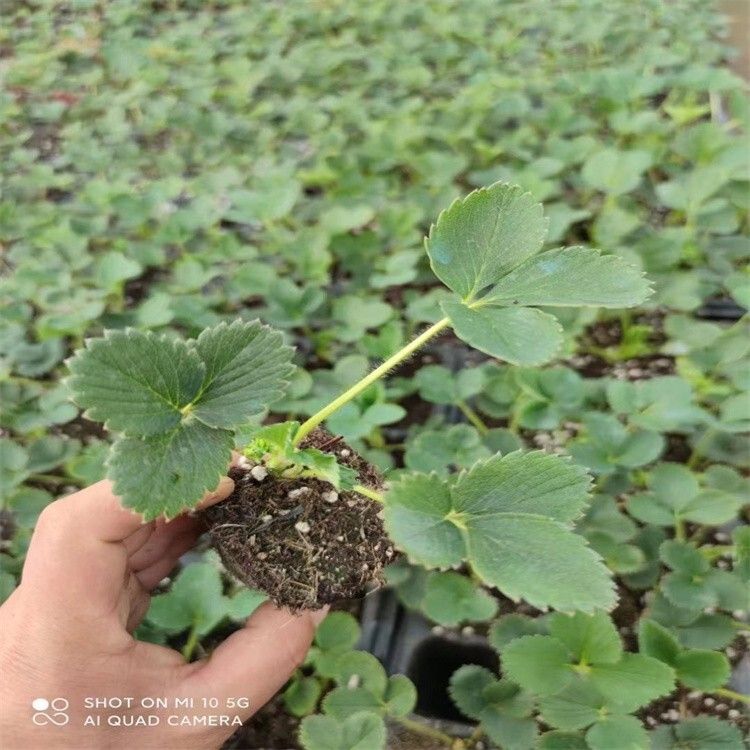
Strengthening management. In order to promote seeding, 50 ppm per chromosophycin (i. E. 20 kg per gram of chromosomal powder) can be sprayed in the pre-plant period, with the leaves sprayed twice at an interval of 7 days. Strawberry and sick leaves are removed in a timely manner to reduce nutrient and water consumption. (b) rationalizing the runners and timely application of the precipitous seedlings (two extended leaves) for the crushing of the chickens or the false planting. In accordance with the principle of “hard weight and hard work”, biofertilizers, rare manure or 0. 3 per cent urea are applied at intervals of 15 to 20 days, usually at nighttime, and the application of dry fertilizer before rain is prohibited in order to prevent the burning of seedlings. For poorly grown strawberry seedlings, 100 grams of acreage should be filled with a 1000 times the root agent. 4. Pine soil weeding. Keep strawberry seedling soils loose, reduce soil moisture evaporation, prevent weed competition for water and promote seedlings. In the case of weeding, the seedlings are prevented from “drilling” and should be produced in a timely manner in order to promote their growth. 5. Disease control. Strawberry sprouts include, inter alia, anthrax, foliasis, yellow atrophy and slashed night moths, tigers, ostriches, etc., which are sprayed in a timely manner in case of insect hazard. Strawberry seedlings1 shall be kept above 30°c during the day, within 710 days after the end of the membrane, in order to prevent the plant from entering the hibernation and also to awaken the plant that will enter the hibernation to new leaves. At the same time, it is necessary to increase the humidity of the shed in order to avoid high temperature burns on the plant. If the leaf temperature exceeds 35 °c, it should be released in time. At night, the temperature should be kept at 1215°c and not less than 8°c. Following the implantation of the pole, the indoor temperature should be gradually reduced to 25°c. Within three days of the beginning of the cooling of the decrepit film, water shall be sprayed on the blades so as to avoid the sudden loss of humidity and drying up of the leaves. This period, which is mainly growth-enhancing, increases the temperature of the shed and the earth's surface as soon as possible and breaks the hibernation. Strawberry seed 2 in the rheumatism period at indoor temperatures not exceeding 28°c during the daytime and at 1013°c at night. The flowering period is at a temperature of 2025°c during the day, and when the temperature of the greenhouse exceeds 25°c, the air is released in a timely manner. At night, the temperature is not less than 0°c, which is appropriate to maintain 81°c, which facilitates both flowering and pollination after flowering. During this period, the temperature is too low for the flowers to disperse; the fertilisation of pollinators increases the proportion of abnormal fruit. During the period of expansion, the temperature should be appropriately lowered. The temperature is maintained at 2025°c during the day and 510°c at night. Appropriate temperature 1820°c during the day and 56°c at night. Strawberry seed 5, fruit harvest period. 2023°c during the day and 57°c at night。
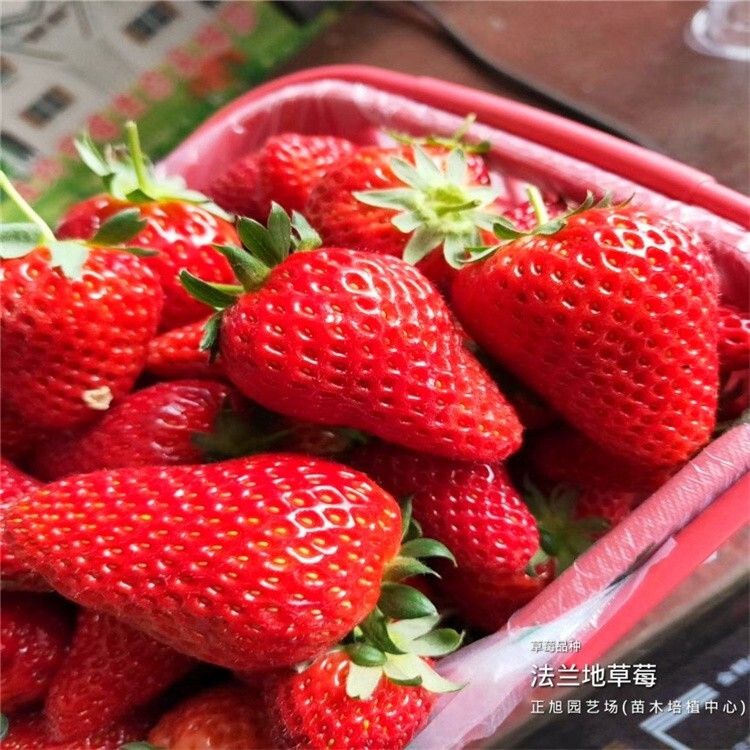
Strawberry plantations mainly produce strawberries and fresh strawberry varieties. The main varieties are zhang ji, zhong yi, zhong yi, zhong yi, zhong yi, zhong yi and zhong yi, among others. Because of the quality, fruit type, colour and taste of both varieties, they are better than other products of the same kind and have higher commodity value in the fruit market. Chrysalberries characteristics (known as the red canyon, japan99), which are large and have an average of about 5 g of single fruit (a larger top fruit with an average weight of 50 g and a large fruit of over 100 g); a cone of fruit (a short cone of the fruit of a generation), with fresh red on the face of the fruit and internal velvet on the surface and on the internal velvet of the fruit, in the same colour, in the same way, in the same way, in the same way, in the same way, in the colour, in the radiant velvet and infrequent fruit; and a soluble solid content of 11. 8% on average (up to 14% of a generation). Acre production of 2 tons. Zhang zhiqiang strawberry nature: japan has introduced new varieties of zhang zhi (known as butter strawberries) and japan's shizuoka county farmer breeders have been born long and early. They are now the main japanese plant species, with a strong plant, a strong plant, an open plant, medium fertility, moderate anti-anthrax and disease capacity, and good productivity. The cream fruit is cone-shaped, with a small number of large malformations, soluble solids containing 9 to 14 per cent, cream type, sweet taste, aromatic aroma, colourful fruit, soft and juicy, and colourful fruit surface. The primary sequence fruit weighs 40 grams and the large fruit weighs 130 grams. It is dormant and suitable for the gift strawberries and close distribution greenhouses. 8,000 to 9,000 acres. This is often the case for a large number of farmers with 2. 5 tons of average acre production when growing strawberry seedlings, which have a strong body, which is a bad, if not no, result. This phenomenon is more normal, mainly due to poor or delayed chromatosis. Strawberries can only bloom if they form buds. The flower bud is formed on the basis of the leaf bud, and the process of shifting from the leaf bud to the physiological state and form of the bud is called the flower bud dichotomy. And the quantity and quality of buds that divide are the main swarms that affect strawberry production. As a result, the separation of strawberry buds is influenced by both internal and external factors
The north usually moves into sheds around the end of august, blooms around november and clears the sheds the following april/may. Strawberries, which are grown using the winter sheds, allow fresh fruit to be marketed during the new year's and spring festivals, with considerable economic benefits, as a technology suitable for rural extension. The following are some of the technical elements for the production of strawberries for winter-heating sheds. Houses are built at locations where wind escapes, the terrain is flat, the soil is fertile, water is abundant, drainage is good and soil ph values range from 5. 5 to 6. 5. The shed is better than anything. The length and extent of the huts should be determined by the characteristics of the terrain in order to facilitate management and lower prices. The average length is 50-80m and the range is 7-8m. The sheds generally follow a short, back-sliding structure. Varieties selection: currently, the main varieties of strawberries suitable for winter sheds for planting are vigi, poignant births, fragrances, all-stars, hani, etc., but virginia has been shown to be a variety by comparison. Whole area and bottom fertilisation: in the first half of the month in which the plant is grown, a high-quality cormorant fertilizer of 3,000 to 5,000 kg is applied, ammonium phosphate 30 to 40 kg, potassium sulfate 15 to 20 kg. Cultivation and post-plant management: strawberries, which are produced in winter, are suitable for planting in mid-september in the east. In order to achieve productivity gains as soon as possible, strawberries should be pre-planted, i. E., seedlings should be separated from the mother's plant in mid-july, and fertile soils should be selected for falsification until the vagrancy is divided before planting in the shed。
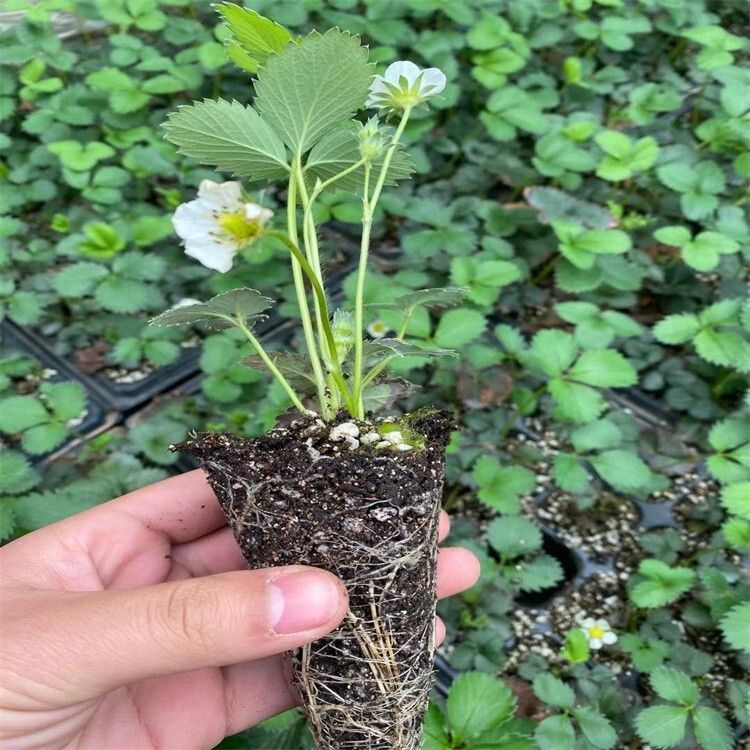
Strawberry seed varieties: red-coloured strawberry seedlings, emerald strawberry seedlings, cream strawberry seedlings, milk strawberry seedlings, vanilla strawberry seedlings, green strawberry seedlings, white strawberry seedlings, peach strawberry seedlings, sweet charlie strawberry seedlings, french strawberry seedlings, all-star strawberry seedlings, fragrance strawberry seedlings, fragrance 7 strawberry seedlings, snowy strawberries, etc. Strawberries are recommended to be grown in two rows, with the general bar 30 cm-40 cm, up 50 cm-60 cm, down 70 cm-80 cm, and a ditch 20 cm. 15 cm to 18 cm, 25 cm to 35 cm. They plant 7,000 to 9,000 plants per acre and 8,000 to 10,000 plants per acre. In general, an acre is planted with 8,000 strawberry seedlings, which, with proper management of water fertilizers, can produce 8 quarts of fruit, so that an acre can harvest about 3,000 kg of strawberries as light plants, but with greater shade resistance. When light is strong, it is small, small, dark and of good quality. Medium light, large fruit, light colour, low sugar, long harvest time; light is weak and adverse strawberry growth. In a box or half of a earth bee, which promotes the pollination of strawberries and the development of fruit, the next march's heat will open up both sides of the shed and move the beehive outside the shed。
Strawberry cultivation is based on the choice of a good breed, which should be based on the criteria of complete and disease-free seedlings, normal growth of leaves, a new coarseness and a more developed root. Due to the nature of the soil, the seedlings should be properly selected, the clay should be planted with eight-leave seedlings and the sandy soil should be planted with medium seedlings. Strawberry cultivation is preceded by the disinfection of the ground, the control of underground pests and the application of sufficient amounts of base fertilizers, such as thorium phosphorus fertilizer and triple compound fertilizer. Most of the sheds are set in the early part of september, with the choice of suitable strawberry seedlings for planting in the evening. During the planting process, care should be taken to turn the sapling bow back into a ditch and ensure that the fruit is produced in the back position for later management and harvesting. The depth of the implantation is inappropriate for heart and for rooting below. In the case of double-row cultivation, it is appropriate to maintain a 20-centimetre spacing. We have to choose where to grow, and the ground for strawberry cultivation has to be more flat, with a higher altitude. The requirement for soil is ablution, drainage and mixing of sands in the soil at the time of the soil, which will improve soil drainage and ventilation, disinfection of the land can be sprayed with thiphos-methyl cream, and control of pests such as thiram and tigers。
It is not a very large number, but it is important to prevent it, mainly by agricultural control, and to select seedlings, to select some of the resistant varieties that are less likely to breed them, and then to have proper and rational rotations of the land, and to treat them as soon as strawberries bloom, which would have a great impact, if asymptomatic dusts were found to be treated using multimixable wettable powders, and to collect a good period of time between 8 a. M. And 10 a. M. And between 4 p. M. And 6 p. M. To 6 p. M. Strawberry seedlings should be guaranteed in the number of leaves 5-6 and a strawberries sprouts should be preserved, while the extra old leaves and sprouts should be removed in a timely manner. The old and dead leaves of the penis should be removed when the strawberries bloom, and the runners should be treated in a timely manner to ensure excessive nutrient consumption. In addition, small branches and weak fruit should be treated in a timely manner. Most of the rags retain between 7 and 9 fruits to ensure the size and quality of strawberry fruit. Strawberry cultivation should generally be controlled at a temperature of 20-28°c, which can be adversely affected by higher or lower temperatures。