


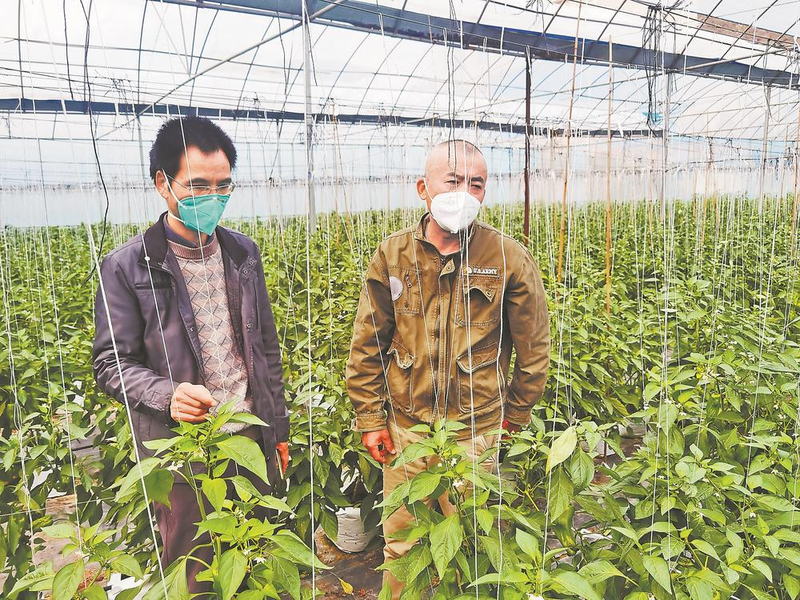
Linjun (left) is mentoring growers in base planting。
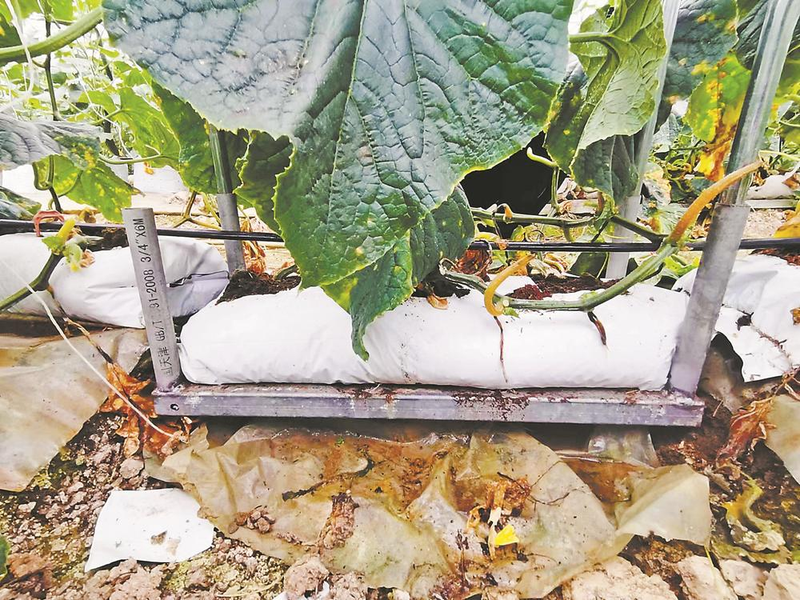
This is a basket of tomatoes with a matrix weight sensor under it。
At the moment, the tomatoes in the ground-based vegetable production shed of governor fowler's queen's landing have been brought back to the harvest, with green and green seedlings and red and green tomatoes saturated. “the disease is low, the medication is low, safe, of good quality and the cost is low.” growing a large family, li myung cai, is a happy sight, and one breath lists the advantages of using a matrix to plant tomatoes。
Ground-based cultivation, which is a non-earthed form of cultivation, refers to techniques that use artificial matrix-based plant cultivation without the use of natural soils, which have been prohibitive to many growers because of its high cost. The vice-researcher of the land fertilizer institute of the provincial agricultural institute, lin jian, and his team have integrated innovatively to replace expensive coconuts with agricultural waste such as low-cost, renewable grainshells and wood crumbs, and to promote soilless cultivation through the use of material-networking technologies and remote-controlled vegetables, lowering the technology application threshold。
To date, the technology has been replicated in fuku, ningdeh, yongjiang, zhui and guangdong chouzhou, with a total area of over 600 acres and a cumulative area of over 3,000 acres, mainly producing tomatoes, cucumbers, watermelons, peppers, etc., as powerful assistants to farmers in increasing their yields。
From imported coconuts to native grain shells
With guidance from linjun, the grower lee myung chou became the first crab eater in our province as early as 2017, moving from earth to soilless cultivation。
“the technology originated in europe and the united states and was subsequently widely produced in countries such as israel, the netherlands and japan.” according to linjun, the technological advantages are clear, but the relative underdevelopment and application in the country is largely due to high costs and “burning money”。
Where's the burn? In addition to fixed inputs, such as greenhouses, specialized planting matrixes, and water fertilizer integration systems, the most heavy burden is on expensive base materials, which need to be replaced every two years. “the original 2000 ton of coconuts has doubled since the outbreak began in 2020!” linjun said。
Most of these coconuts originate in south-east asian countries, and when the seller's offer comes from the telephone, linjun happens to be in a rice-processing plant in the changle district, looking at the crust of the ground, and he suddenly moves: “it's about 20% woody, which is hard to decompose organic material, can you replace coconuts with grain shells and make an economically efficient matrix?”
A ton of grain shells is only $400, which is one tenth of the price of coconuts。
In response to this idea, lin-jong and his team were in the lab, looking for a trace of feasibility from the available literature, and finally trying to replace one third of the coconuts with grain shells, and unearthed cucumber seedlings. “it took us six months to argue whether the first question was whether such an economically efficient matrix would meet standards in terms of penetration, water conservation, etc., and whether a grain shell would be decomposed by a matrix, such as residual wheat particles.”
Unlike the methods described in the available literature, linjun does not use fermented or carbonized grain shells, “fermentation means that there is an additional fine process, and the cost follows the water up the ship”。
This is not without scientific justification. “we replace one third of the coconut husks with grain shells, which do not replace them in full. Even if they produce slow natural fermentation during their use, they can release the fermented intermediates from the matrix through multiple daily nutrient irrigation.”
The result was a surprise to lin-jong: “assistable! All concerns are removed from the experiment.”
In may 2020, li ming cai replaced the matrix of 250 acres of the greenhouse complex with an economically efficient matrix. A cooperative of modern agriculture professionals in the zhuong lak district has also produced 150 acres of greenhouses, alternately growing tomatoes and cucumbers。
In early 2021, lin jian shared technology pro bono with jiangping biological basement co., inc. In xiamen city, to map out the production of a commodity matrix with wood crumbs and grain shells as the main raw material, replacing the coconut base completely and freeing itself from the “high price” constraint of coconut。
“the cost of soilless cultivation is within $7,000 per acre, equal to the cost of conventional soil cultivation.” according to linjun, conventional soil-cultivated crops also need to take into account the application of fertilizers, such as “fertilized” little peppers, which cost more than $7,000 for an acre alone。
At a recent on-site acceptance conference on “economicly efficient tomato-braining technology”, lin jian had been credited with: 0. 07 per cent of the incidence of ailments and atrophysics from an economically efficient matrix-planting tomato, which was significantly lower than the rate of 16. 01 per cent of conventional soil cultivation; an average of 760 kg of tomatoes, which represented an increase of 6. 3 per cent over the production of conventional soil; 79. 2 per cent of tomato sperm fruit, which was significantly higher than the rate of 72. 7 per cent of conventional soil cultivation; and an increase of $4317 per acre in the efficiency of cultivation compared with conventional soil cultivation and $3776 in net income。
Web-based remote control of vegetables
High-tech, a double-edged sword, once unearthed。
The supply of crop nutrition comes entirely from nutrients. “the nutrient ratio, concentration, ph, and frequency and amount of drip irrigation need to be determined with precision according to plant demand and different growth cycles.” li ming cai says。
The emergence of an internet-based technology in smart temperature-control sheds has made it easier to plant vegetables。
Lee ming cai has a professional fruit and vegetable cooperative in the city of huezhou, guangdong. In large sheds, there are wetness sensors, photolytic effective radiation sensors, heavy sensors, etc., and a bag of four tomato bars is placed on a designated wooden plate。
“the entire system collects, in real time, information on the temperature of the air in the greenhouses, relative humidity of the air, information on the photolytic effective radiation in the greenhouses, and information on the mass of the matrix and crop, thus obtaining the evaporation of the crops, i. E. The decrease in the weight.” linjun says。
Sensors transmit data to backstage programs, where lin jian can keep abreast of real-time information on the greenhouse environment, the water content of the matrix and the evaporation rate of tomatoes through his mobile phone app, and, based on the information obtained, can make adjustments to nutrient formulations and irrigation procedures for the cultivation of genre tomatoes far from guangdong to ensure healthy growth of vegetable guacamole -
With tomatoes growing from a trifle to the opening of the first flower, linjun learned from app that daily intake of nutrients for crops had increased significantly, changing the original irrigation four times a day to five times a day
(a) when tomatoes are coloured in uneven fashion, the experienced lin jørn immediately judged that pre-nature nitrogen overweight resulted in potassium deficiency, potassium nitrate added, and timely nutrient supplements for tomatoes
I'm sorry
After li ming cai's son graduated from little li university, he took over this professional fruit and vegetable cooperative, "i'm completely outsiders. Thanks to the technology of the internet of goods, agricultural experts in fuku county can help with the management of the farm, which is moving towards an automated transformation path”。
Another agricultural company, located far from tibet's south city, under the direction of linjun, has also applied new technologies, such as networking, artificial intelligence, big data, to the field of cultivation, through the networking management system, the integrated water fertilizer system, which has led to the demonstration of the production of a variety of fruits and vegetables and the development of cultivation techniques。
It is worth mentioning that lin jian and the team invested more than $500,000 in cooperative conservation equipment by adding a metering pump to the common domestic fertiliser and transforming it into an automated precision water fertilizer supply system that can be used for extensive soilless cultivation。
“technology war” on soilless cultivation continues. During this period, lin jian was busy working with the team to develop a “basic cucumber-based evaporation and machine learning system for intelligent irrigation”. “looks forward to intellectualization and reduced artificial intervention in the cultivation of trophic irrigation on a matrix.” lin joan said. (reporter lin ha man/chart)



