


Building an autonomous knowledge system for philosophy and social sciences in china
Terminology are the building blocks of knowledge systems, and the “noun revolution” is a key link to knowledge production and reproduction, theoretical innovation and development. Contemporary china is undergoing the most extensive and profound changes, providing a powerful impetus and a vast space for theoretical creation and academic prosperity. The party's twenty-third plenary session proposed a major theme, “building an autonomous knowledge system for philosophical social sciences in china”, and the “revolution of terminology” played a crucial role in the construction of an autonomous knowledge system for philosophical social sciences in china and in the development of social science for the flourishing china。
The origin and content of the “revolution of terms”
The term “terminologies” is the basic language tool by which human beings summarize, classify and analyse natural and social phenomena on the basis of the accumulation of practical activities and experience. It is an indispensable intermediary for the abstraction of many phenomena into concepts, in terms of their scope and in terms of the description of an objective world and its inherent patterns, and for the transmission of knowledge and ideas. The term “terminologies”, as a symbol of concepts and scope, is both a unique indicator of a particular knowledge system and a cornerstone of its construction。
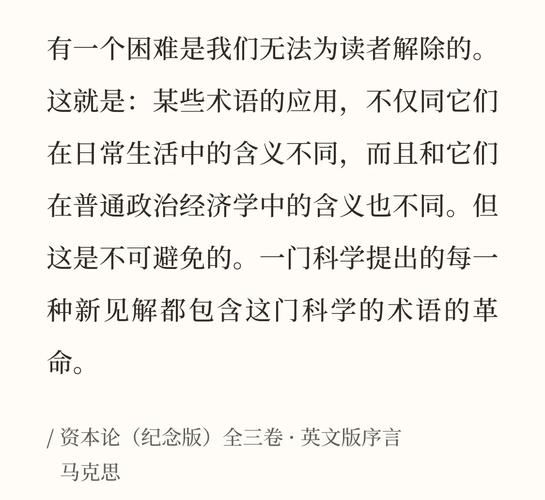
In academic history, the concept of the “revolution of terminology” was first proposed by engles. In order to give a clearer picture to the world of the inherent mechanisms of capitalist production, marx used the term “residual value” used by robertus in capitalism, and was therefore subjected to “plagiarization” from the followers of lobertus and his national socialist doctrine. In the face of these attacks and criticisms, the preface to the english version of the first volume of capitalism was clearly echoed by engles: “each new scientific idea contains the revolution of the scientific term.” in the view of engus, the “revolution of terminology” is a reinterpretation of existing terms and serves specific theoretical interpretation and critical needs. Marx's recasting of “residual value” in the first volume of the capital doctrine is precisely the “revolution of terminology”. According to marx: “this residual value is the balance created by the value of the product in excess of the value of the consumed product formation factor, i. E. The value of the means of production and the labour force.” this reinterpretation of the traditional view of political economics as a source of residual value reveals that the true source of residual value is the unpaid labour component of workers ' possession by capitalists。
Marx's use of “residual value” has exceeded lobertus's intentions in scope, scope and orientation, and his new regulation of “residual value” has contributed to the construction of a capitalist critical linguistic system, which has led to a revolution in political economics. The deliberate neglect of the specific context and underlying logic used in particular concepts, and the view of marx's use of “residual value” as a “remnant” is clearly an unconsidered misunderstanding. Moreover, engles has further elevated the discussion of the subject to a methodological level, arguing that marx has achieved a subversive recasting of the capitalist knowledge spectrum in terms of the underlying concepts and parameters of the discourse. This makes the capital theory's criticism of capital logic based on a “collective approach”, which is implicit in the “revolution of terminology”。
The view of engus provides an important inspiration for our understanding of the “revolution of terminology”. A comprehensive grasp of the meaning of the “revolution of terminology” also needs to be made more explicit in methodological terms that are consistent with history. The “revolution of terms” is not an empty language game, but a product of changes in material production and interaction. In the german ideology, max engers stated that “the production of ideas, ideas and consciousness was initially directly associated with the material activities of people, with their material interaction, with the language of real life”. The term “understanding” is rooted in the production and interaction activities of human beings and is bound to undergo a revolution along with changes in human practice, because “people who develop their own material production and material interaction, while changing their own reality, are changing the products of their own thinking and thinking”. In this sense, the “revolution of terminology” is not an event of an accident, but a logical development of the history of practice that has led to the transformation of understanding. When human practice of material production and communication changes, the “revolution of terminology” is inevitable. A thorough theory of practice gave a new function to the “revolution of terminology” and introduced a new requirement to constantly create new terms based on the development of practice and to provide a new horizon of understanding. For example, in order to address the cyclical dilemma of the use of labour by classical political economists to justify the value of goods, marx used creatively the new concept of “labour” in the economics book 1857-1858; xi jinping's economic thinking was based on the economic practices of the new era, introducing a range of new concepts, dimensions, including “new economic normal”, “quality development”, which also provided a new horizon for understanding political economics。
Meaning of the “revolution of terms” for building autonomous knowledge systems
“the real content of all epoch-making systems is shaped by the needs of the period when they were created.” the development of times, the progress of civilizations and the transformation of knowledge systems are synergizing, echoing and developing together. With the deepening of the great chinese-style modernization practice and the gradual development of new forms of human civilization, the task of achieving a “revolution of terminology” and building an autonomous knowledge system of chinese philosophy and social sciences that matches it has become urgent。
On the one hand, the deepening of china's modernization has led to profound changes in a range of areas, from practice to awareness, from material to cultural, from technology to institutions and from production to life. The old knowledge system faces a serious “interpretation crisis” in responding to new situations, changes and problems. On the other hand, old knowledge systems are deeply influenced by western theories and discourse, which are rooted in western soil, are rooted in western experience, and have natural limitations in expressing, interpreting and describing china’s experience, making it difficult to truly embed and modernize china. Building an autonomous knowledge system of chinese philosophy and social science, building on chinese logic and upgrading china's experience to chinese theory are the requirements of the era of modernizing china。
How to highlight “china identity” and achieve “china autonomy” is at the heart of the building of the knowledge system, of which the “revolution of terms” is the most critical. The concept is the foundation of the edifice of knowledge systems and is based on the concept of scope, subject matter, rationale and theory. From concept to scope and rationale to professional terminology, it is a general rule for building autonomous knowledge systems. The construction of china's autonomous knowledge system of philosophy and social sciences is also governed by the rule that traditional concepts are given a new intellectual, contemporary and civilizational dimension through the “revolution of terminology” and a series of original and symbolic concepts are proposed. The “original concept” is rooted in chinese practice, and the chinese position, thinking and logic inherent in it make the knowledge system chinese; the “marked concept” can, by virtue of its inherent originality and transcendence, contribute to the dominant and autonomous nature of the knowledge system. It is only through the production of “original concepts” and “signative concepts” that autonomous knowledge systems can be built that truly provide theoretical support and intellectual leadership for china's modernization。
Language systems are also important elements of knowledge systems. Words are in themselves a power that stems from the deep forces behind them. In this new journey, if we are to fully build a modern socialist power, and if we are to win the right to speak with power in the international community, we must work to break western hegemony and guide and advance chinese practice with an autonomous knowledge system. It is only by constantly refining original and indicative concepts based on chinese practice and learning from china's experience, and by developing its own research paradigm, personality and core competitiveness through the “revolution of terminology”, that china's system of autonomous knowledge of philosophical and social sciences can truly be built, and the international status of chinese discourse will be continuously elevated, with a fundamental reversal of the international discourse of “the west, the west and the weak” to support the building of socialist, modern and powerful nations。
Methodological principles for advancing the “revolution of terminology”
The “revolution of terminology” needs to be carried out in an orderly and steady manner, based on adherence to fundamental principles and the mastery of scientific methods. The use of the “revolution of terms” to promote the construction of china's autonomous knowledge system for philosophical social sciences should be guided at least by the following methodological principles:
Keep up the innovation. It is marxism that stands up. Marxism is the theory of science, the theory of people, the theory of practice, the evolving theory of openness, with influence, interpretation and vitality that transcend nations, time and space. The advancement of the “revolution of terminology” must always be based on a marxist approach to the evolving reality of the world, revealing the inherent patterns of the development of objective things, and developing concepts and parameters that keep pace with the times and scientificly express the essence of the objective world. “innovation” is the logical background of the “revolution of terminology” and the necessary path to building an autonomous knowledge system of chinese philosophy and social sciences. Based on china's great modernization practice, analytical research on new situations, situations and problems should be intensified. Through systematic stock-taking, accurate refining, deep excavation and scientific overviews, outputs should continue to be based on original, ground-breaking, emblematic concepts and new dimensions, accelerating the development of an autonomous knowledge system based on the practice of the new era。
The “revolution of terms” has led to the construction of china’s autonomous knowledge system of philosophy and social sciences, with a dual mandate: to build china’s china-based identity, chinese style and chinese style, to present a theoretical view that is fundamental, original and symbolic, to tell chinese stories in chinese and to move china to the world; to look to the world, to play the role of the original language system in international exchanges, and to create new concepts, dimensions and expressions that can be understood and accepted by the international community, so that the world can better understand china. In order to accomplish this dual task, it is necessary to maintain a balance between the original and the outside, for the present and the present. On the one hand, it promotes the creative transformation and innovative development of china's excellent traditional culture, extracts from it chinese-specific thinking, refines new core terms and provides a “key” to the world's understanding of china; on the other hand, it draws extensively on the excellence of human civilization and creates new concepts based on comparison, comparison, criticism, absorption and upliftment, building a “bridge of thought” for china to the world by giving new theoretical content to transform traditional concepts。
Overall advance. The secretary-general of xi has proposed, at a symposium on the work of philosophy in the social sciences, the creation of a system of philosophy and social sciences that is “all-round, all-round, all-embracing”, which will provide us with a direction for building an autonomous knowledge system of philosophy and social sciences in china with a “revolution of terminology”. Systematic knowledge-building consists of knowledge points that are rich in diversity and that are combined with a certain order or connection. The construction of china's autonomous knowledge system in philosophy and social sciences is not a simple superstition or mechanical assembly of knowledge, but a complete, three-dimensional revolution involving the discipline, academic and linguistic systems. From a holistic perspective, and in keeping with the principle of holistic promotion, the “nouns revolution” should be launched in a comprehensive manner within the “three major systems”, so that the “nouns revolution” between different fields can be aligned, aimed at the same purpose, and respond to each other, drawing up new concepts and dimensions that are well structured, logical, independent and mutually supportive, and laying the foundation for the construction of china's autonomous knowledge system of philosophical and social sciences。
(author: liu soo-chun, researcher at the centre for research on socialism in china during the new age of xi jinping, zhejiang province, and dean of the marxist institute, zhejiang university)



