


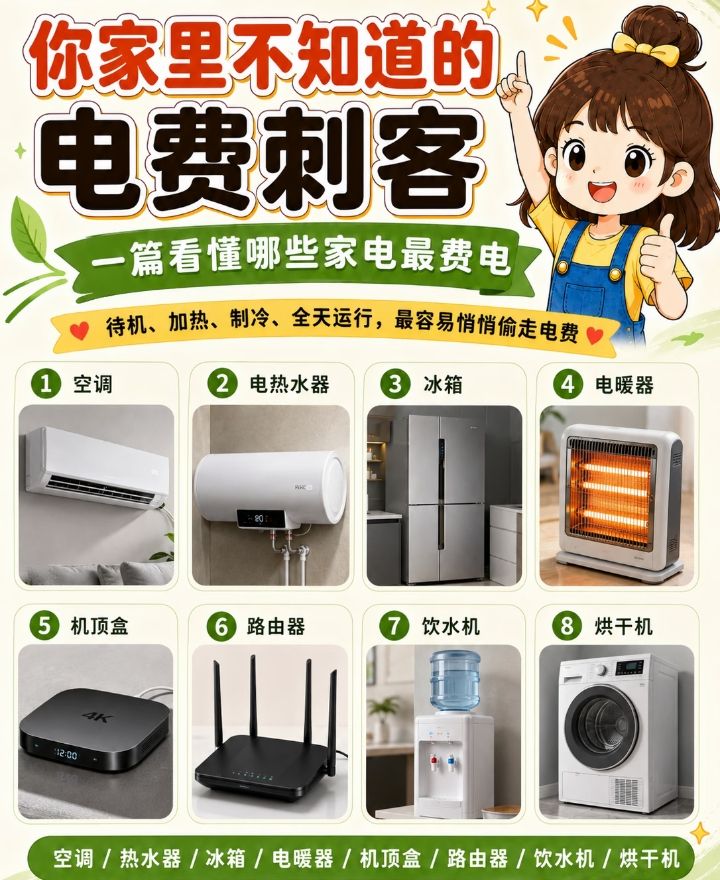
When the electricity bill is paid, the first reaction of the vast majority of people is that the air conditioning is too expensive in the summer. We can talk to the electrician, and we can do it with a power test. Short-term use of air conditioners is really not a waste of electricity, and those 24-hour plugs, little household electricity that nobody cares about, long years of running power, spend hundreds more a year。

First, let's figure out a real deal: how much electricity does air conditioning take? Don't blame him again
Many people have a deep-rooted error zone and feel that air-conditioning power is high, sure the house is the most expensive. We're using 1. 5 wall-mounted air conditioners in our homes, which, in combination with official measurements, are realistic and not exaggerated。
1. Basic power consumption parameters: 1. 5 air-conditioning units with a rated power of approximately 1100 w, which, in brief, runs for one hour, consumes 1 degree of electricity。
2. The average person has a real use time: only six, seven, eight months of high temperatures in a year are frequented, while the remaining nine months are essentially free of electricity. Most families sleep for six to eight hours at night, even in three volts, and work during the day is closed and does not operate 24 hours a day。
3. Total annual electricity consumption is measured: acs consume approximately 630 degrees for the whole summer, based on three months of summer and seven hours per day; by autumn winter and early spring, acs are completely out of service and do not exist。
4. Air-conditioning on-line is extremely low: even if the interpolation is not lifted during the change season, a wall-mounted air-conditioning on-board is only 1 to 3 watts, a whole year is less than 12 degrees of power consumption and less than $7 can be discounted, almost negligible。
Objectively, air conditioners are seasonal high-power appliances that use only one third of the year, leaving most of the year completely out of power. Retrospect of the small equipment in the home, which provides electricity throughout 365 days of the year, is the main reason why many households are becoming increasingly suspicious about the cost of electricity。
Neighbors and me, same household size and same population, spend 40-50 more per month on their own electricity than their neighbours, and air conditioners are used for less long periods of time. The problem is not to cool the heat at all, but rather to plug in invisible power-consuming equipment that is constantly being used. In recent years, the national electricity grid has been running statistics showing that the average three-member household, with all types of electrical appliances on hold, consumes between 300 and 500 degrees of electricity per year, at an average civilian cost of 0. 55 yuan/degree, at an additional cost of 160-275 yuan per year. This money is not a big sum, but it's a long time to buy food and pay for gas。
Ii. Number one battery theft: cat + router + roof box, year round, most households have electricity all day
None of these three things are among the most easily neglected electric assassins in 90 per cent of households. How many times do people think they can use a box with a big slap? The actual data would subvert the perception, and there was no real “put-off” of the equipment and it would continue to operate as long as it was plugged in。
1. Official measurement power of equipment
Gg: continuous operation of 5-7 w; dual frequency common router: 4-6 w; high-clean television iptv roof box: 11-15 w, highlighting: the roof box shut-off is a black screen and the internal master plate, signal receiver, auto-up module work in its entirety, with a minimal gap between effort and starter。
The three packages together have a stable power of 20-28 w, and we take the median of 24 w。
2. Accurate accounting of electricity costs throughout the year
24 hours running without interruption at 0. 576 degrees a day; 17. 28 degrees a month; and 207. 36 degrees a year, equivalent to close to $114。
Many people have never lost power since the day they were installed with broadband, and the roof box has been stuck year after year, even after six months without watching television, and the plug remains intact. The three small items alone cost more than a hundred pieces of electricity a year, a figure that is far higher than the air conditioner for the season。
In addition, the light-cat routers are permanently off-lined, free of charge, and frequent cartons and grid speeds are slow, restarted every two or three days, reducing inefficient power consumption and stabilizing network signals. The routers now have their own memory function, and power cuts do not affect configuration。
Iii. Water-storage electric heaters, 24 hours cold, wasteful, with many households running electricity 24 hours a day
The household bathrooms are now equipped with water-based electric heaters. The vast majority of the population is used as a constant plug-in, with water temperature reduced by automatic heating, which appears to have hot water at any time, while large amounts of electricity are used to offset the dispersion of water tanks, which is typically inefficient。
1. Measurement of electricity consumption: general 60-litre water heater, single-day combined power consumption of 1. 1-1. 3 degrees, average of 36 degrees per month and 432 degrees per year in a day temperature-preservation mode。
2. Differences in electricity consumption by population group
Worker families: no one in the house during the day, no hot water for the whole day, water heaters continue to heat up repeatedly, and almost one degree of electricity is wasted all day
Retired seniors are at home all day with frequent water use and 24-hour electricity is reasonable
There is absolutely no need for renting houses, young workers to have full-time electricity, one hour before bedtime, to heat up, to run out of direct power cuts, to have enough hot water to wash, and to save more than 20 degrees of electricity per month。
Here's to correct the one-sided error of the online flow: it's said that water heaters are more expensive to turn on than to keep the heat all day. The findings of the institute of electricity studies show that electricity consumption will increase slightly only if repeated stoppages take place in less than two hours; power cuts occur at intervals of more than eight hours, save much more heat than reheating electricity consumption, and workmen leave their homes for more than eight hours during the day, with an absolute reduction in power cuts。
In winter, the temperature of the environment is low, water tanks are spreading at a high rate, and electricity consumption is expected to increase by about 20 per cent, and in winter, the difference in the cost of electricity is likely to become more pronounced among households with full-time electricity。
Iv. A standing drinking water machine, infinity cycle to keep the water warm, full-time power plugs being wasted
Offices, living rooms, stand-alone drinking water units, which are neglected by many households, especially when there is no one in the house during the day, are still running throughout the day, all of which is consumed in an ineffective cycle of “burning - cooling - burning again”。
Power and power consumption measurement: general stand-by drinking water machine heats 550 watts, but does not work continuously, cycling around the clock keeps the temperature warm, constant daily consumption of 0. 5-0. 7 degrees, monthly calculation of 18-21 degrees of electricity, 216-252 degrees of electricity a year and up to 100 head of electricity。
2. Real life scenes: most households drink water only early and late, out of work for more than eight hours during the day, and water from the drinking machine is heating up several hundred times, not only with electricity, but also with long-term drinking。
The simplest way to save electricity is to remove the plugs directly from the water machine, to go home and drink water and get electricity, to burn a pot of sufficient water, without any delay, and to save more than a dozen points per month。
V. Kitchen power, unplugged plugs, and much of the remaining capacity
The kitchen has the largest number of small and large electrical appliances: smart meals, microwave ovens, wall breakers, electromagnetic furnaces, air fryers. Almost all people use only the air-closure buttons, plugs are placed in slots year after year, and the accumulated amount of electricity is not negligible。
Let's be clear about every remaining loss:
1. Smart telecommunications: home reservation, temperature protection, stand-by power of 3-5 watts, power consumption of 0. 096 per day for 24-hour plugs, which is low, but accumulated at 35 degrees throughout the year, at a cost of nearly $20
Microwave ovens: stand-by screens, control of continuous electrical power on the main panel, 2-4watts, 20 degrees more per year
3. Wall breakers, air fryers: stand-by power of 1-3 watts, low single-station losses, full electrical plugs in four or five small household units in the kitchen, followed by additional five to eight degrees per month after supercharge。
Many people think that the amount of kiva is nothing, but we're counting, with a kitchen full of small household electricity standing by for the whole year, which consumes almost 80 degrees more, folding up the front cat, water heater, drinking machine, and wasting power directly over 700 degrees a year, far exceeding the total of 1. 5 air conditioners in the summer。
The kitchen saves money: after cooking, removes the power of a small household electric plug, or directly uses a charger with a switch, without frequent plugs, with one button cut, and saves electricity。
Vi. Smart little things in the bathroom: smart toilets, hot tubs, the most obvious in winter
In recent years, smart toilets and hot tubs have become popular, many household maps have facilitated the year-to-year transmission of electricity, and the amount of electricity consumed in winter has been doubled, representing “lower-use, much-consuming”。
1. Smart toilet: the heated circle is the main power-consuming point, with a temperature-heated mode of 10 w or so, full-time power consumption of 0. 24 degrees per day and 7 degrees per month; no heating circle is required in the summer, and still plugged into electricity is simply wasted
2. Temperature-controlled temperature-control modules, 4-6 watts (w) stand-by, annual electrical power consumption of 3-5 degrees per month, regular bathing and complete power cuts for the rest of the year。
The use of both types of equipment is very limited, with only a short period of time spent on washing, such as latrines, and more than 20 hours of constant heating and electricity consumption, with hidden costs in the long run. Turn off the heating function in the summer and reduce much of the wear and tear without pulling out the plug。
Vii. Fragmentation of chargers of all types cannot be ignored
Cell phones, tablets, electric cars, razor chargers, which are filled and still plugged into the plugs, many feel that “no charge without charge” is a completely false perception。
The electricity detection agency has determined that in the empty state of chargers, there is still a trace of empty charge loss, with a single power of 0. 5-2w, and that three or four chargers are plugged into the home, with cumulative loss of 0. 03-0. 07 degrees of electricity a day. The single value is small, but year-round, consuming 10-25 degrees of electricity over a year。
More critical security alerts: chargers have long-term empty plugs, lines continue to heat, old plugs are prone to aging, short-circuit hazards, non-light-cost electricity, fire safety risks, full of power to unload chargers in a timely manner, and less electricity。
Viii. Objective comparison: air conditioners and house-to-house power consumption across the year, breaking down perceptions
Based on standard three-member family configuration, combined with all the above measurements the total amount of electricity consumed throughout the year is based on the national grid feeder tests and public tests by the institute of home power research, which are not exaggerated and presented in one-sided terms:
1. 5 wall-mounted air conditioning (7 hours a day for three months in the summer and electricity outages during the rest of the season): electricity consumption is about 630 degrees a year
2. Total annual electricity consumption of small units throughout the year
Photocat + router + roof box: 207 degrees
60 litres of water heaters all day: 432 degrees
All-day plug-in of a standing drinking water machine: 230 degrees
Kitchen sets: 80 degrees
Smart toilet + thermostat: 90 degrees
Space-borne loss of chargers of all types: 18 degrees
Total remaining power consumption throughout the year: 1057 degrees
Clear contrasts can be seen directly: power consumption for all types of small appliances, which are inoperable and temperature-preserving, amounts to 1057 degrees a year, 427 degrees more than the air conditioner that continues to be used during the three months of the summer, and more than 230 times more than the equivalent cost。
This is also the central reason why many home-based air conditioners are not running much and the monthly electricity bill remains high. Air conditioners are only phased electricity, while various types of small household electricity are available, with 365 days of uninterruptible run-off and long-term accumulation of far-over air conditioning。
The objective addition here is to avoid partial and misleading content: full-time electricity is a reasonable option if water heaters and drinking-water machines are used at high frequency per day in the home; but full-time electricity is available to working people, to families that have no one at home during the day, which results in large amounts of non-effective electricity consumption, differentiating the use habits among the population, and not one-size-fits-all proposals for power cuts, with more rigorous and objective content。
9 - people can do electric exercise without being forced to use electricity
All methods are simple and easy to access, with no cost to replace energy-efficient household electricity, and only to adapt daily electricity habits to accommodate comfort and savings, and to organize the scenes so that you can compare them:
(i) living room network, television equipment
1. Work during the day, family trips, removal of cat, router, roof box set plugs; reboot every 2-3 days when the home does not leave the house, stabilizing grid speed to reduce electricity consumption
2. Long periods of absence from television, direct removal of the roof box power, and not only turn off the remote control black screen。
(ii) bathroom water heaters, smart guards bath
1. Worker is not home for 8 hours during the day, electricity is out of the house and one hour before sleep is provided with electric heating; the elderly are able to maintain electricity throughout the day
2. High summer temperatures, smart toilet closures, heating functions and power switches when hot tubers are not needed。
(iii) drinkers in the living room
Direct power outages during the day, drinking water and reconnecting electricity at home to avoid a full-time cycle of heating。
(iv) kitchen electricity
1. Electrical cooking, microwave ovens, air frying pans, and power outages by a total plug switch
2. The short-term one-to-two hours will also be required to maintain electrical power supply, which will not have to be cut overnight。
(v) types of recharge equipment
Cell phones and electric cars are full of electricity, and chargers are pulled out at the first moment and are not permanently emptyed for plugs。
(vi) rational use of air conditioners and reduction of electricity consumption
1. Refrigeration set up at 26 °c in the summer, at a temperature of 1 °c lower, increasing electricity consumption by about 8 %; regular cleaning of filters and smoothing of heat and electricity
2. Use of air-conditioning for long periods of time during the fall and winter seasons and removal of plugs to eliminate trace standby losses。
X. Concluding remarks: employment of employment is not a kind of business
Many people feel that electricity at one time is more than 50 cents, and there is no need to pay attention to this loss or loss, even though there is less to live. The amount of electricity, which once looked worthless, accumulated hundreds of degrees and spent an extra $200 million a year, could be used to buy food, gas and supplies。
People don't have to carry air conditioners on their own in the heat, they use them, and they don't have to sacrifice their comfort to save electricity. What really needs to be adjusted is those who have no one to care about the bad habits of electricity use: the constant unplugging of plugs, the 24-hour temperature-burning of water, and the uninterrupted power supply of equipment throughout the year, which is completely unnecessary, and then the cost of electricity billing will drop significantly。
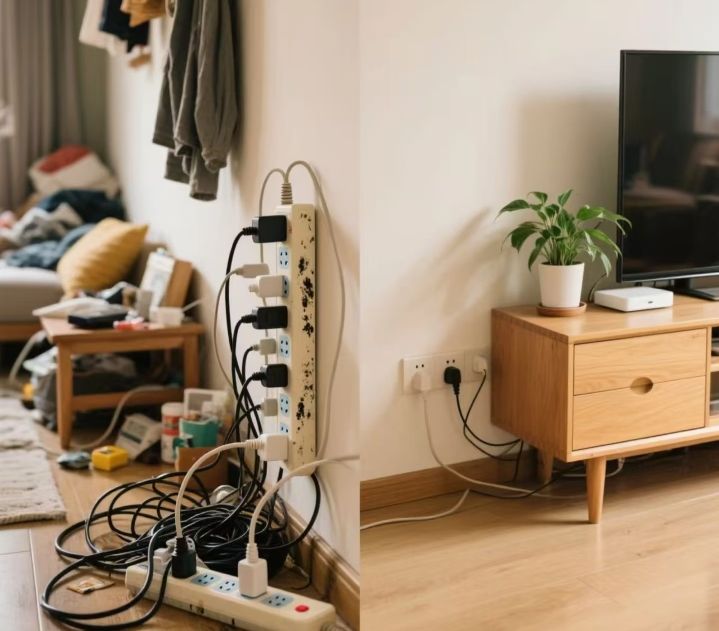
When they come to the door, they often say that 80 per cent of households suffer from high electricity costs, which are rooted not in air conditioning, refrigerators, etc., but in the continuous theft of electricity by a bunch of low-profile small equipment. After reading this article, we can go home tonight to go to a check-in plugin, cutting off long-activated equipment, and next month we can see a clear gap。
What's your monthly electricity cost? Do you have any appliances that don't pull plugs? Welcome to the comment section, saying that you're saving your electricity, and you're learning to save money
Disclaimer
All the data on household electricity consumption and the measurement of electricity costs are based on the national grid intake survey and the public inspection report of the national institute of electrical sciences of china。



