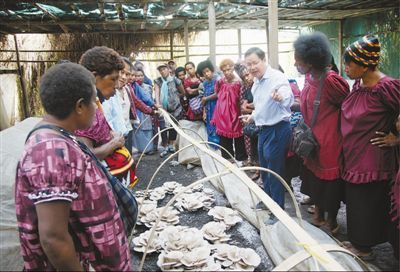
Chinese experts have trained new farmers in mushroom cultivation. China's technical assistance team for pneumatic grass and rice figure
266 training courses in the field and abroad for 10,000 participants; establishment of training centres and bases in the field of grass technology; translation into 15 languages and extension to more than 100 countries and areas; the teaching of bacterium technology, invented in 1986, is constantly moving out of the country, providing effective programmes for many developing countries to lift themselves out of poverty, combat soil erosion and desertification, and develop livestock。
The story of the wild grass changing to the golden grass continues to be heard
On the outskirts of goroca, east highlands province, papua new guinea, homemaker zaka abori collects mushrooms every day from her home. Last year, only one mushroom was planted, and zaka ' abori earned 15,000 kina (kinayo = rmb 1. 83). Most of the local households grow coffee and vegetables, with an annual income of only one or two thousand kines. She told the newspaper's journalist: “weeds and mushrooms are easy to grow, do not need fertilizers and pesticides, transport is easy, and the economic benefits are 20 to 30 times higher than those of past vegetables. My life has improved considerably through the cultivation of mushrooms, and it is no longer particularly difficult to pay school fees for children, purchase new clothing and other everyday items.”
The governor of east highlands, peter num, described the grass as “a gift from china to assist east highland province”. There are currently more than 700 mushroom farmers in the eastern highlands province, over 70 per cent of whom are women. And num said, "this is our land from poverty."
Png is one of the least developed countries in the world. In 1997, at the invitation of the government of the eastern highlands province, a team of chinese experts, after an in-depth study, decided to establish a demonstration site in the rufa district of the eastern highlands province to help lift people out of poverty and enrich them。
This gang is for over 20 years. The team leader of the chinese project to assist png grass and dry rice technology, lin shin, told the journalist that the chinese team's efforts had not been wasted and that the grass industry had become the second largest after coffee in east highland province. To date, the group has conducted a cumulative number of 18 local training courses on grass technology, for a total of 1,337 participants。
In fiji, where 1 hectare of grass can produce 30 cows or 300 sheep, where cattle and sheep are fed, and where the technology of grass is hailed as “a new hope for island agriculture”; in lesotho, in african countries, where the cost of the bag can be recovered in 7 to 10 days because of low investment and high productivity, the grass is considered a good way to make rapid enrichment; and in south africa, where small farmers use the “10 square metre mushroom field” to produce 1. 2 tons of mushrooms annually, local women are happy to sing and dance when they first harvest mushrooms. In a growing number of countries, the story of weeds changing to “gold grass” continues to be glorified, and weed technology builds a bridge of friendship and gives chinese wisdom to the cause of global poverty reduction。
Use it to the best of its ability
Bresin nkasai's farm lies on a hill north of the lesotho capital, maseru, where fruit trees and blueberries are planted. Chinese experts are teaching him techniques for the cultivation of grass. “in china, endad (the local language is the esteemed language of adult males) has taught me how to build huts and grow grass.”
Lesotho is mountainous and livestock-raising, one of the leading industries, has led to the destruction of vegetation and heavy soil erosion as a result of livestock dispersion. “one day, i came by the grass base and came in with curiosity. I didn't expect to know ndade, china, and they taught me how to plant grass.” nkasai said that the river near the farm became clear after a wide range of grass was planted。
"it's also my wind-proof sand grass. My goal is to plant grass on the remaining land, to keep the livestock in chains and to fatten the land.” now nkasai is interested in using grass for green energy. “gross produces biogas for power generation; electricity is available to pump water for irrigation; biogas residues can be used as fruit tree fertilizer ...”, which forms a virtuous ecological cycle。
Chepo héqua, 30, has also become a mushroom grower under the guidance of chinese experts, while using herbs to develop livestock. “the experts of the technical cooperation project team of china for lesotho grass systematically imparted knowledge of the herb to me. In 2018, i was given the opportunity to study in china.”
During that visit, hecqua learned about the utility of giant grass. The macrobacterial root systems are strong and can be effective in improving the soil, increasing the water retention capacity of the land, and the effect of wind sand protection is evident, which can be used for vegetation restoration and low-carbon economies. As a new eco-governance application, macrograss can achieve economic, ecological and social benefits while combating desertification and soil erosion. “in recognition of the great value of the grass, i have a new idea in my heart, and the industry can do a great deal.”
Leputo, president of the crop sciences academy of the university of lesotho, is equally aware of the great value of grass for environmental protection. According to the agricultural sector in lesotho, in the southern part of the country there are approximately 76,000 hectares of arable land, but 64 per cent of the country has suffered from severe soil erosion and only 0. 5 tons of crop production per hectare. If the ecological environment improves, crop yields are likely to rise to 3 tons per hectare. The grass from china is not only an ideal grass for managing soil erosion, but also a good feed for livestock. “we are working with china to plant more grass on the lesotho plateau, maintain and restore existing cropland, maintain water sources, protect the environment from wind and sand.”
In rwanda, the country of “thousands of hills”, where bacterium is made with fruit trees, maize and soybeans, and seeded for soil and water conservation, has been promoted throughout the country by the rwandan agricultural commission; in the countries of papua new guinea, fiji, the central african republic, nigeria, madagascar and laos, weeds are used as an important means of improving soil erosion and protecting the environment. An increasing number of countries have opened new paths to poverty eradication and environmental protection with grass。
Innovative technology to make a grass full of it
Turiyang is the manager of the achara livestock company, fiji. In the past, the company had over 3,000 acres of grazing land and lacked green feed during the dry season, which severely limited cattle and sheep. In 2016, upon the recommendation of the chinese expert group, a test of seven acres of giant grass was started on rangelands. Three months later, the tully ocean fed its cattle and sheep with colossal grass. "the grass can also grow very high in the dry season, and the cattle and sheep can eat fat and strong." as a result, the truri ocean continues to grow on the scale of megagrass cultivation, resulting in an increase in cattle and sheep breeding. The rangelands are now able to export meat cattle to countries such as solomon. Recently, companies have declared to the relevant authorities licences for organic cattle and sheep products that are grown using cobuliage。
The head of china's technical team of experts in fiji's herbs told the newspaper's reporter, lin jingsen, that the cultivation of herbs had been extended to livestock research stations under the ministry of agriculture of fiji, and that livestock enterprises and farmers had accumulated more than 1,000 households and cultivated over 7,000 acres, thereby reducing the mortality of cattle and sheep in dry seasons。
In addition, the chinese expert group addressed the technical difficulties of high temperatures, adverse mushroom growth and affecting the quality of mushrooms in fiji, ending the history of fiji's inability to produce medicinal fungi. Fiji is now involved in the cultivation of mushrooms in more than 600 farming households, with the establishment of two model villages and the establishment of the fiji mushroom cultivation association, which is home to a group of microbacteria entrepreneurs。
The minister of agriculture of fiji, mahendra reddy, stated that, through technological innovation, the chinese team of experts had achieved a great deal of use: providing adequate raw materials for the cultivation of mushrooms in fiji, effectively alleviating the scarcity of dry and dry-dry fodder, promoting livestock development and combating local soil erosion, particularly in the case of secondary disasters caused by hurricanes. During the control of the new coronary pneumonia epidemic, thanks to the force of the grass, the livestock industry has been able to sustain development and ensure the supply of meat products。
At present, the china center for technical demonstration of fiji herbicide has become a core demonstration base for the emerging fungal industry in the sopac. The chinese grass received an international invention award in geneva and paris. In 2017, the “china-united nations peace and development fund weed technology project” was launched at united nations headquarters in new york, united states of america。
A plant of grass that lays down the roots of friendship and produces a win-win outcome。
(this is canberra, johannesburg, march 27)