


In recent years, hiv infection among student groups has been a major concern for young people in china. On 23 november, during a regular press conference of the national health and health council, han mengjie, a researcher and director of the ipc, stated that over 3,000 students had been infected every year for the past two years. The knowledge of students about aids has once again become a hot topic. What is the extent to which university students are aware of the causes, prevention and transmission of hiv/aids? What educational campaigns are being conducted to prevent it? With regard to aids, what was the most popular message for university students and what was the attitude towards aids patients?
On the eve of the 31st world aids day, the chinese youth network conducted a survey of 1606 students around the country, which showed that 15. 6 per cent of students are still unaware of aids, that nearly 90 per cent of them have access to the internet, that nearly 40 per cent consider the school's information campaign on aids prevention to be “inadequate and yet to be strengthened”, that more than 80 per cent of students are interested in the prevention and treatment of aids, that more than 70 per cent are “willing to deal with aids patients and to help them”, and that literacy talks, activities in schools, and new online media education are popular means of disseminating information about aids。

The figure shows the percentage of university students with knowledge of aids. Chinese youth network journalist lee wah-sik
The survey shows that 1. 56% of university students are still unaware of aids
How well do college students know about aids today? What do they think are the main ways of transmitting aids? According to the survey, 16. 13 per cent of the 1606 students interviewed were more knowledgeable about the causes of aids, prevention, transmission, etc., and 82. 31 per cent had basic knowledge and 1. 56 per cent indicated that they were not。
With regard to the means of transmission of aids, 98. 63 per cent of university students consider it to be sexual transmission, followed by blood and mother-to-child transmission, with 96. 45 per cent and 91. 03 per cent of university students opting for it when completing the questionnaire. It can be seen that most university students have a basic understanding of the main modes of transmission of aids。
“there is some knowledge of aids.” the three junior students of beijing industrial university, yang ki, stated that contemporary university students should be promoted to live with positive ideas and civilized healthy ways and to stay away from aids: “every one of us should know that he is responsible not only to himself, but to others.”
Second year students at the huainan teacher training college expressed their appreciation for the fact that she understood the three ways of transmission of aids: mother-to-child transmission, blood transmission, and sexual transmission
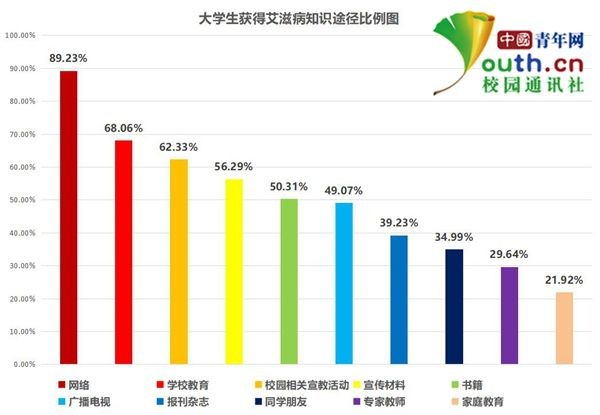
The figure shows the proportion of university students who have access to aids knowledge. Chinese youth network journalist lee wah-sik
Nearly 90 percent of university students have access to the internet
According to a survey conducted by chinese youth network journalists, 89. 23 per cent of the 1606 university students who participated in the survey obtained aids knowledge through the network, followed by school education, school education activities, etc., with 68. 06 per cent and 62. 33 per cent each choosing. It can be seen that most university students have access to aids-related knowledge in a variety of ways, but networks are the most important channel。
Wang ji-hyun, a student at tianjin university of technology, said that he used to have more internet access and that he had learned a lot about aids from television stations and newspapers, including through the creation of a special section on family education to combat aids。
Zhang yi, a junior university student at the north china polytechnic university, believes that there is a great need for university students to learn about aids. “many people, including some, are now talking about the change of aether, who think that shaking hands and hugs with patients and coughing around them can be contagious, which is the area of error due to insufficient knowledge.”
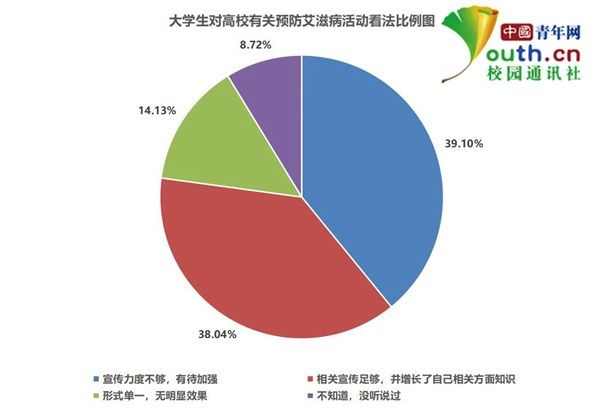
The figure shows the proportion of university students who perceive the activities of higher education institutions related to aids prevention. Chinese youth network journalist lee wah-sik
Nearly 40 per cent believe that school awareness of aids needs to be strengthened
A survey of the chinese youth network showed that nearly 70 per cent of university students learned about aids through school education. So, what do students think about school activities related to aids prevention? According to the survey, 39. 1 per cent of students think that “sensitization is not strong enough and needs to be strengthened”, 38. 04 per cent think that “sensitization is sufficient and has increased their knowledge” and that “single form has no visible effect” and “not known” account for 14. 13 per cent and 8. 72 per cent respectively。
In an interview with a journalist, li lina, a junior student at the school of quixian teacher training, said that “the school will conduct a campaign in small squares with a large flow of people in the cafeteria, which has been very effective, remembering that i also signed the poster and received a ribbon against the apostille”
At the same time, what kind of aids awareness-raising activities have university students been involved in? Survey data show that in-school activities, knowledge lectures and subject-course projects are the main activities of university students in the promotion of aids, with 48. 94 per cent, 46. 2 per cent and 31. 26 per cent, respectively. As can be seen, there is a greater diversity of aids awareness campaigns for students。
Students at changzhou university zhou told journalists that they had been involved in voluntary aids awareness campaigns organized by the schools, and he said that “it would be interesting to have our activities focused on placing banners and banners in all corners of the campus and distributing information leaflets on hiv prevention to fellow students”
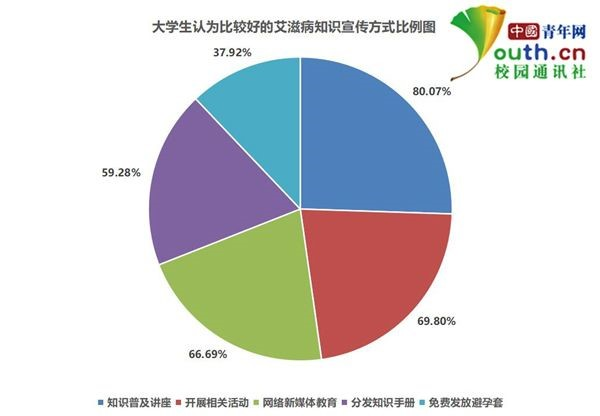
The figure shows the percentage of students who consider aids awareness to be better. Chinese youth network journalist lee wah-sik
More than 80% want to know about hiv prevention and treatment
With regard to aids, what information is available to university students? What do they think is a better way to promote aids? The results of the survey show that 85. 74 per cent of university students want “to know about prevention measures and treatments for aids”, followed by “information about aids” and “new aids-related news reports” about “the current state of life of people living with aids and aids”, with 70. 86 per cent, 63. 2 per cent and 58. 16 per cent of students choosing. As can be seen, most university students want to learn about aids in many ways
In the survey, 80. 07 per cent of university students considered the better way to promote aids to be a “knowledge seminar”, followed by “related activities” and “new media education on the internet”, 69. 8 per cent and 66. 69 per cent respectively。
Tan tsai, a senior student at shandong girls ' college, expressed his desire to learn more about hiv prevention. She told reporters that she knew only that aids could be transmitted through blood and sex, and that other knowledge of aids was not yet clear: “i am most concerned about the symptoms of aids and the ways in which aids is treated”
“the knowledge about aids is simple and not comprehensive.” u sawayan, a student at the university of south-west transport, believes that the better way to communicate aids is to conduct a knowledge-sharing seminar, which would be of great benefit to university students if experts could be invited to conduct a knowledge-sharing seminar and conduct in-depth lectures。
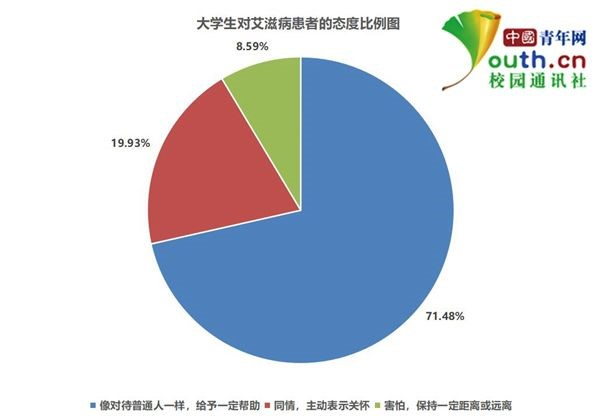
The figure shows the proportion of university students who have attitudes towards aids patients. Chinese youth network journalist lee wah-sik
Over 70 percent of university students are willing to deal with aids patients and help them
So what is the attitude of university students towards aids patients? According to the survey, 71. 48% of university students said that they would “do the same to the average person and give some help”, 19. 93% chose “to show sympathy and take care of themselves” and 8. 59% said “to be afraid, to stay away from them”。
Liu xian, a student at zhejiang university of industry, believes that more attention should be paid to aids patients, that confidence should be given to them and that the courage of their lives should be increased. “i feel that more help should be given to patients in their lives and work, that they know that they have not been left by the community, so that they can face and actively treat them properly.”
Teachers advise schools to conduct regular and permanent awareness campaigns to learn to protect themselves
According to chen ming, a young teacher at the institute of trade and industry, the current level of knowledge of aids among university students is insufficient and less in-depth, and needs to be strengthened in this regard. In addition, there is a greater need for students to learn about hiv prevention and measures to protect themselves。
To this end, chen ming recommended, first, that schools disseminate aids-related knowledge on a regular and long-term basis, not just around world aids day; second, there is an automatic distribution of condoms in schools; thirdly, students must always be taught the right idea of love; fourth, students are encouraged to volunteer, care for aids patients, know their lives, habits, etc.; fifth, students need to strengthen their sense of self-protection and care for themselves。



