


With the rapid development of the greening of urban parks, the greening of construction quality, construction cycle and standard requirements has increased relatively. As a rule, growing green construction needs and daily maintenance cannot be met by spring planting alone. Non-seasonal migration is thus a useful complement。
In the early autumn winter, which is the golden season in which leaves are planted, trees and bushes are also more suitable for planting. Autumn transplants are generally selected during periods of slow flow of tree fluids, the best time being from the fall of leaves to the early winter of the early autumn before the soil is frozen. In addition to normal cropping practices, a range of technical measures are required to improve survival rates。
Tree selection
1. Tree habits:
Among the easy-to-living trees are trees such as yang, willow, faki, guang, white wax, zhuang, zhubai, taifa, jeong mae, violet lee, and the west pond, and flowers and shrubs。
The hard-to-live seedlings are saplings, dragons, black pines, cedars, doubles, sidebrushes, etc., and small shrubs。
Principles of selection:
The choice is to select trees that are robust, well-developed, disease-free and that meet the specifications of the engineering design. The trunks of the trees shall be straight and unbridled, the branches shall be evenly distributed, the trees shall look beautiful and the bark shall be coloured in green enough water. For example, platinum, platinum, white wax, preferably between 8 and 15 cm, are the most resistant to transplantation of trees at altitudes of 2. 6 to 3. 8 m。
For the selection of the permanent green tree species, the spring tree should be selected as the tree that has ceased to grow and that has not sprouts twice. In the case of fake seedlings, which cannot be transplanted in that year, it is necessary to grow for one year before the transplantation takes place to ensure the growth and development of the root system and the integrity of the earth ball during the transplant。
For transplantation, it is advisable to use transplantation in nurseries for more than three years, with a high rate of survival。
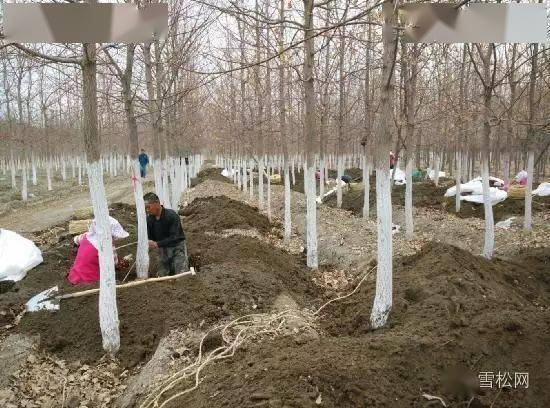
Replant program
1. Tree selection:
A strong, tree-shaped tree should be chosen。
Under the same conditions, trees with short trees have higher rates of activity than large trees, smaller leaves have higher rates of activity than large leaves, and soft leaves have higher rates of activity than hard leaves。
2. Material:
In recent years, there has been a very rich supply of products from various types of trees, such as anti-vapours, root powder, root fluids, embalmed wounds, needles for large trees, eugenics for large leaves, root rotors, etc. It can be used on a case-by-case basis during planting. This depends mainly on the land conditions in which the trees are planted and on the types of tree shapes。
Three, trim:
Total coronal transplantation: one half of the branches were cut in the same year, and the appropriate cut was cut。
Semi-capacitation: ensure whole tree structure. All branches above 3 cm are left or appropriately short。
Dry-dry transplants: only main or a few large branches。
Anti-season tree transplants need to be increased, trimmed, less evaporation and maintain a balance of underground and underground tree positions。
The leaves fallows can be trimmed by one half; the trees of needles are mainly estranged by branches, which can be trimmed by one third; the trees of trees that are often green as large leaves are chaste leaves, which are shrunk with a coronary cut, and the branches of the coronal are duly trimmed; the corsets of trees are often made according to the requirements of their form, and are generally not trimmed; and the flowers bushes are trimmed by corsets and foliage。
For large trees with more than 20 centimetres of chest size, a week before transplantation, the nutrients are poured into the canopy projection area to allow the plant before its roots to fully absorb nutrients to compensate for the adverse effects of inhalation after the break-up and effective neonate root delay。
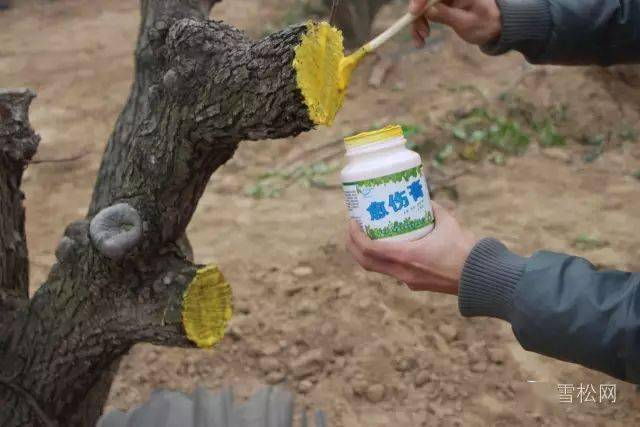
Protection measures, such as wound smears, should be used to prevent excessive run-off of water and to speed up the healing of wounds after dry trim。
Four, tree up
Take care to select skilled teams for seeding。
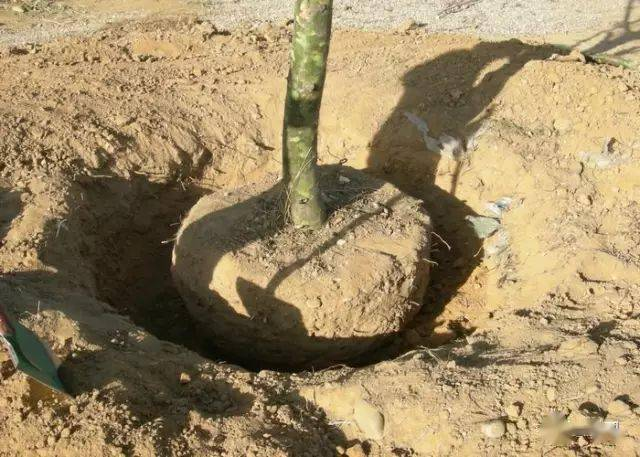
It would be preferable to carry earth globe transplants, reduce damage and reduce nutrient consumption. During a bare root transplant, the bark of the tree cannot be fractured, the root line should be flat-cut and not torn apart, and the length of the root line at the transplant is generally 10 to 12 times the length of the stem diameter of the tree base。
Three days before the excavation, anti-evaporation agents were sprayed from beneath the tree, the earthforms should be more than 10 times the size of the chest during the excavation, tied with grass ropes, and the trees were placed flat and then sprayed downwards from the tree top. This is because the main component of the anti-vapour agent is high-molecular polypropyleneamine, which preserves water while temporarily blocking large gas holes on the back of broad leaves, thus preventing evaporation and loss of moisture. In the course of these measures, heavy spraying is required in the event of rain within three days. This treatment does not normally cover up the sunnet. During the excavation process, the width and depth form the proportional shape of the apple ring, especially with regard to the application of shovels to the upper part of the ground to the upper part of the ground, which makes it less likely that the earth ball will be crushed when loaded。
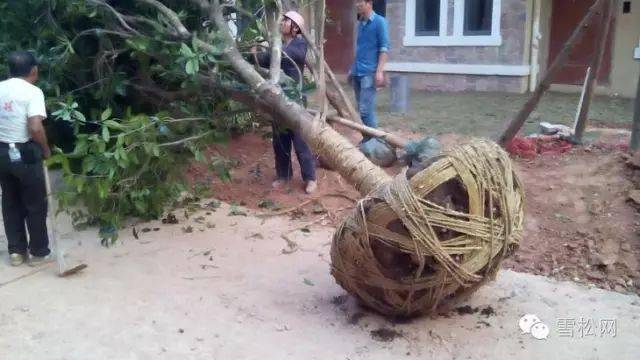
5. Packaging
In general, grass ropes are used to wrap earthballs, tree crowns, etc. In exceptional cases, trunks of trees with a chest size of 15 to 30 centimetres or more and large trees with sandy soils are transplanted in wooden boxes。
6. Transport
It is best to use cranes for loading and unloading, to use professional straps and not to replace them with big ropes, to prevent injury to trees, branches, earthballs, etc. The transport time is kept to a minimum in order to prevent loss of moisture, and more than 12 hours are required to spray and wet the trees. From the beginning of the excavation, the transfer time should be as short as possible from the tree to the planting, and no more than 48 hours。
Seven
Before planting, you have to choose the positive nature of the tree, plant it with the fertilizer and then refill it, then plant it and then support it, water it and seal it. After planting, the soil surface does not exceed the original root level of 5-200 px. The backfill should be filled as much as possible, and the water should be watered and isolated from the mud ball. If the mud ball surface is so dense, it should be pumped out and the thinner grasslines can be preserved. In any event, the packaging or entanglement of the piece of dirt should, in principle, be removed during the completion of the planting. The failure to remove grasslines or packages is a condition that affects the survival of trees。
Post-plant conservation management
In post-plant conservation, fresh trees must be ploughed three times during the winter season, to be grown in a manner that provides proper support, soil and water, ensures that the pits are sealed and reduces the loss of water on the roots of the trees. The day after the planting, the cracks that were created by the root system at the time of the first watering were filled with soil, ploughed and watered to prevent leakage of the roots; the water was poured around a week later, the pits were again sealed to prevent freezing。
At the same time, a number of anti-frozen measures are required, such as entanglement of trunks with grass ropes, packaging of thin membranes or binding of tree wrapping bands. For flower shrubs, balls, such as violet, red leaf, bonnet, etc., they are covered with straw curtains, and for cold-tolerant tree species, such as cedars, wind barrier protection is required。
Particular attention is paid to the fact that trees transplanted in the fall require fertilization in the following summer. The support is normally removed after a year of transplantation. When the tree is alive, it is able to remove the extra sprouts of the main pole and gradually develop the tree shape, which is to be done two years after the tree is planted。



