Failure one: the whole machine is silent, the rest is normal
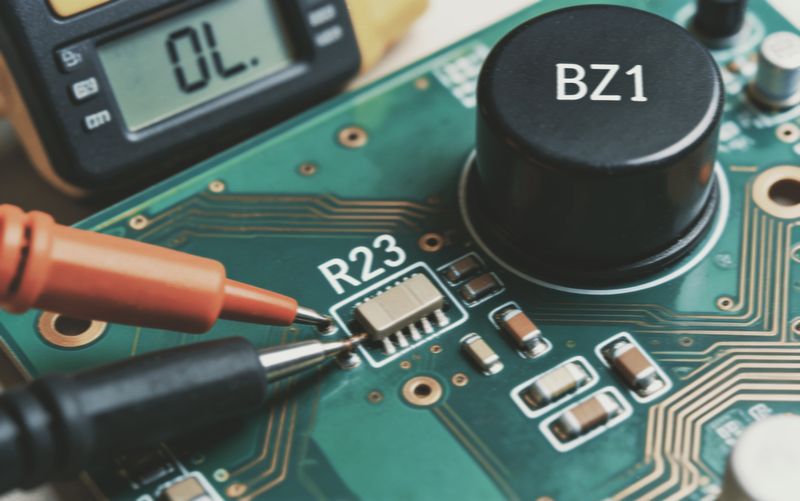
• malfunction maintenance: this failure is usually caused by the break-up of electrical resistance r23 on the master plate。
R23 is in the alert signal-driven magnifying circuit, and once the circuit is opened, the beeper-driven electric current is cut off, resulting in the alarm silence。
The alarm function can be restored with the replacement of the same-specified electrical resistance (note the coloured ring marking, typically hundreds of euros to thousands of euros)。
• method of overhaul: priority should be given to measuring both ends of the r23 barrier (normally close to nominal values and endless break-ups). At the same time, it is recommended that the triode or the ic output end, and the beeper bz1 itself, be followed by detection. In the event of damage to r22 (restricted current resistance) or bz1 (pressure beeping film), which also causes silent malfunctions, the bz1 poles can be lightly touched with a tensile surface block (rx1k) and a weak “sing” sound should normally be heard and the silence replaced。
Fault ii: water intake, washing process is normal, but can not be drained after washing
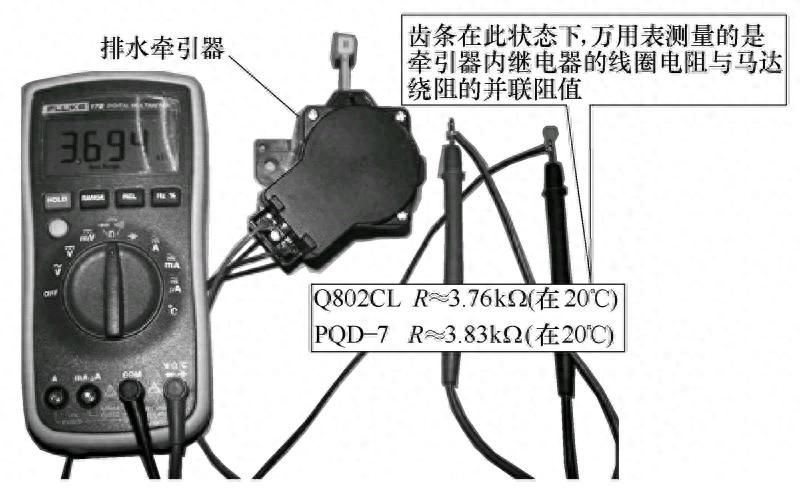
• failure maintenance: the underlying causes are mostly small step-in motor loops within the drainage tractor. The walk-in machine is controlled by a computer plate, which reverses the pulse-drive body to pull the drain valve. When the wire is cut off, the tractor does not move and the drain valve cannot be opened. The replacement of a step-by-step generator of the same type (with attention to leg definition and work voltage) will remove the malfunction。
• method of detection: during the overhaul, a manual check is made to see if the drain valve pole is stuck — the pole should be free to resume (the bullet returns to its original position) under normal power outage. Non-drainage may also occur when the pole is stuck to death or when alien objects (coins, buttons, wire chips, etc.) are inside the drain valve, at which point the core of the valve or the drain pipe is removed. When the mechanical component is confirmed to be normal, the tractor is cut off, and the direct current resistance of two sets of circuits of the electric walker (common resistance of tens to more than 100 euros) is measured using a mass-utilized surface block, and if any of the circuits appears to be extensive, the circuit is determined to open and the tractor is replaced by a total or step-in。
Break three: when it's turned on, the whole machine is shown, but it can't get into the laundry
• malfunction maintenance: mostly due to a severe failure or deterioration of the capacity of the electric motors to initiate the electrical capacity. Commencing the capacitor (usually oil immersion or cbb type) with the ageing of the medium internal medium in its long-term use, resulting in an increase or decrease in the insulation of the equivalent chain of electrical resistance, which does not allow the generator to obtain sufficient transfer triggers. The failure can be resolved by replacing the same capacity (within 5% of the error) and holding at no less than the original specifications。
• test method: power discharge (short-duration resistance) must be done before detection of the capacitor. Use of table rx1k or rx10k for a pointer, with a clear swing and a gradual roll back to the infinity of the measuring time point (the greater the capacity swings slowly), if the pointer is tilted to a very small or straight pointer (the barrier is close to zero), indicating that the cap has failed or the leak has been punctuated. More precisely measured by the capacitor table, the actual capacity should be not less than 5 per cent of the nominal value. If the electrical capacity is normal, it is also necessary to check whether the motor transfer belt is loose and smooth (which can be adjusted for a tight wheel) and whether the coding face of the clutch has been severely worn or carcasses, which also results in the emptying of the power but not the wheel。
Battery four: signal lights on when power is out, but the motor is completely static
Fault maintenance: this phenomenon is often caused by the deterioration of resistance r25 in load-driven circuits (higher or open). R25 as a two-way transistor (vs2, vs4) door pole triggers a limited-flow electrical resistance, which, if it fails, does not reach the pulse and the electrical circuits do not have electricity. Replacing r25 with the resistance power (commonly 1/4w or 1/2w metallic membrane resistance) should allow the power to be activated normally。
• test methods: the focus of the overhaul should be on the load-driven circuit area. R25-end electrical resistance is measured on a single scale and is replaced directly if there is a clear deviation from the nominal or infinity. At the same time, it is recommended to conduct a full screening of the relevant meta-systems: two-way crystal tube vs2 (reverse control), vs4, absorption protection component c7, c9, c16, c13, current resistor r24, r21, r37, driver triode vt10, and filter capacitive c5 etc. Damage to either of the above-mentioned devices (e. G., cross-barrel penetration/disconnection, leaks in conceiving, triple-pole penetration) may result in the initiation of an unusual signal or a unstable power supply, leading to the non-turning of the power. It is recommended that a “sub-exclusion” be used to measure the availability of municipal voltage between the main electrodes of the transistor, and then the activation of pulses at the door poles (with a tensile direct flow of voltage slot to detect a weak jump)。
Battery 5: power voltage is normal, but alerts are sent as soon as the power goes off (without pressing the start-up button)
• failed maintenance: mostly due to the poor performance of the diode vd14 (reverse leakage or puncture) in over-pressure/unpressure protected detection circuits. Vd14 is usually used for current sampling exchange voltages, and its anomalies send the wrong voltage signal to microprocessor ic1 and trigger protective alarms. The same type of diode (e. G. 1n4148 or 1407 series) can be replaced。
• methods of detection: high- and low-voltage protected circuits, especially the 12-foot voltage of the microprocessor ic1 should be inspected with a focus on deviation from normal range (stable direct flow reference voltage, approximately 2. 5 to 3. 3 v when normally on standby). In the case of 12 foot voltage abnormalities, check in turn whether the fractional resistance r35, r36 is variable, whether the filter caps c11, c22, c23 are leaking, whether the steady diode vd13 is piercing, and whether the pressure-sensitive resistance znr1 (overpressure protection) is short or leaking. Any damage to any of these components may result in detection of a leveling error that triggers an electrical alert. It is recommended that the znr1 be cut off for a second and that if the alarm is lost, the pressure-sensitive electrical resistance is rendered ineffective。
Fx6: once the power is connected and the "start" key is pressed, the alarm is activated soon, showing the "e9" malfunction code on the screen
• failed maintenance: this failure results from the opening of resistance r16 (usually 100k-5w high power resistance) on a weigh signal detection circuit. R16 the opening of the r16 string in the weigh sensor (or current sampling) circuit will result in the microprocessor not being able to sense the load of clothing and the system determines that the abnormal report "e9" is "e9". Replacement of a 100-k-time resistance with a rated power of not less than 5 w (recommended to use circuits or metallic membrane oxidation)。
• detection methods: the most effective method for overhauling “e9” is to disconnect the electrical control line (to remove grey and blue plugs on the circuit board that control the operation of the electrical device) and then to measure the a and b test points on the circuit board (i. E., welding at the r16 end). R16 is confirmed to be on the road if both needles are not distorted (the barrier is overwhelming). If the r16 barrier is normal, further checks are required on whether the vd18 (whole-stream diodes) and the photolytic pc1 (photo-electric coupling) are damaged - also the failure of the internal lighting tube or the light-sensitization tube would render the weighing signal untransmitted. In addition, it should be verified whether the sensor link beams are poorly exposed and whether the magnetic ring/hort elements at the lower end of the wheel are dirty, which may indirectly lead to “e9” misstatements。
Recommendations for integrated maintenance:
• the power supply must be disconnected prior to overhaul and the filtering capacitors (especially large electrolytic capacitors) should be discharged to prevent electrical exposure。
When replacing components, select alternatives that are as uniform as possible in their prototype or parameters (retardation, power, resistance, containment dimensions)。
• in the case of multiple device chain damage (e. G., lightning or voltage surge), the entire power supply and the driving part should be systematically detected to avoid being burned again after replacing a single component。
:: functional testing after maintenance, including empty operation, water washing, drainage, dehydration and alarm alerts, to ensure normal operation。